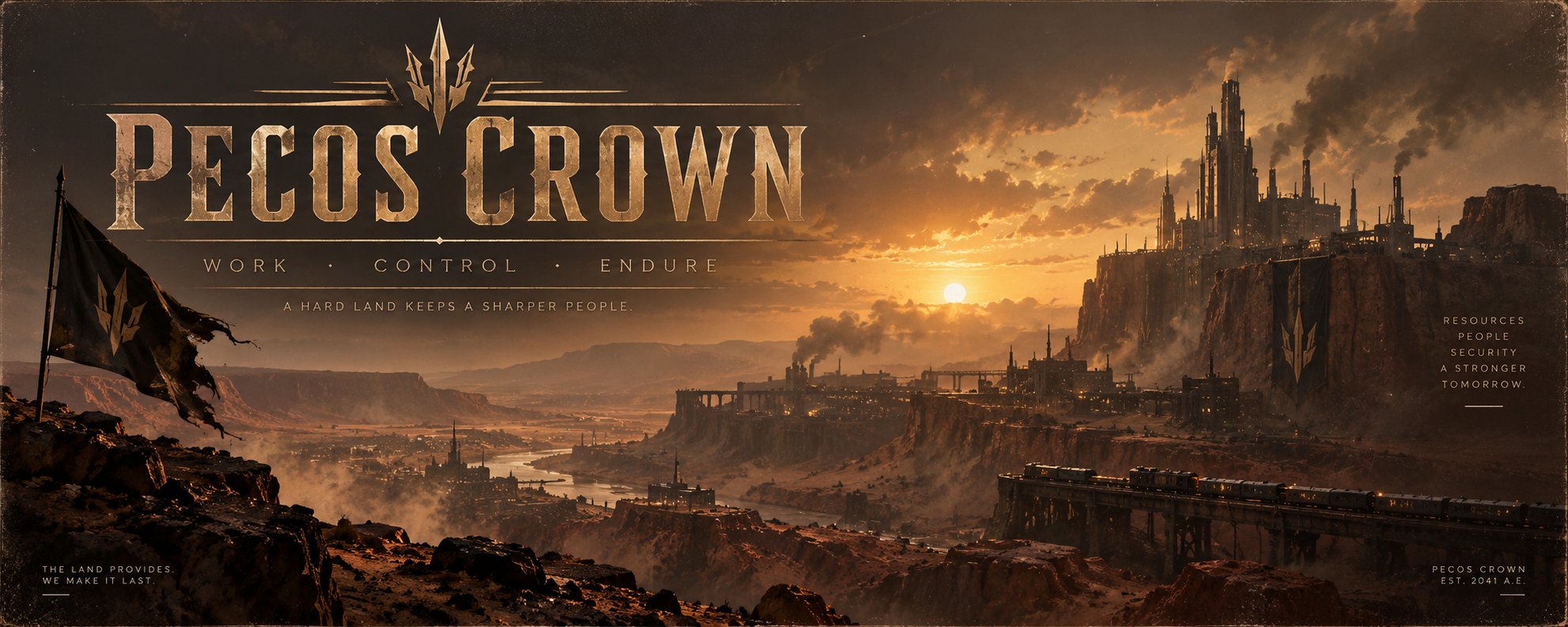
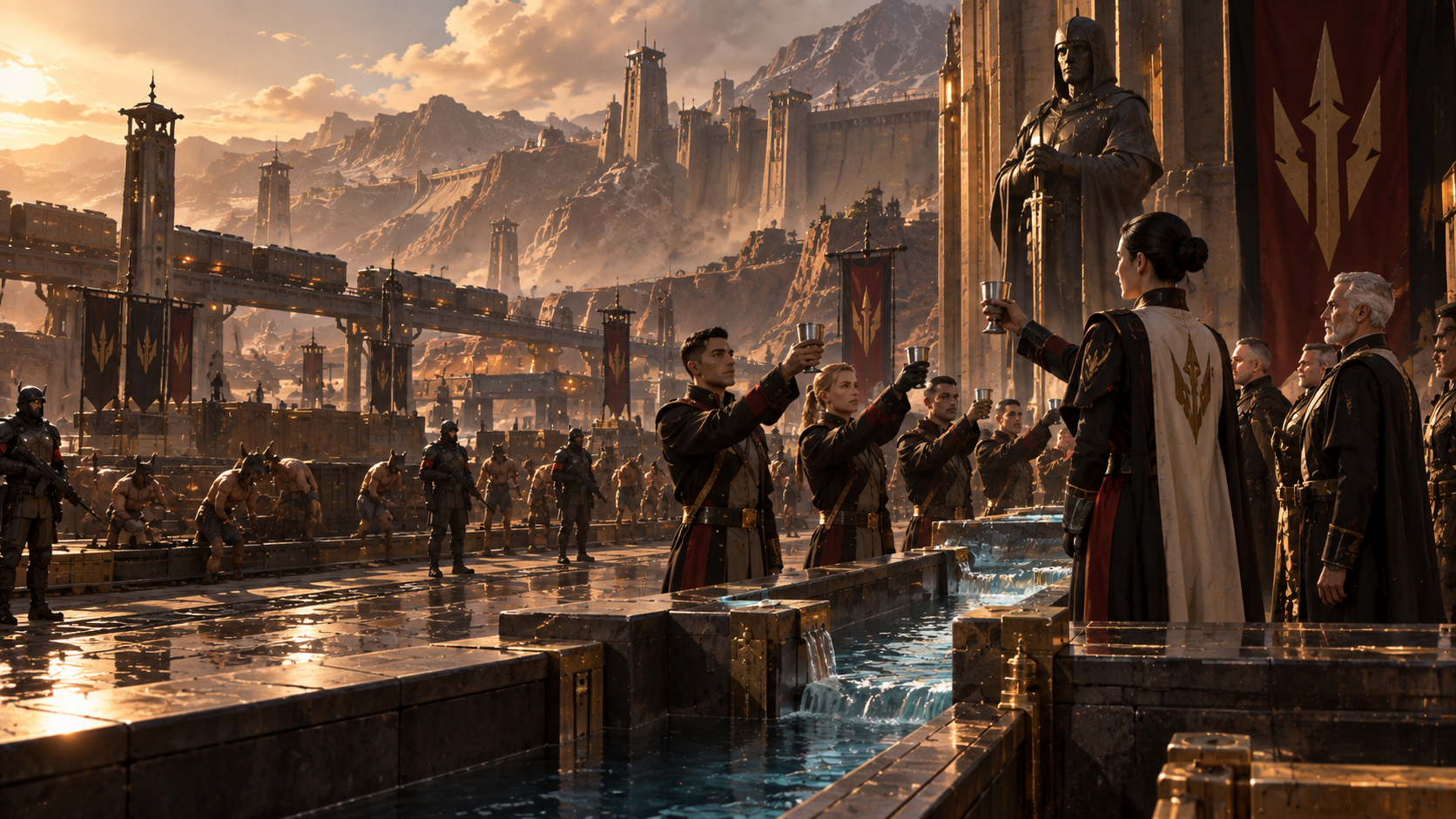
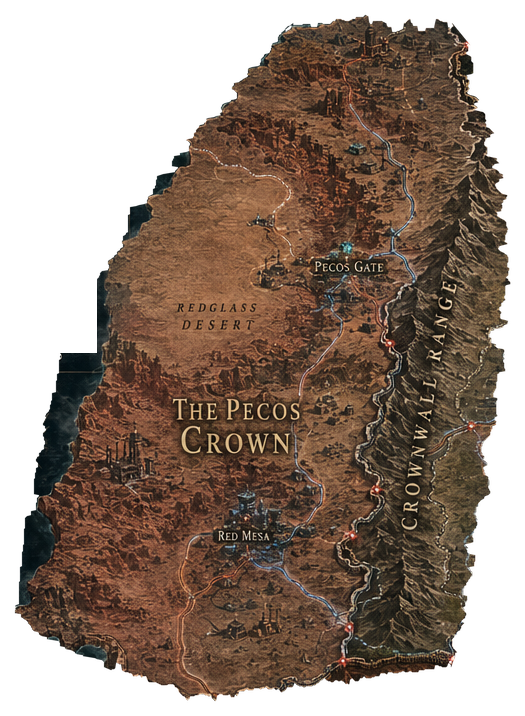
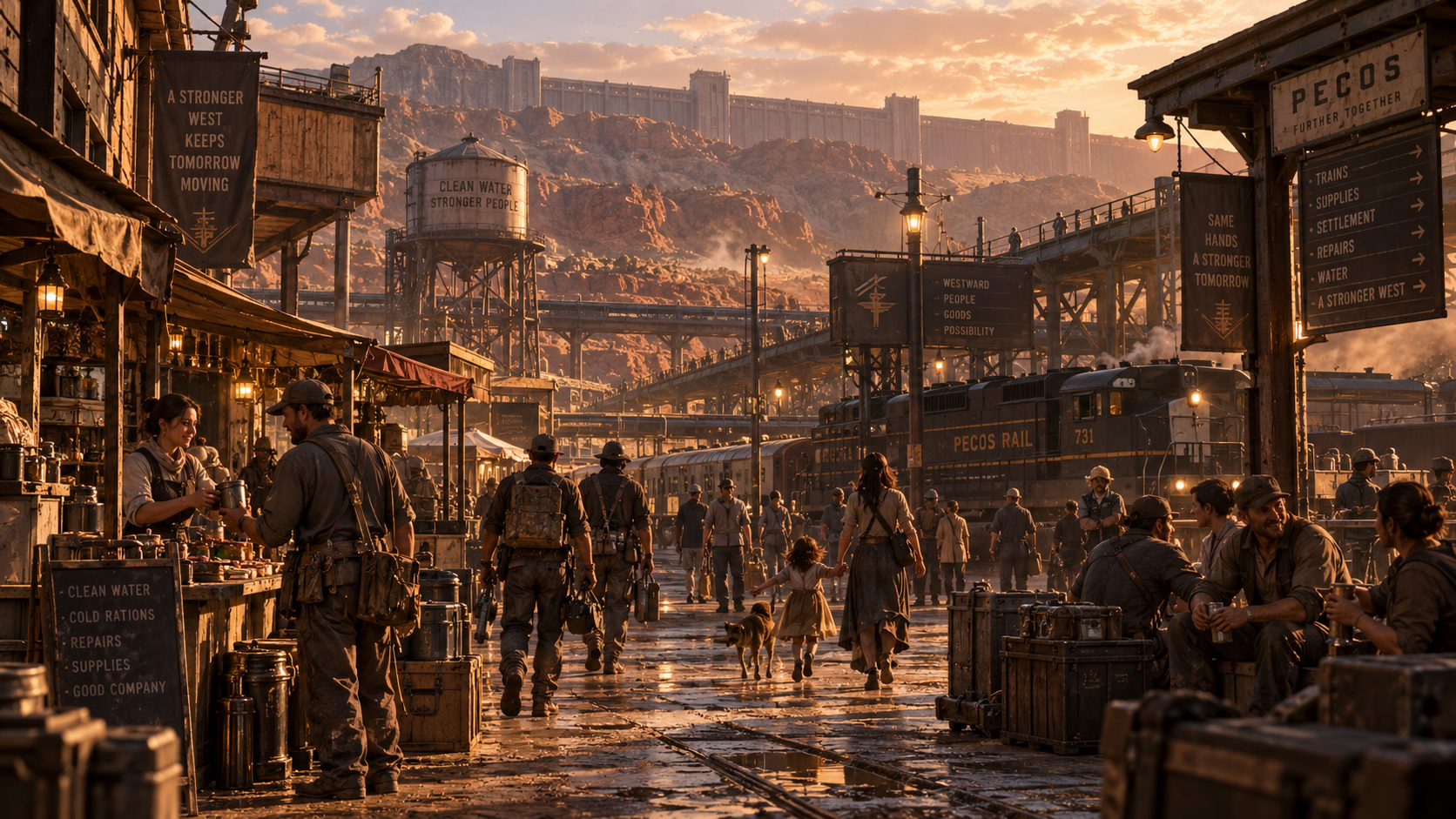
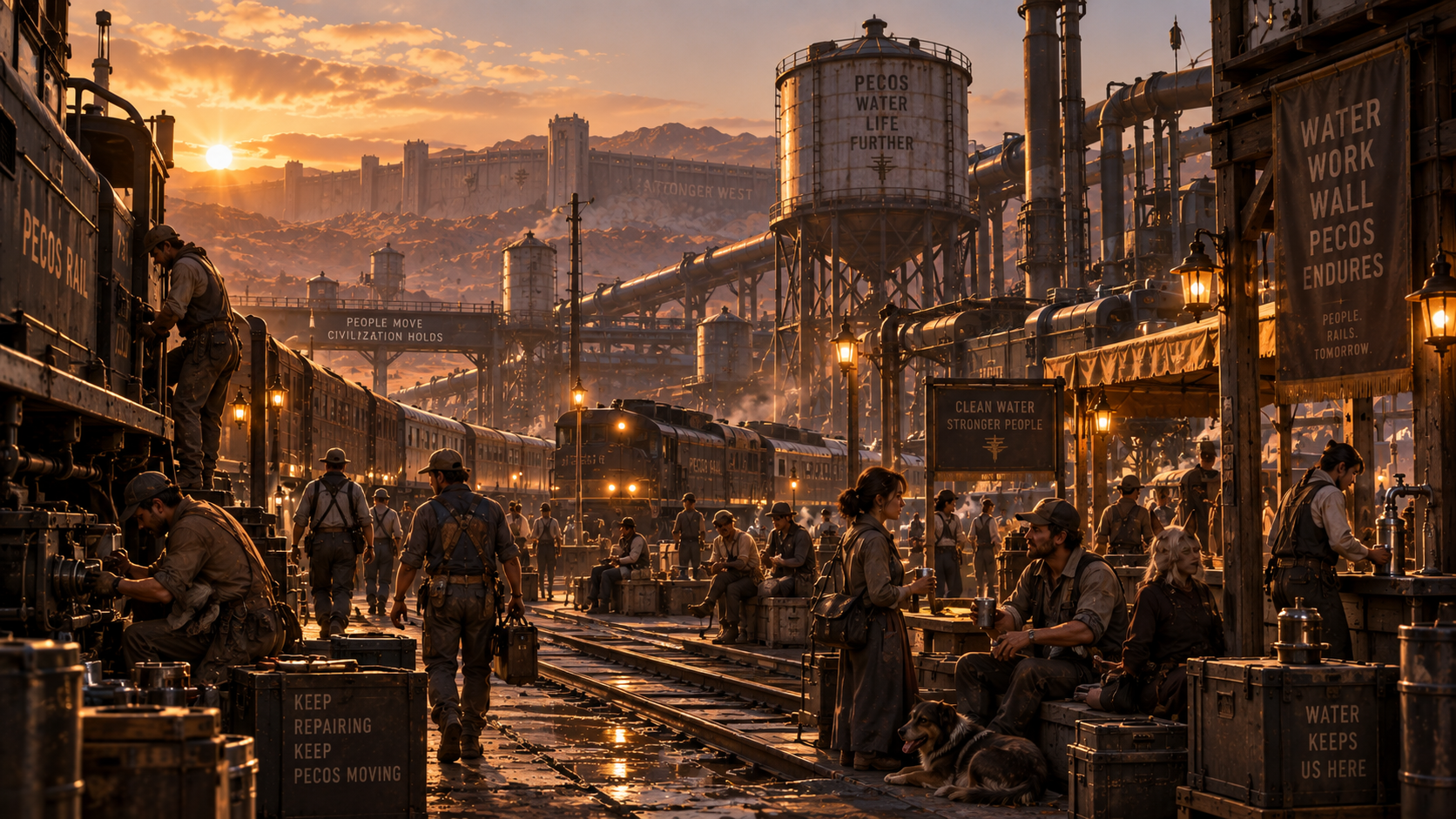
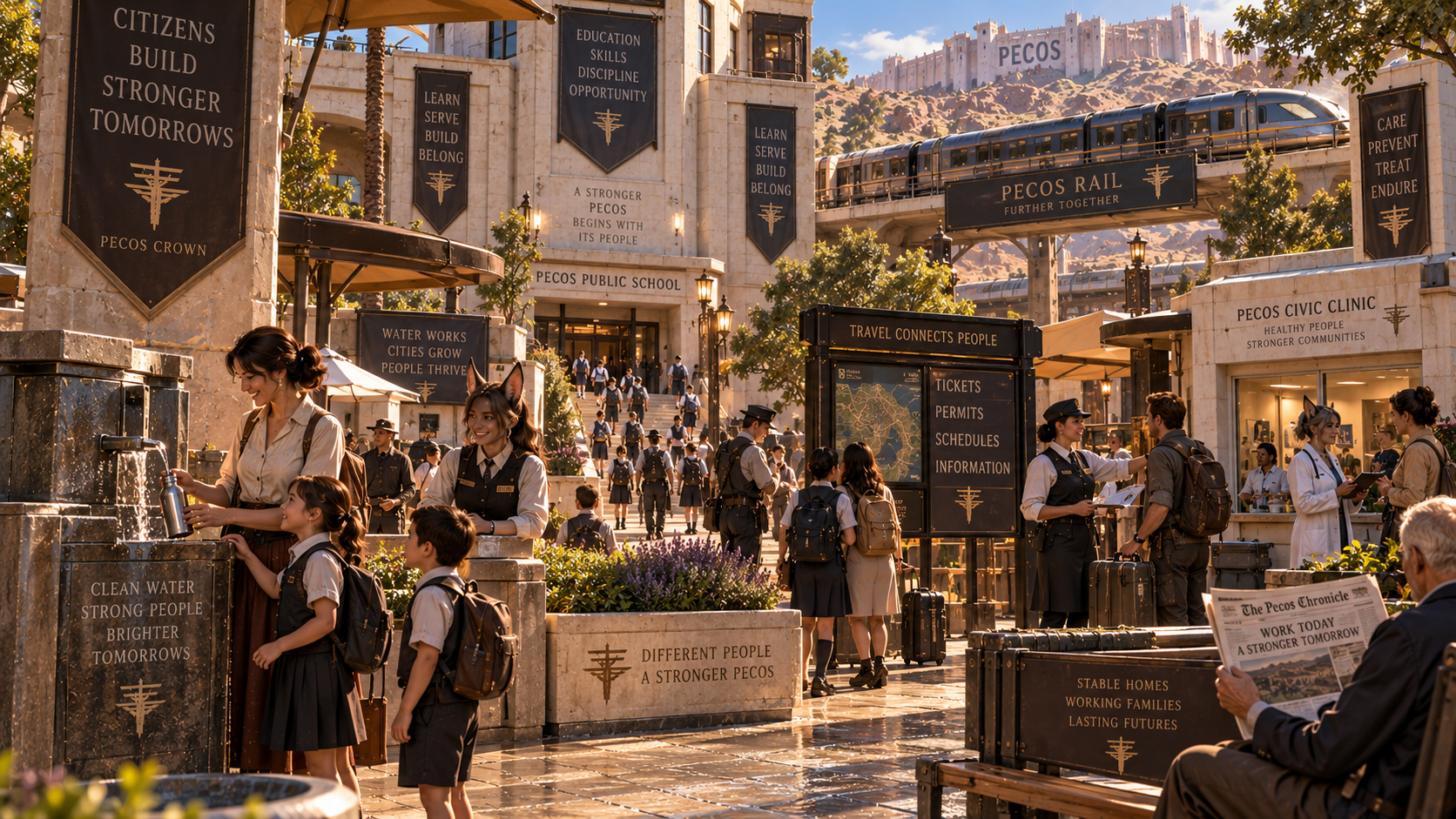
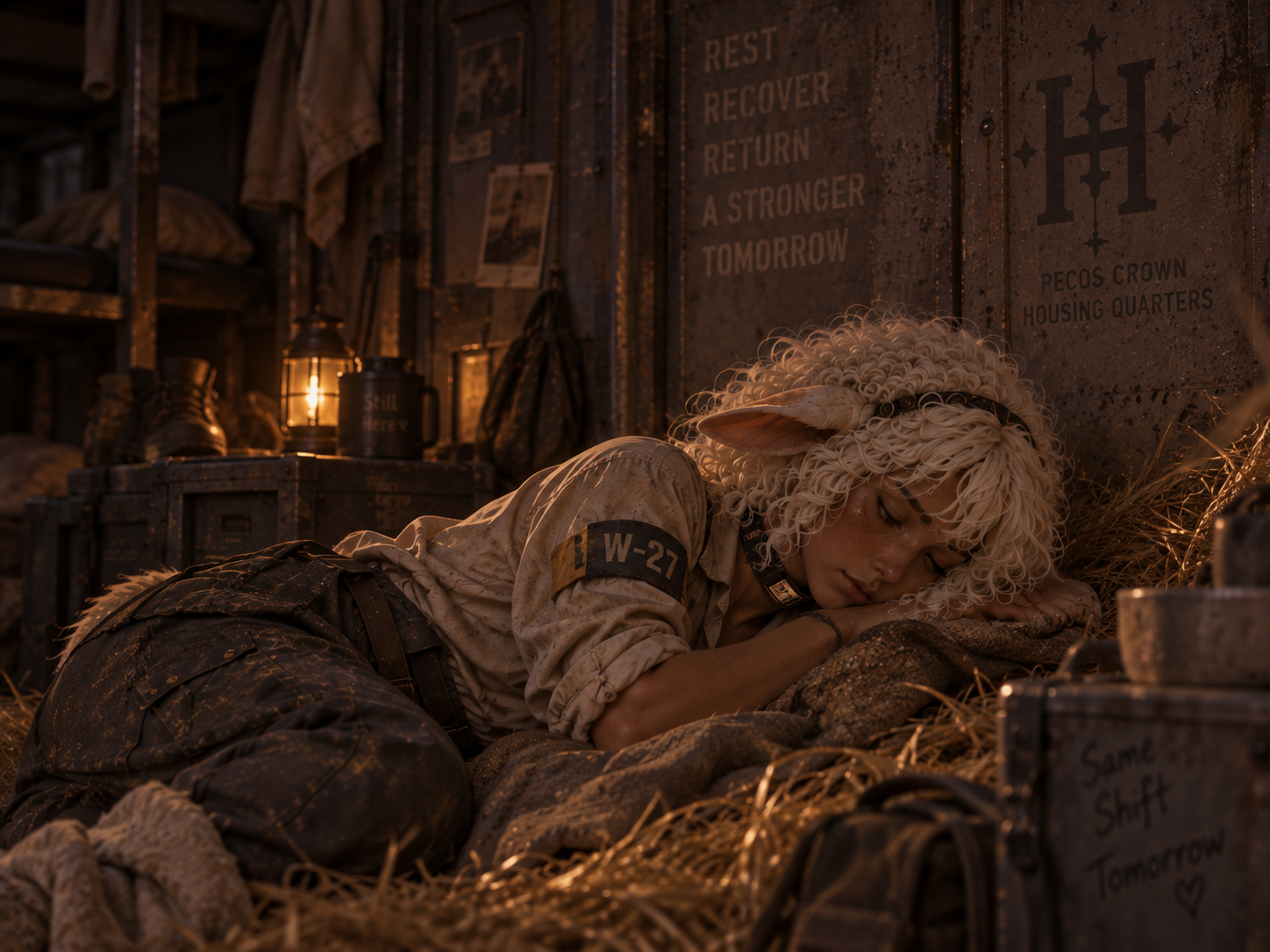
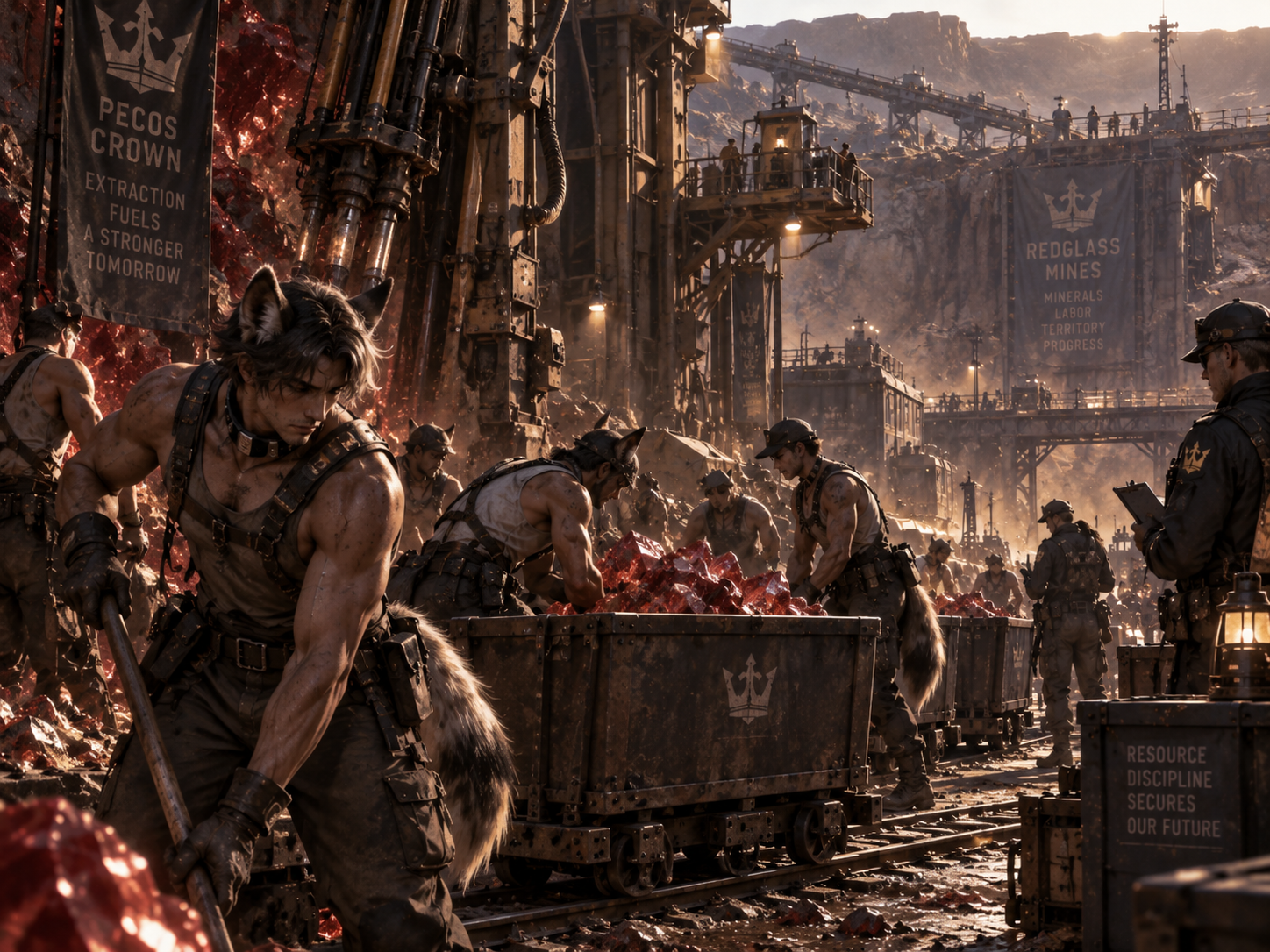
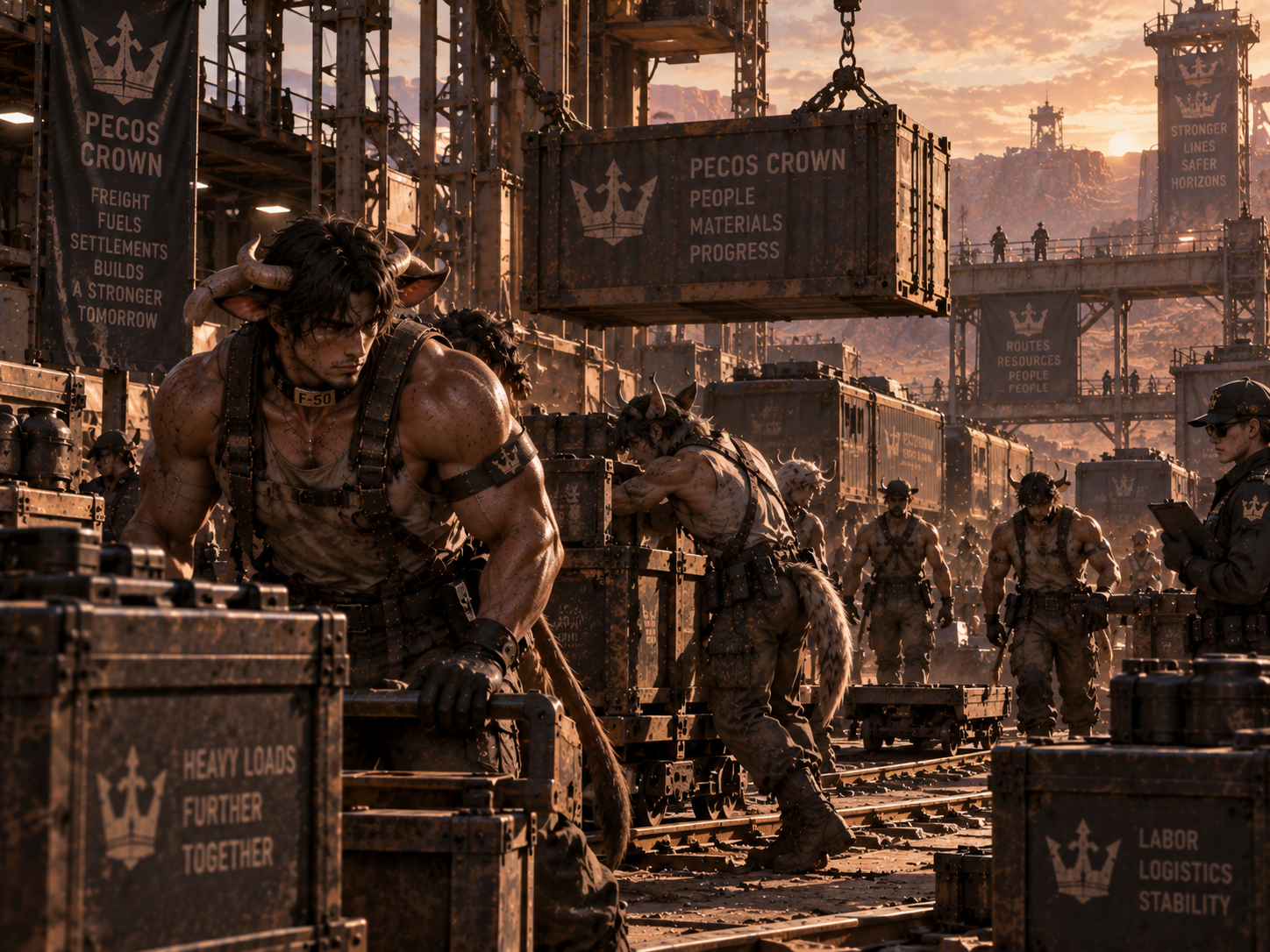
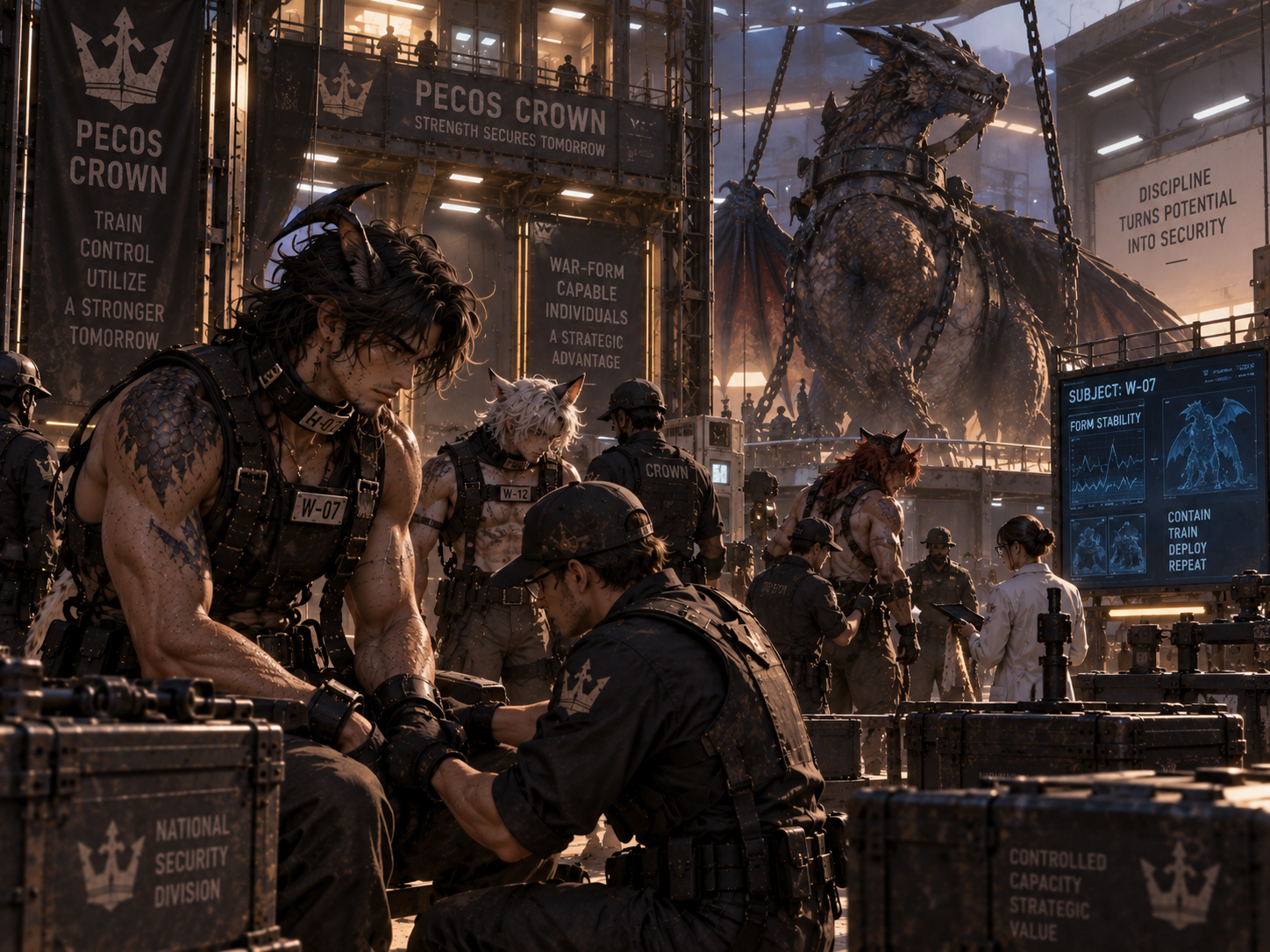
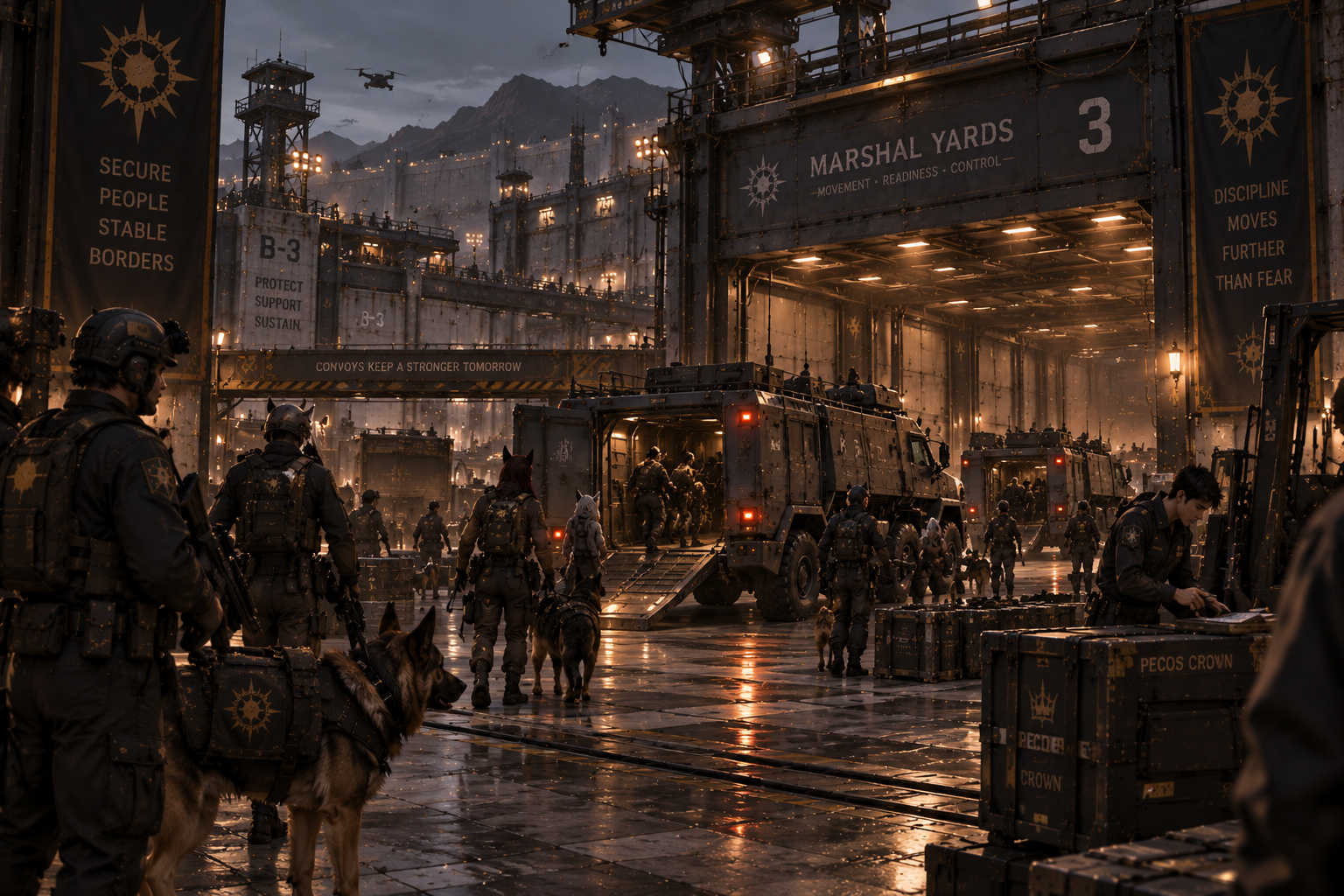
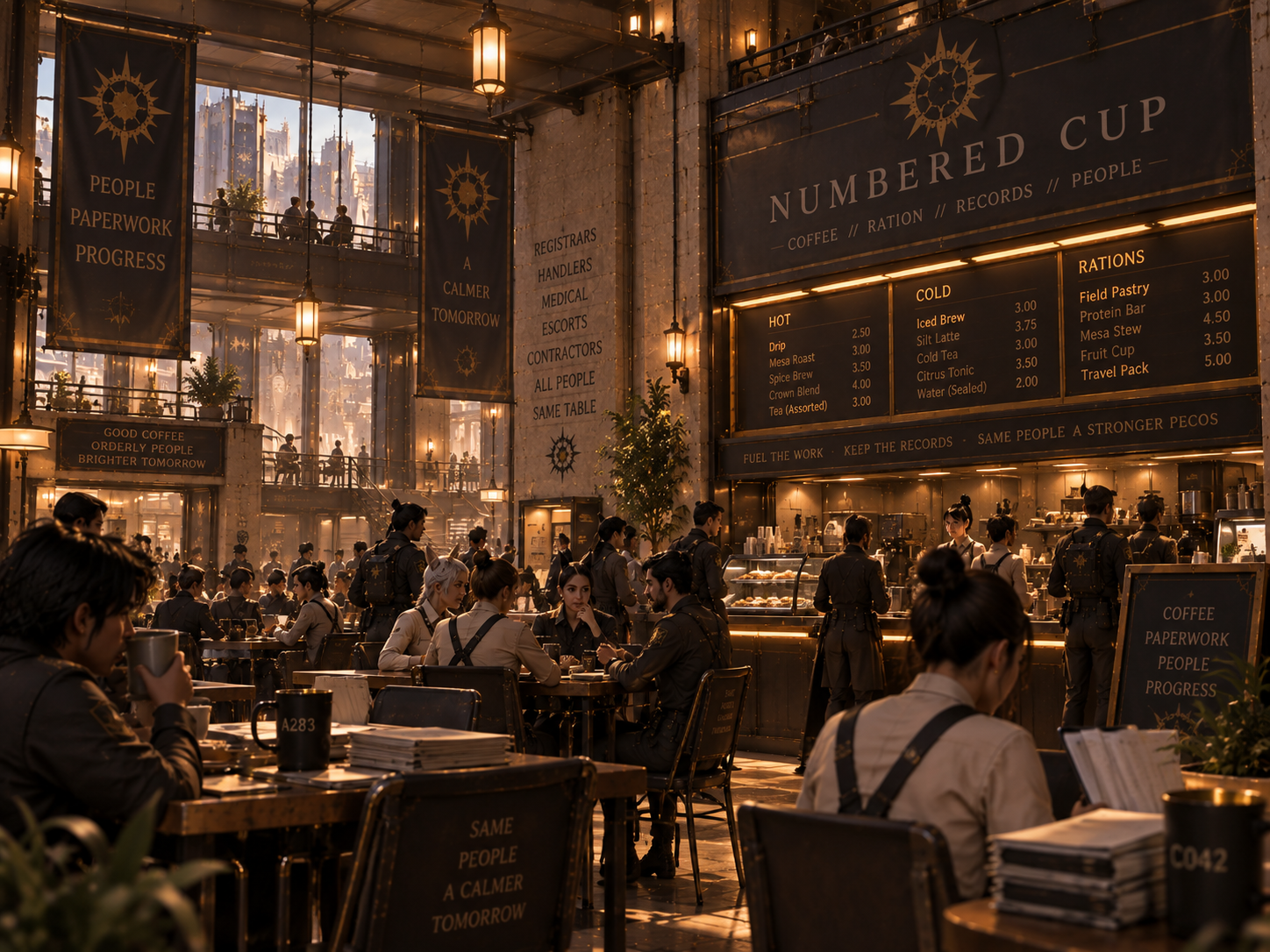
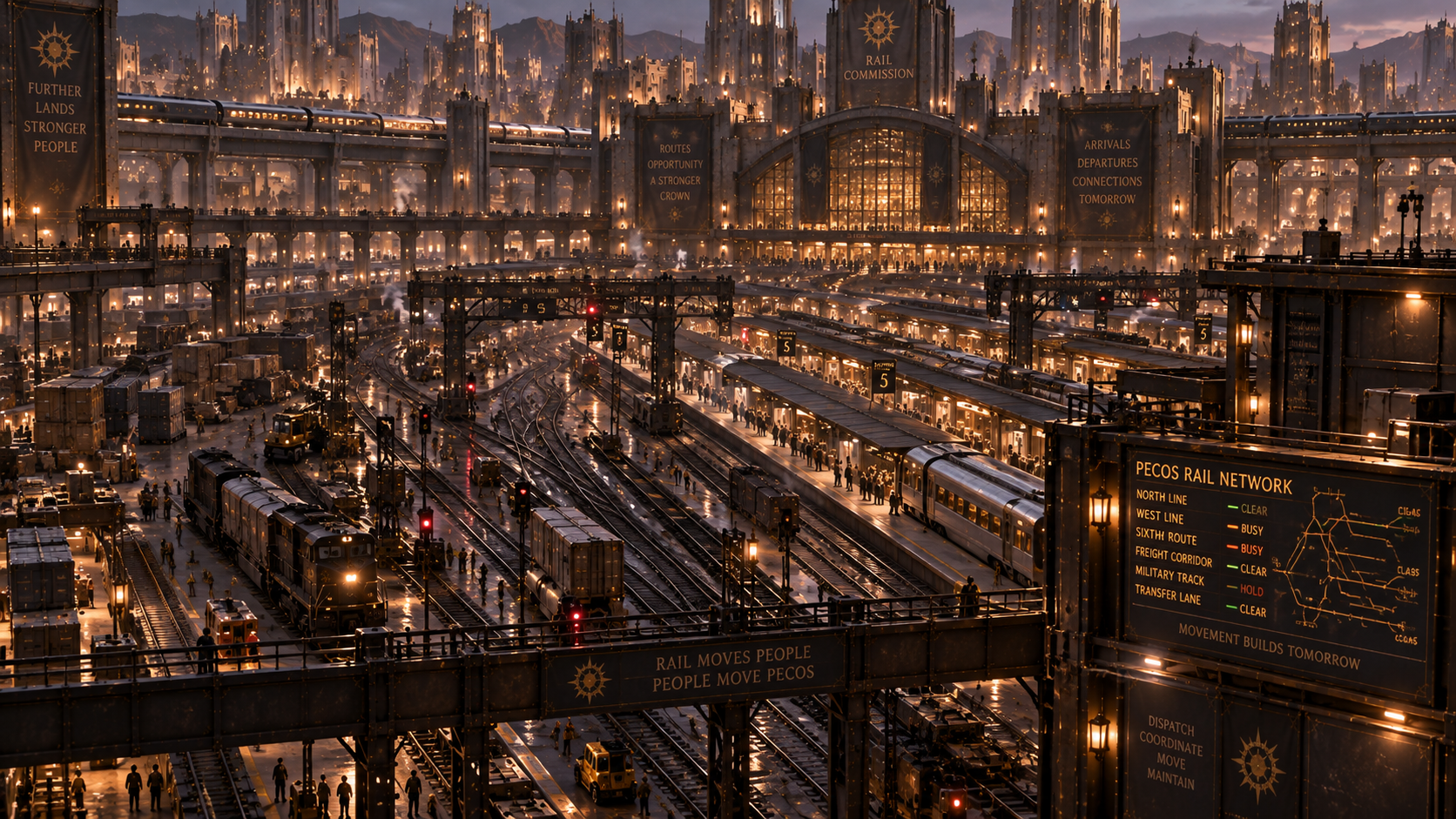
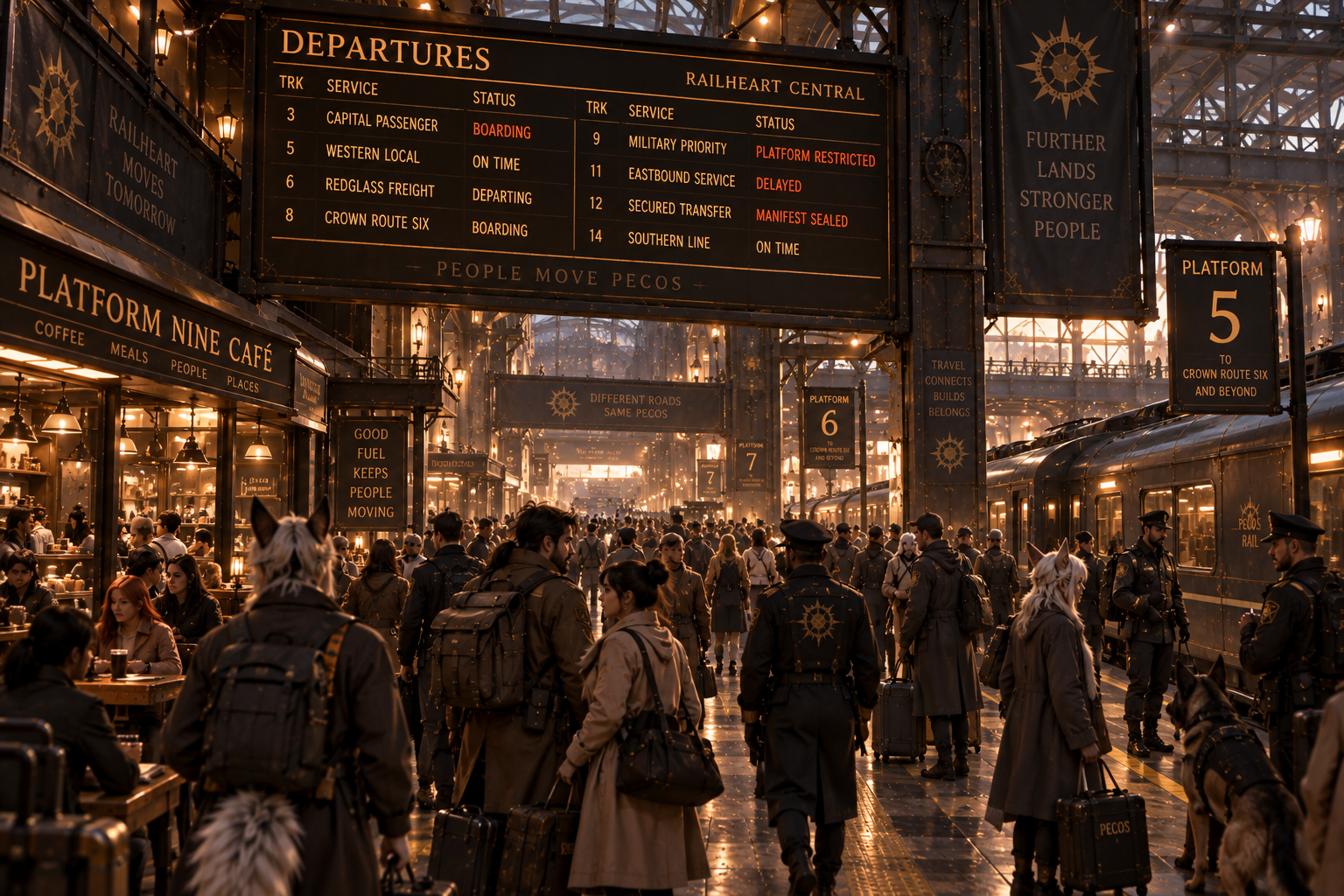
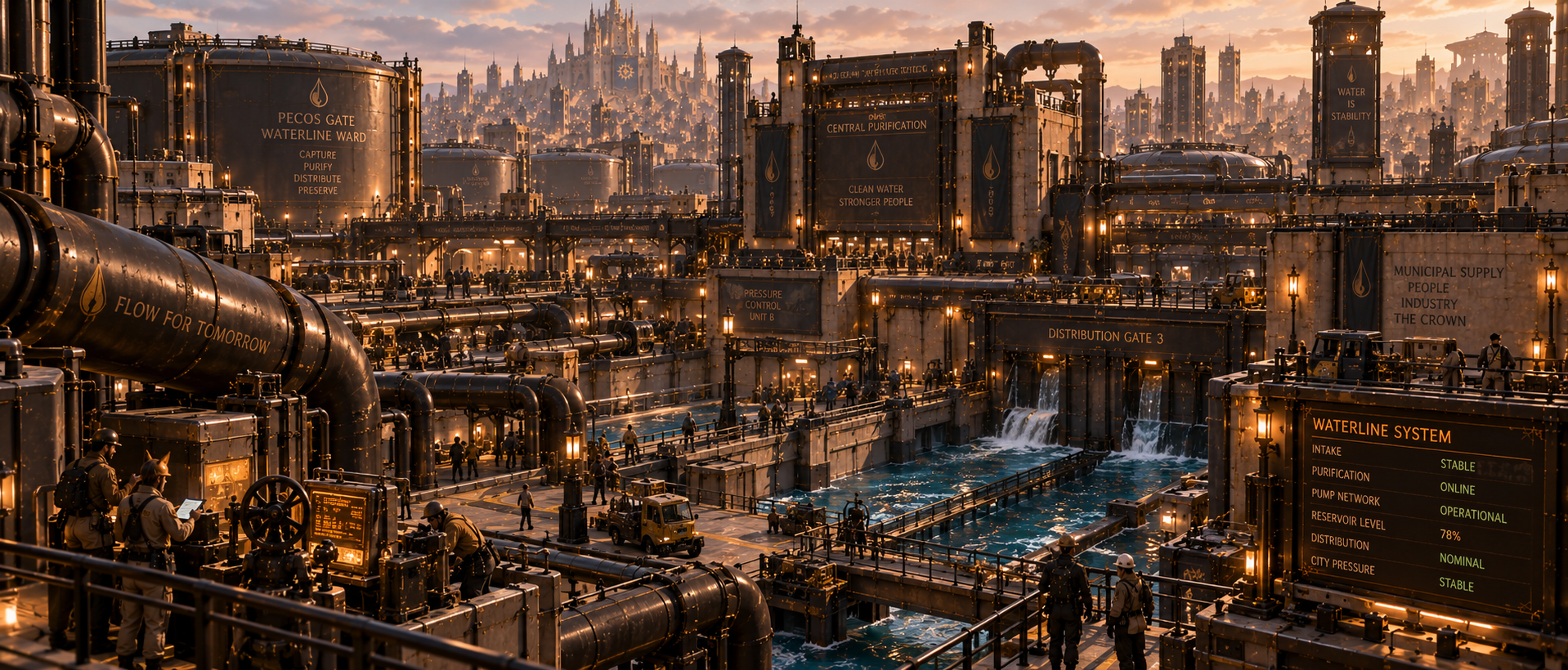
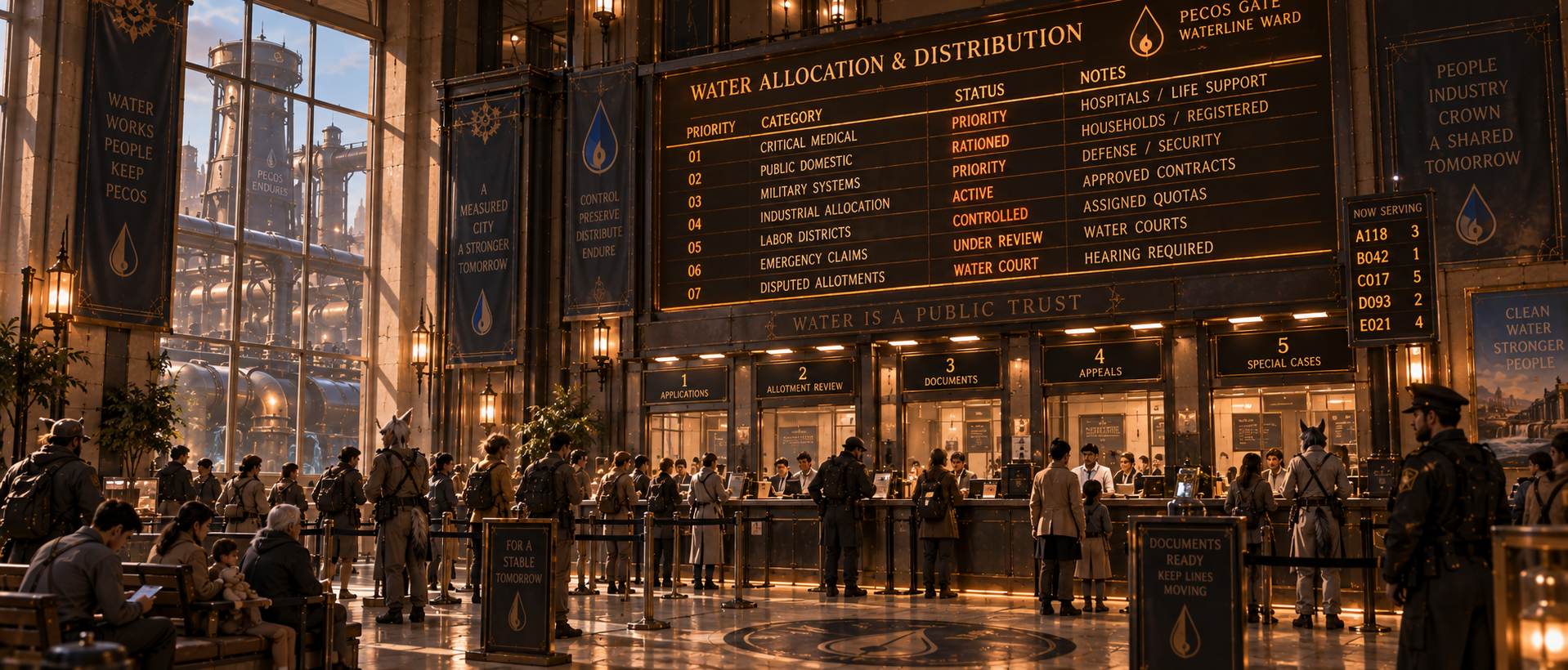
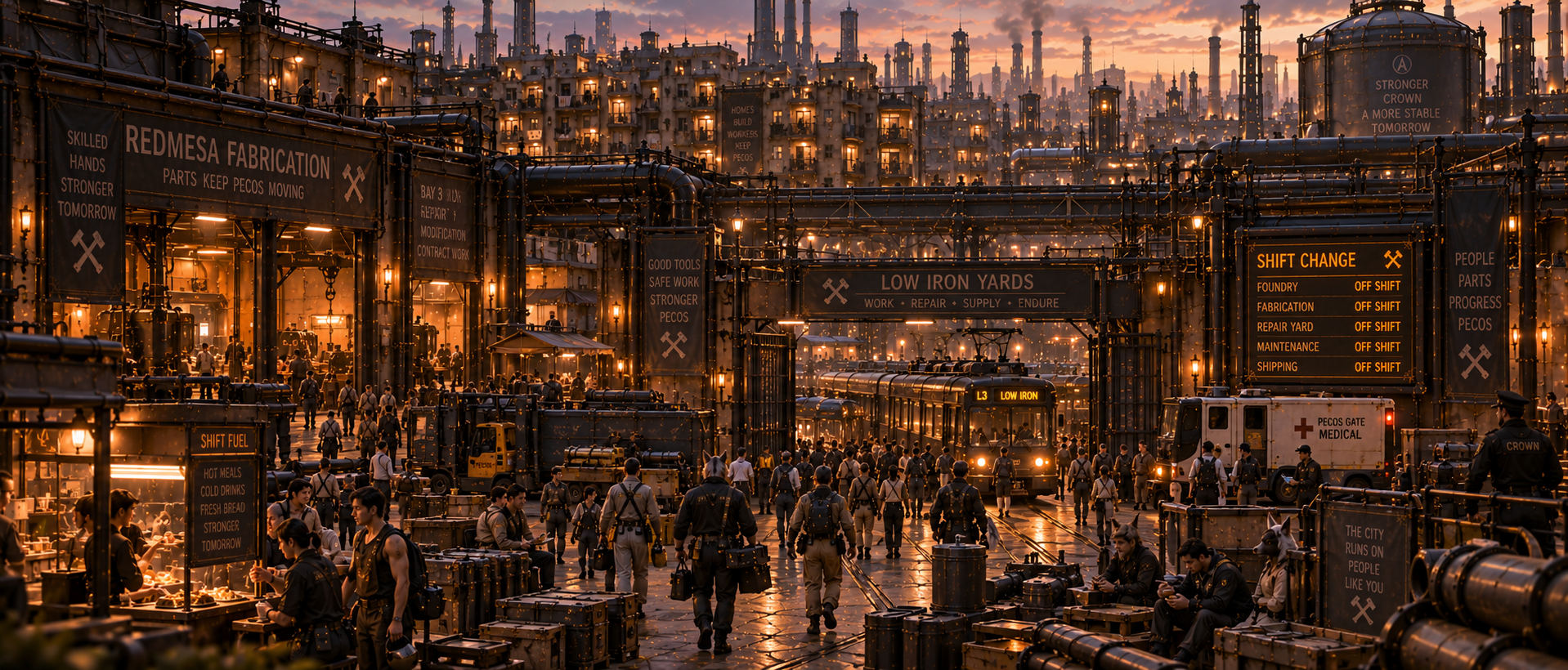
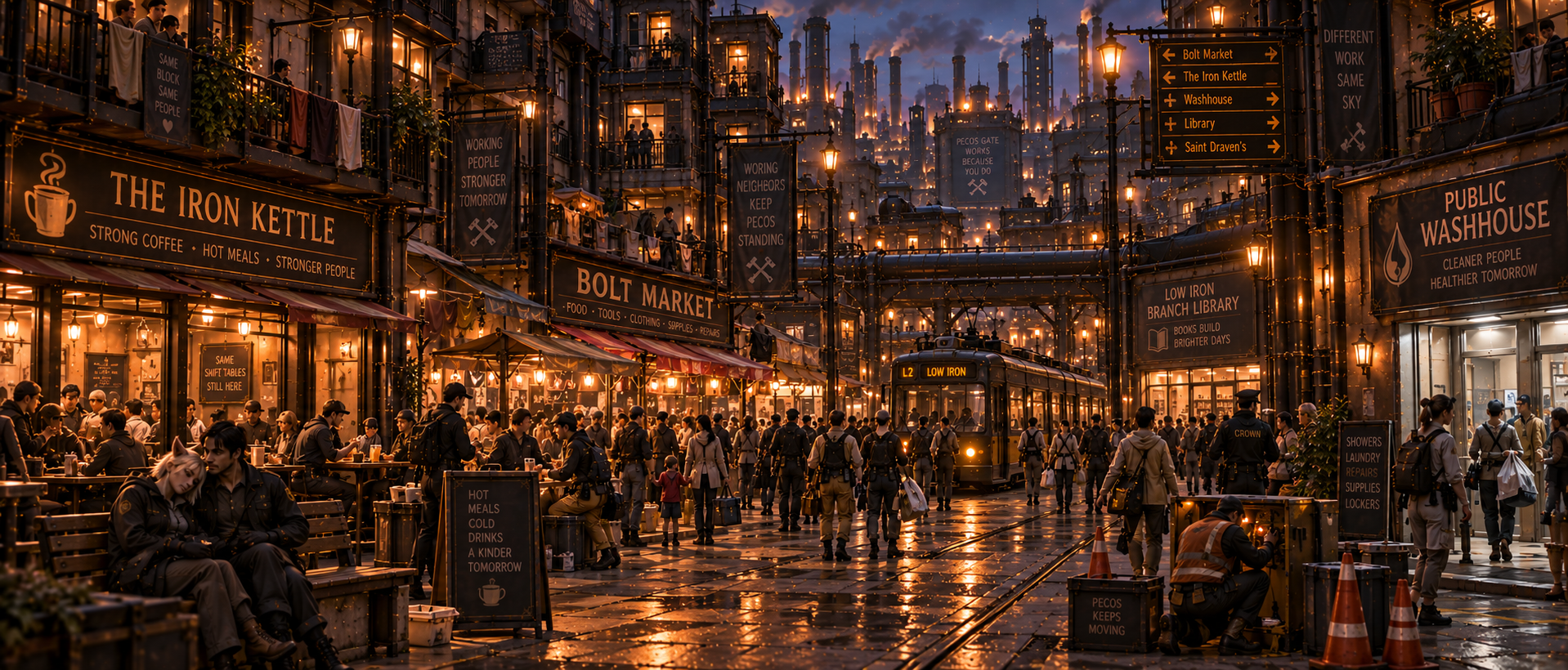
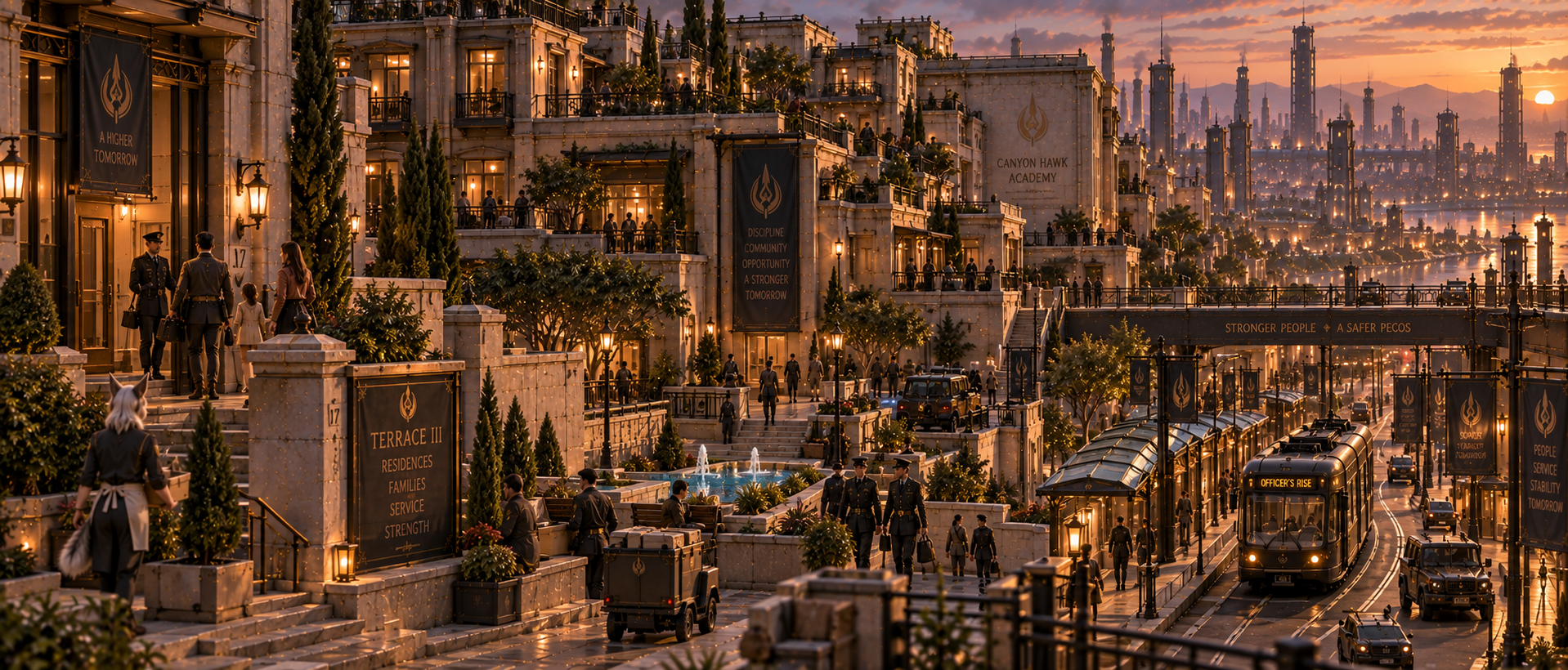
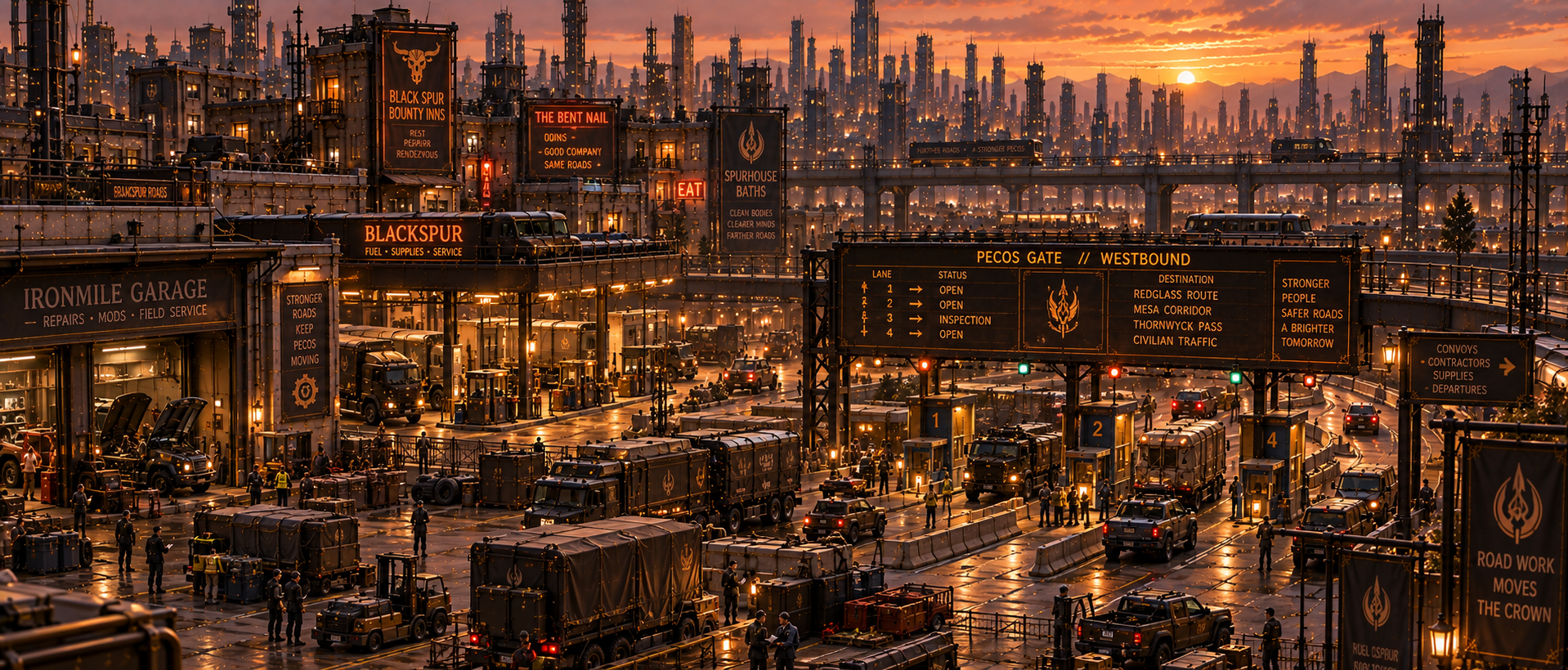
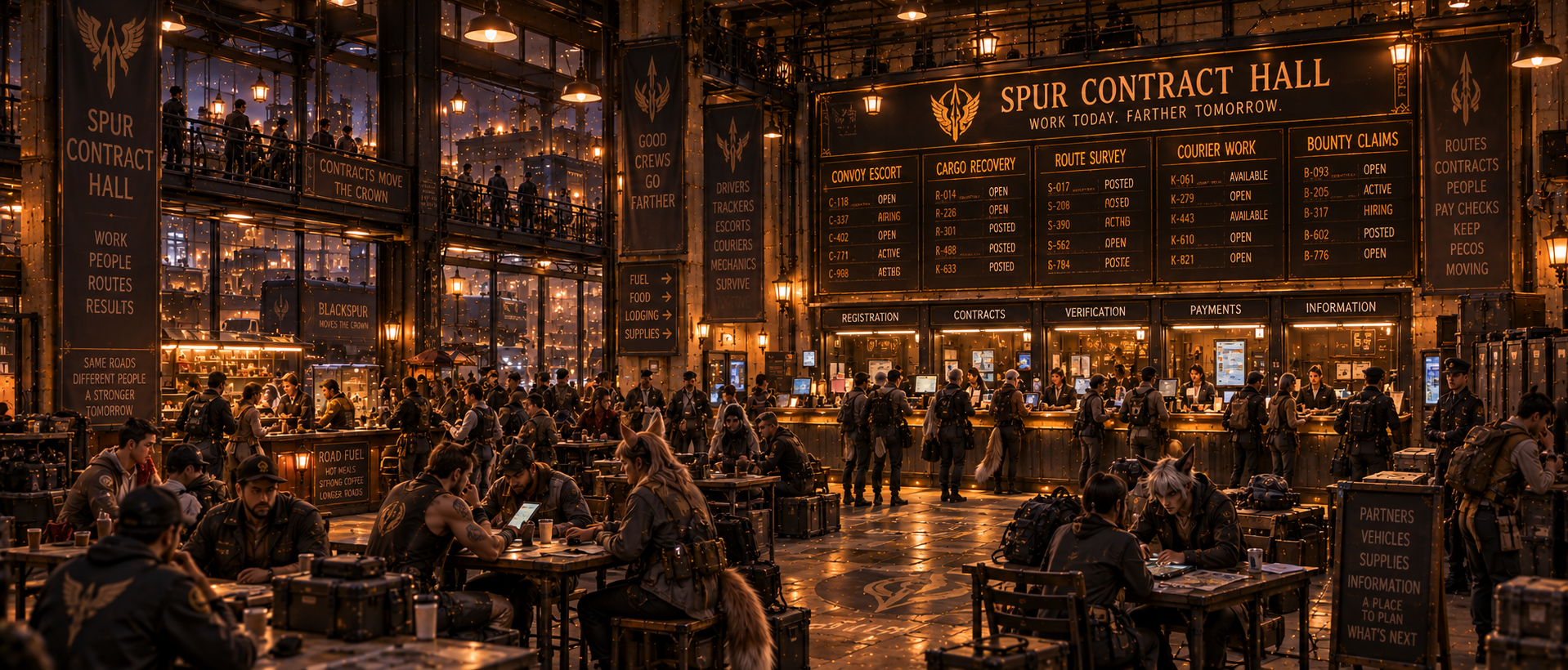
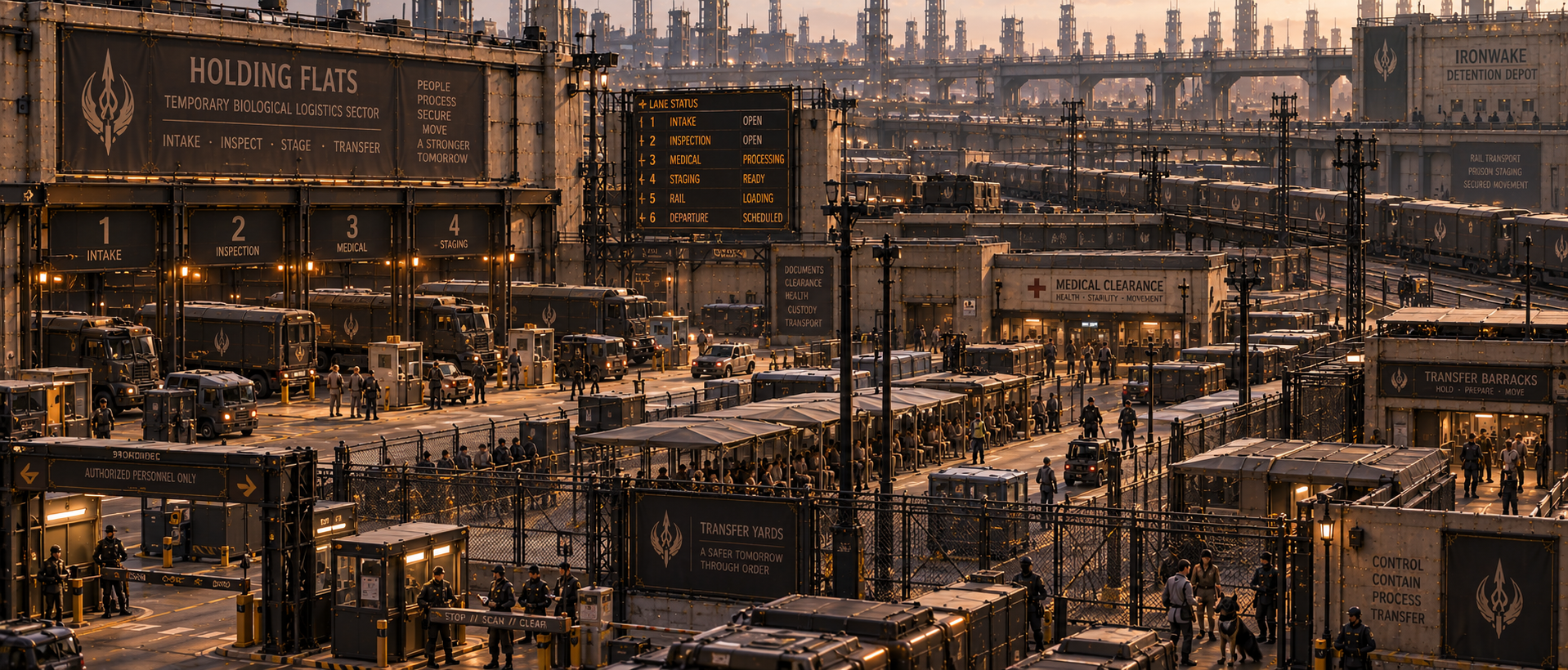
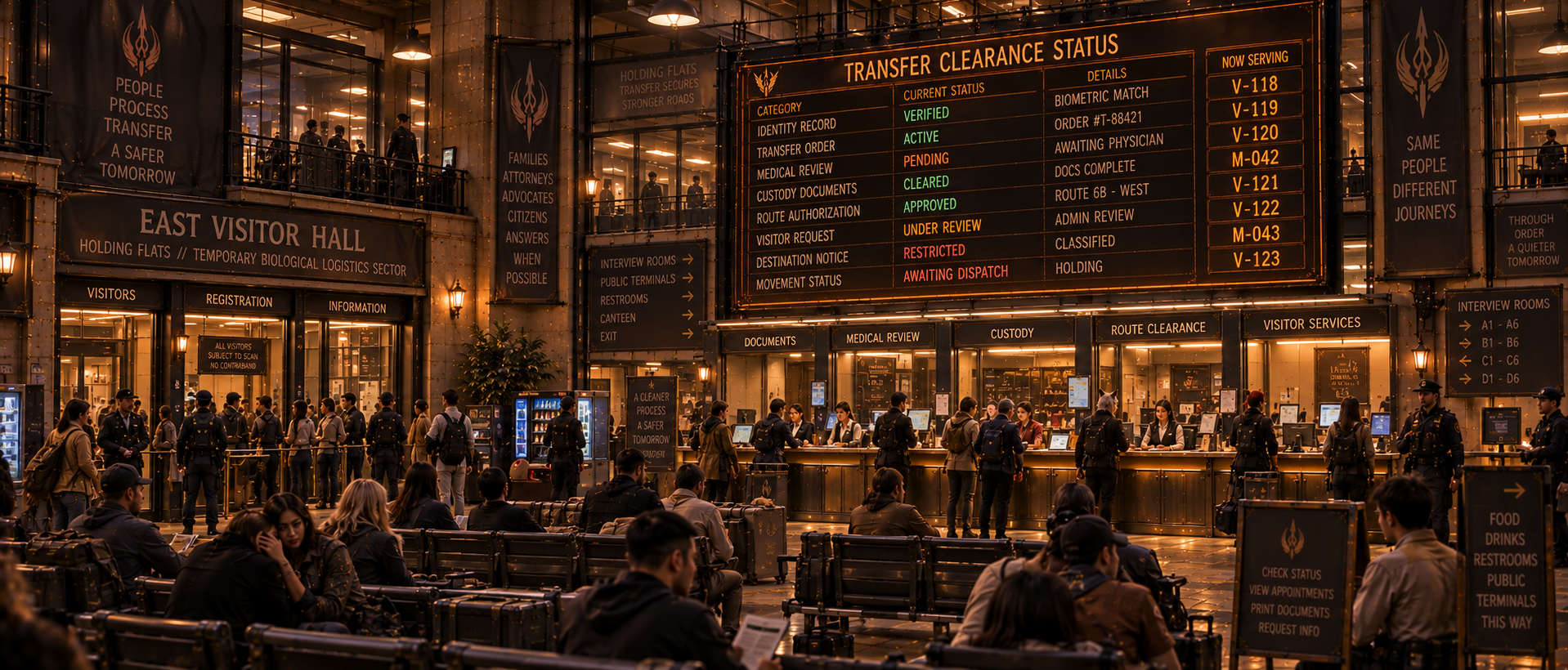
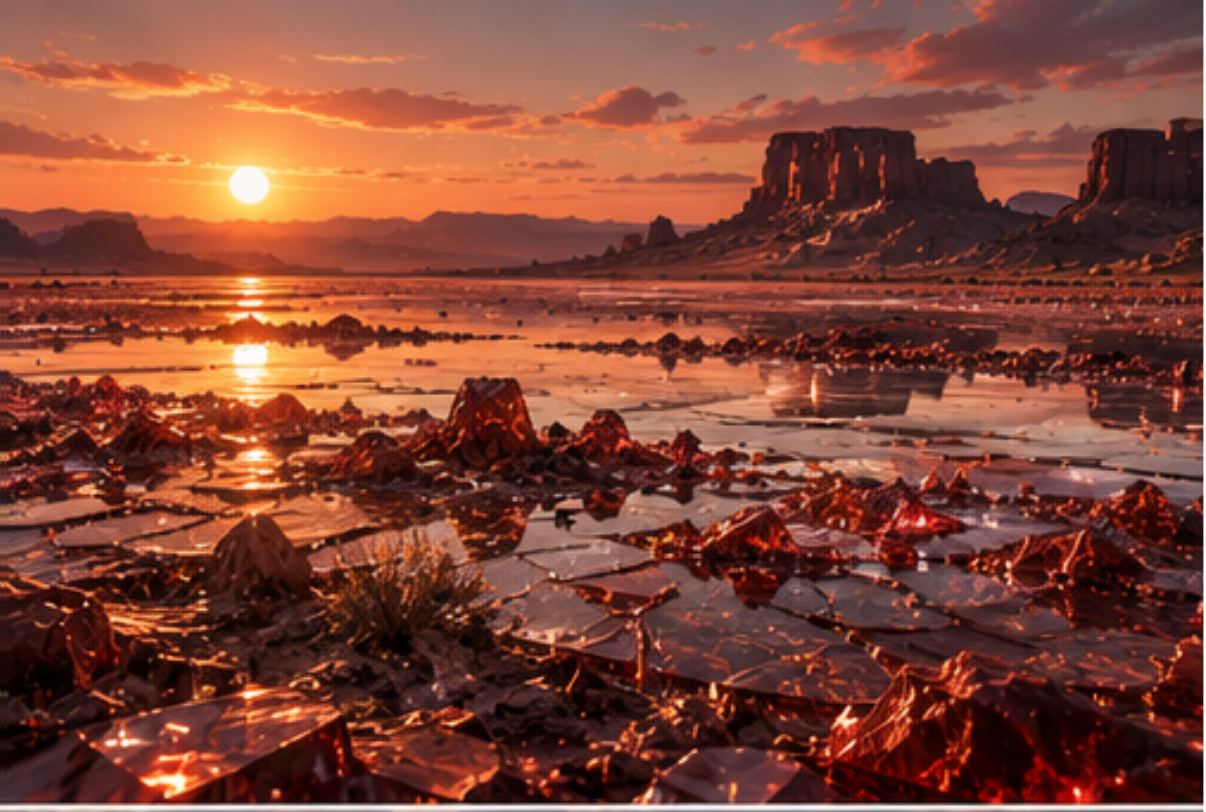
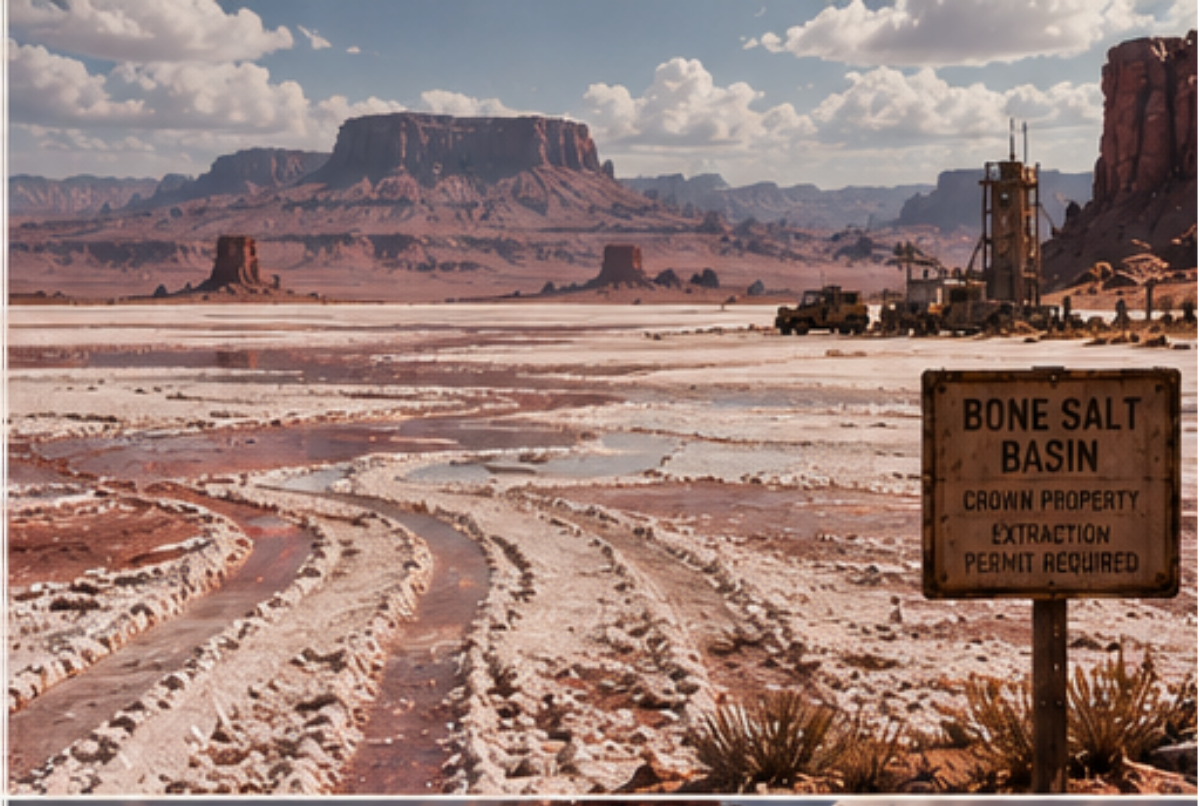
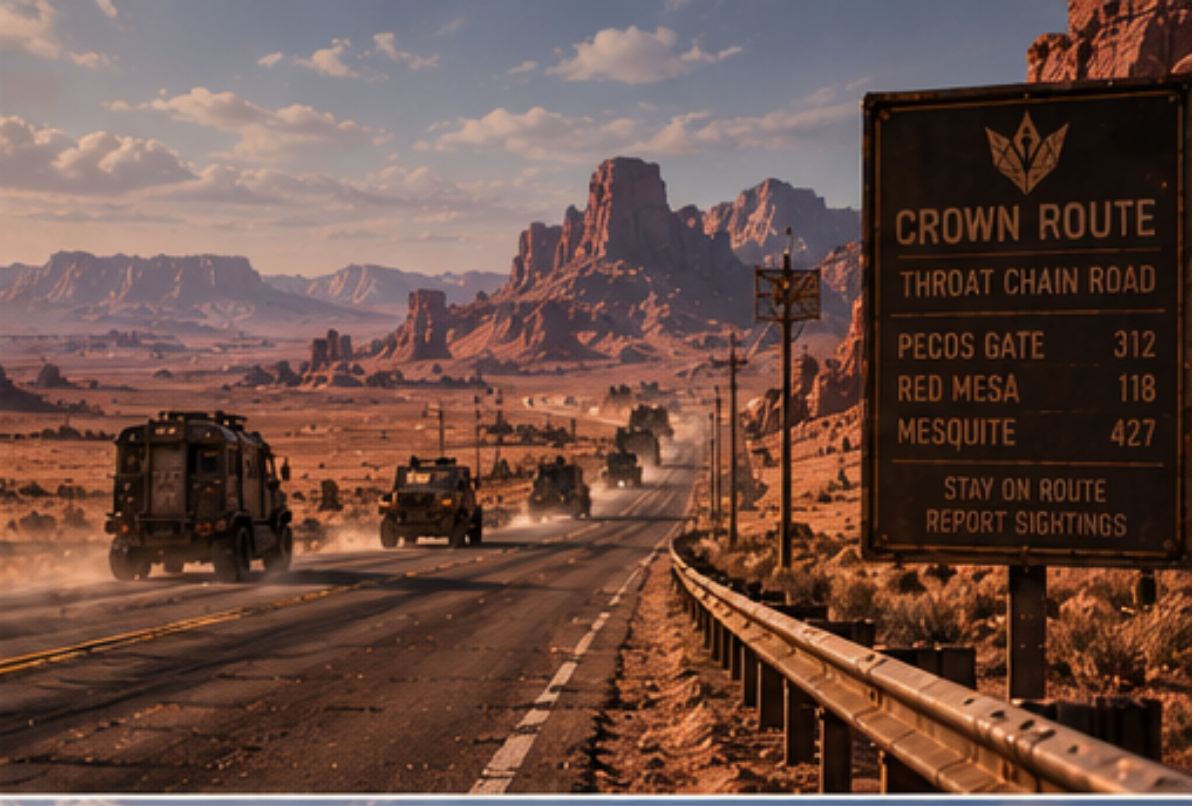
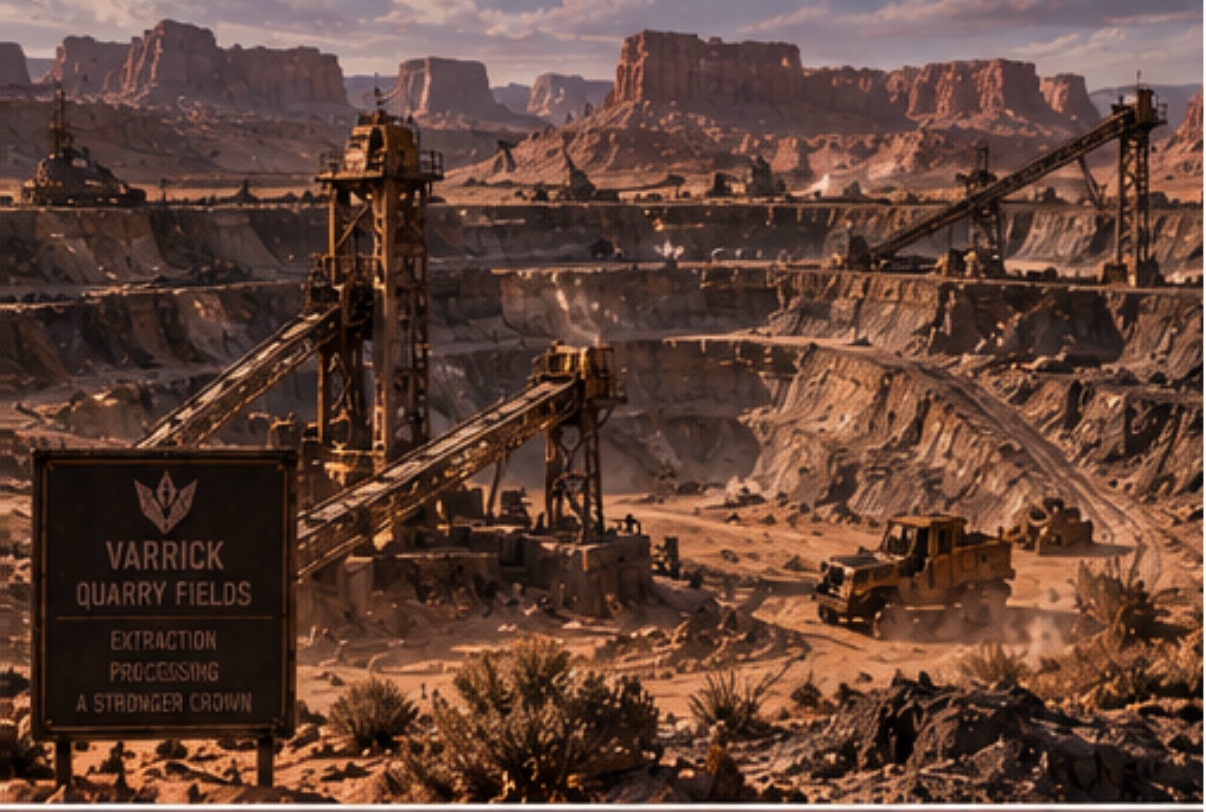
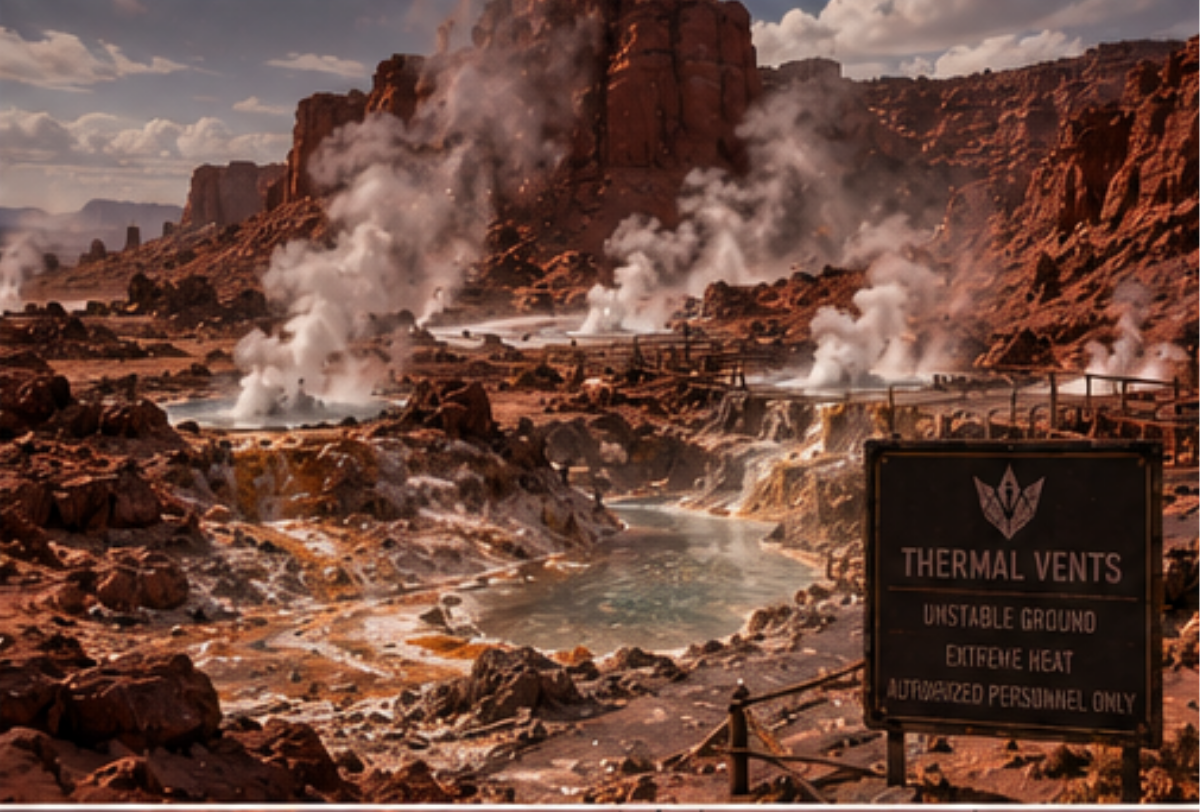
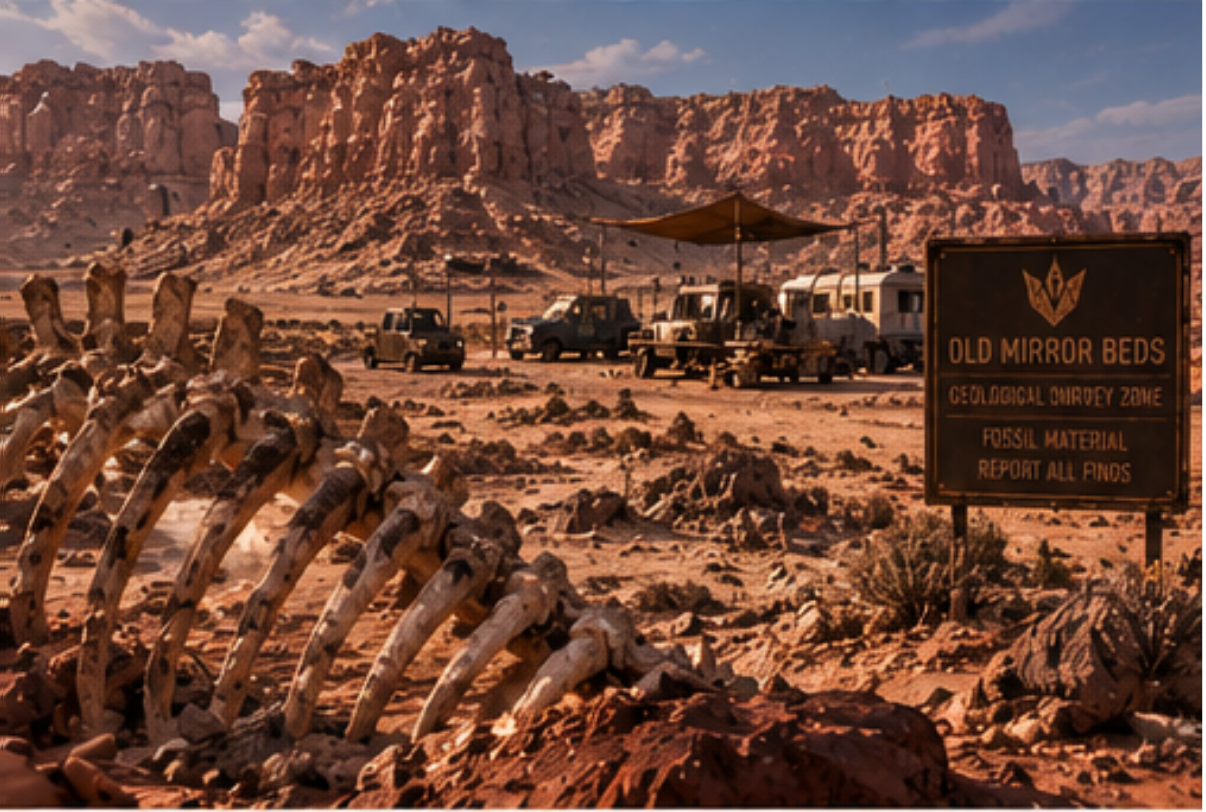
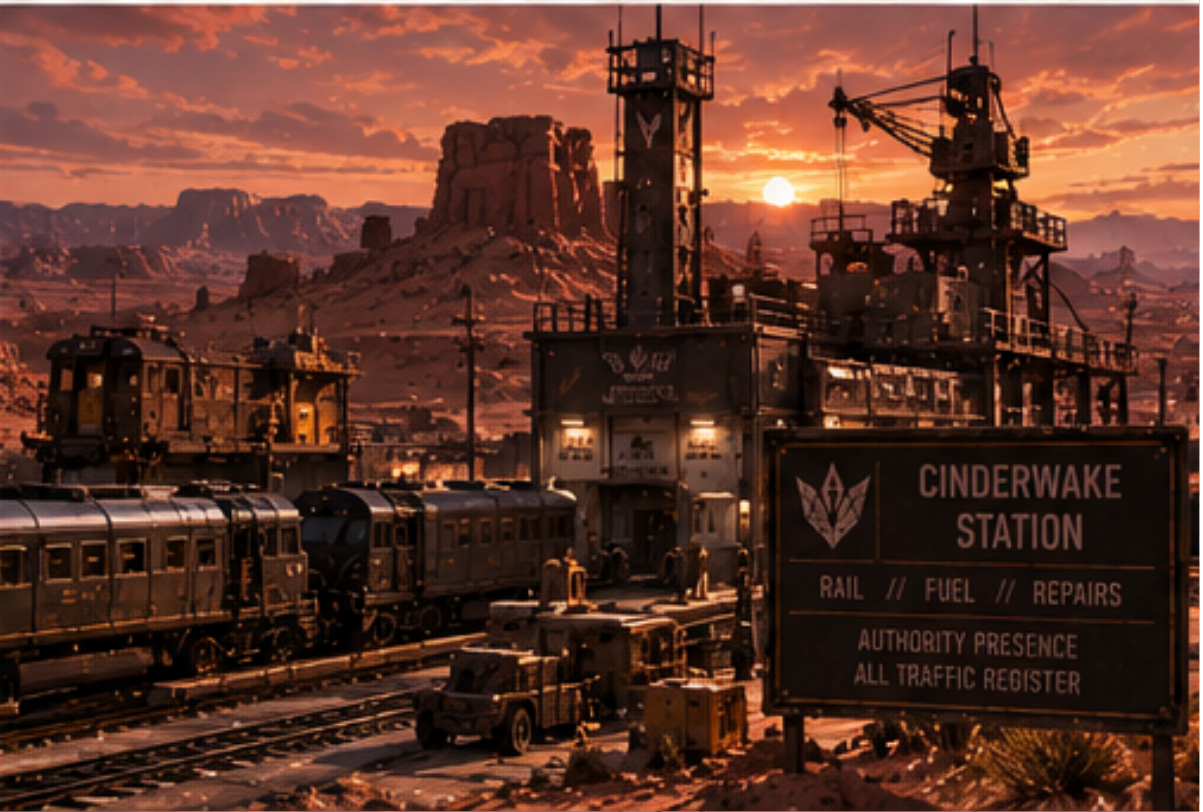
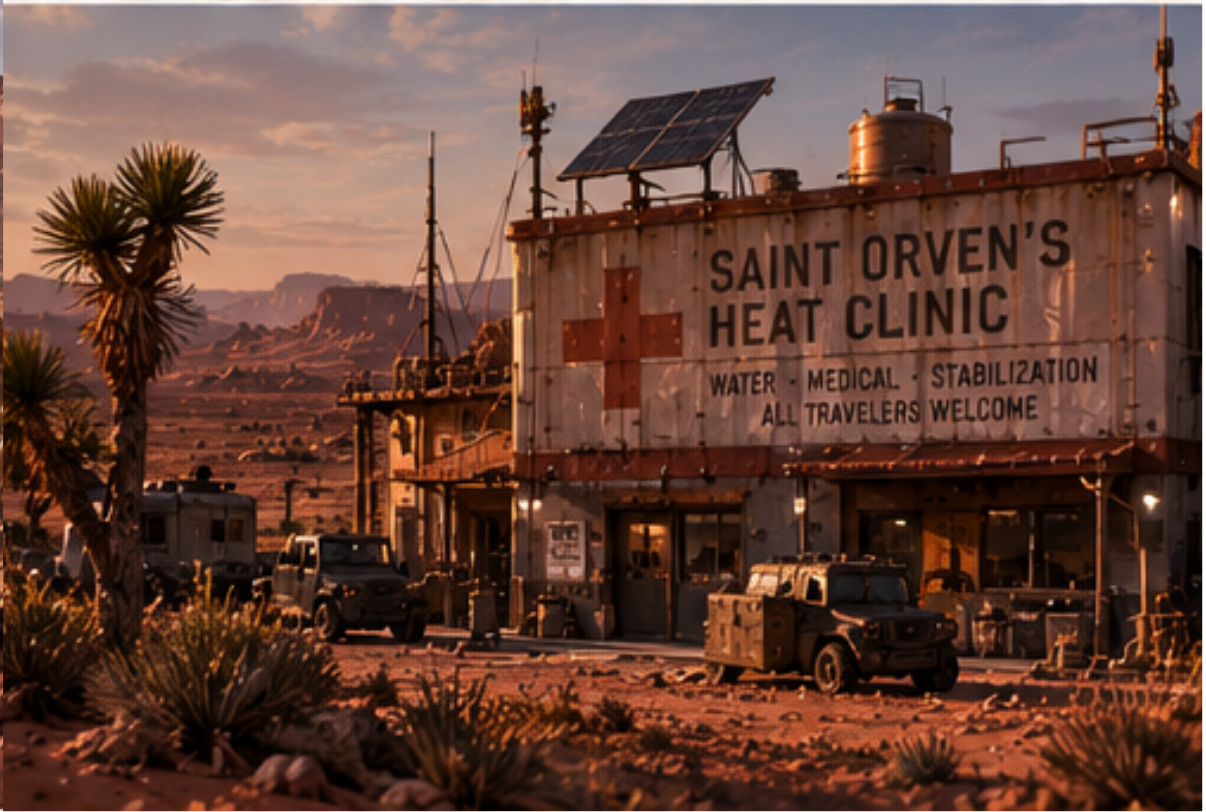
The Pecos Crown is a hard, sun-blasted nation of red canyons, extraction cities, armored rail corridors, military roads, desert prisons, and fortress settlements built against the western face of the Crownwall Range.
It is a human-controlled state where demi-humans are treated as labor assets, security risks, and biological resources. Mining, rail freight, private security, prison industry, and controlled transport form the machinery of the realm.
The Crown does not pretend to be kind. It pretends to be necessary.
National Doctrine
By Water, Work, and Wall, We Hold.
Officials “The desert keeps honest records.”
Survivors “The desert keeps bones.”
Common Saying “Mercy drinks water someone else hauled.”
Pecos Crown At-A-Glance
Pecos Crown // Realm Registry
At A Glance
Realm Profile Active
State Militarized Corporate Republic
Capital Pecos Gate
National Austere / Industrial / Militarized
Terrain Desert / Canyon / Mountain
Stability Strained
Core Mining / Rail / Security / Prisons
Tech Rugged / Heat-Sealed / Amber-Lit
Demi-Human Common / Controlled
Era 2097 A.E.
Pecos Crown Map
Crown Territorial Registry
The Western Realm
Regional Navigation // Active
Pecos Crown // Western Vistall Redglass Desert // Crownwall Range
The Pecos Crown is governed through a partnership of military command, industrial wealth, transport authority, resource control, courts, and administrative bureaucracy. It is technically a republic, but political power is concentrated among the Crown Authority, old settlement interests, corporate houses, military leadership, and institutions controlling the infrastructure required to survive the western desert.
The state’s legitimacy comes from necessity. Water must move. Rails must run. Mines must produce. Borders must hold. Every institution is therefore framed not as political preference, but as something Pecos cannot survive without.
In the Crown, power belongs to whoever controls what cannot be allowed to stop.
Power Structure Institutional Choke Points // Central Authority
Crown Authority Central Governing Body
Military National defense, emergency command, border security, containment, and enforcement authority.
Industry Extraction Houses, mining contracts, prison industry, corporate wealth, and material production.
Rail Freight, route permissions, logistics, transport custody, and movement across the western realm.
Civic Control Water administration, courts, labor classification, records, and state bureaucracy.
Water must move Rails must run Mines must produce Borders must hold
Pecos Crown Authority
Government // Central Authority
The Crown Authority
Central Governing Body of the Pecos Crown
The Pecos Crown is governed through a concentration of military command, industrial wealth, transport authority, resource control, judicial power, and administrative bureaucracy. Though formally a republic, practical power rests with the institutions capable of keeping the western realm functioning.
The Crown Authority is shaped by military governors, Extraction House leadership, rail commissioners, prison administration, water interests, old settlement families, and senior civic authorities. Each controls a system the desert cannot afford to lose.
In the Crown, power belongs to whoever controls what cannot be allowed to stop.
Military GovernorsExtraction HousesRail CommissionPrison AdministrationWater InterestsOld Settlement FamiliesSenior Civic Authorities
Principal Power Centers
National Command
Devon Nyx
High Marshal of the Pecos Crown
The High Marshal holds the most powerful individual office in the realm, directing national defense, emergency authority, Crownwall security, anti-feral operations, military mobilization, prison-fortress response, and war-form containment.
State Force: Crown military authority, border command, emergency law, national defense, and strategic containment.
Extraction Power
Silas Varrick
House Varrick // Mining & Extraction
Represents the extraction interests behind Red Mesa, major mining contracts, industrial quotas, and the mineral wealth on which the Crown and much of human Vistall depend.
Private Security Power
Corbin Rusk
House Rusk // Private Security
Oversees contracted enforcement, convoy protection, industrial security, weapons control, and the corporate armed forces operating alongside Crown military institutions.
Purchased Force: Corporate protection and contracted violence rather than direct state command.
Water Power
Tomas Calderra
House Calderra // Water Authority
Controls reservoir interests, allocation, municipal supply, pumping capacity, water contracts, and access to the resource no Crown settlement can survive without.
Rail Authority Regulation // Freight // National Logistics
State Rail Administration
Cassian Marr
Rail Commission
Handles route permissions, custody disputes, transport regulation, access rights, national rail policy, and the administrative authority governing movement across Crown tracks.
Freight Operations
Harlan Marr
Rail & Freight
Controls operational freight networks, corporate rail movement, shipping capacity, industrial logistics, and the physical machinery beneath Commission policy.
Civic Control & Judicial Authority
Administrative Control
Sylvia Caine
Director // Office of Burden Assignment
Sylvia Caine directs the bureaucracy responsible for classifying demi-humans according to biological capacity, labor suitability, shift ability, risk, ownership status, and prior obedience history. The Office turns bodies into administrative categories and those categories into assignments.
Species ClassificationLabor RatingShift CapacityRisk CategorizationOwnership StatusAssignment Review
Judicial Authority Desert Courts // Crown Law
Judicial Command
Lenora Vale
Chief Justice // Desert Courts
Chief Justice Vale represents the highest judicial authority of the Desert Courts, presiding over rulings, sentencing, Crown law interpretation, and major cases involving sabotage, labor violations, escape, ownership disputes, and anti-Crown activity.
Judicial Administration
Adrian Sable
Senior Docket Registrar
Sable manages docket processing, judicial records, sentencing documentation, transfer paperwork, and administrative enforcement after the court has issued its ruling.
“All beings within Crown territory must serve the security and survival of the realm according to their natural capacity.”
Human Interpretation
Civic Obligation
Human citizens are expected to contribute labor, military service, industry, administration, taxation, or other duties necessary to maintain the Crown.
Demi-Human Interpretation
Compulsory Biological Utility
Demi-human biological traits are treated as state-relevant capacities. Species, shift ability, physical adaptation, and morphology can determine compulsory labor assignment.
Standard Capacity Applications Illustrative Assignment Categories
Crown law is built around continuity of infrastructure, territorial security, labor control, and the principle that survival in the western desert can justify extraordinary state authority. Statutes are written broadly and enforced through administrative offices, security institutions, and the Desert Courts.
Principal Statutes Crown Legal Framework // Active
Crown Doctrine // BP-01 The Burden Principle Foundational legal doctrine establishing compulsory biological labor and service according to natural capacity.
Security Statute // CM-17 Containment Mandate Requires shift-capable individuals to remain registered, trackable, and under recognized Crown or licensed authority.
Transit Statute // RC-22 Rail Custody Act Authorizes Crown inspection, temporary seizure, custody review, and rerouting during transport disputes.
Territorial Statute // DT-09 Desert Trespass Statutes Establishes detention authority over unregistered demi-humans and unauthorized movement through controlled territory.
Recovery Statute // AR-31 Asset Recovery Immunity Clause Provides broad legal protection to licensed recovery operations acting within the scope of Crown authorization.
Emergency Doctrine // FN-04 Frontier Necessity Defense Allows exceptional force, detention, or emergency action to be justified through alleged immediate survival or security necessity.
Judicial Authority
The Desert Courts
Crown Judiciary // Pecos Gate
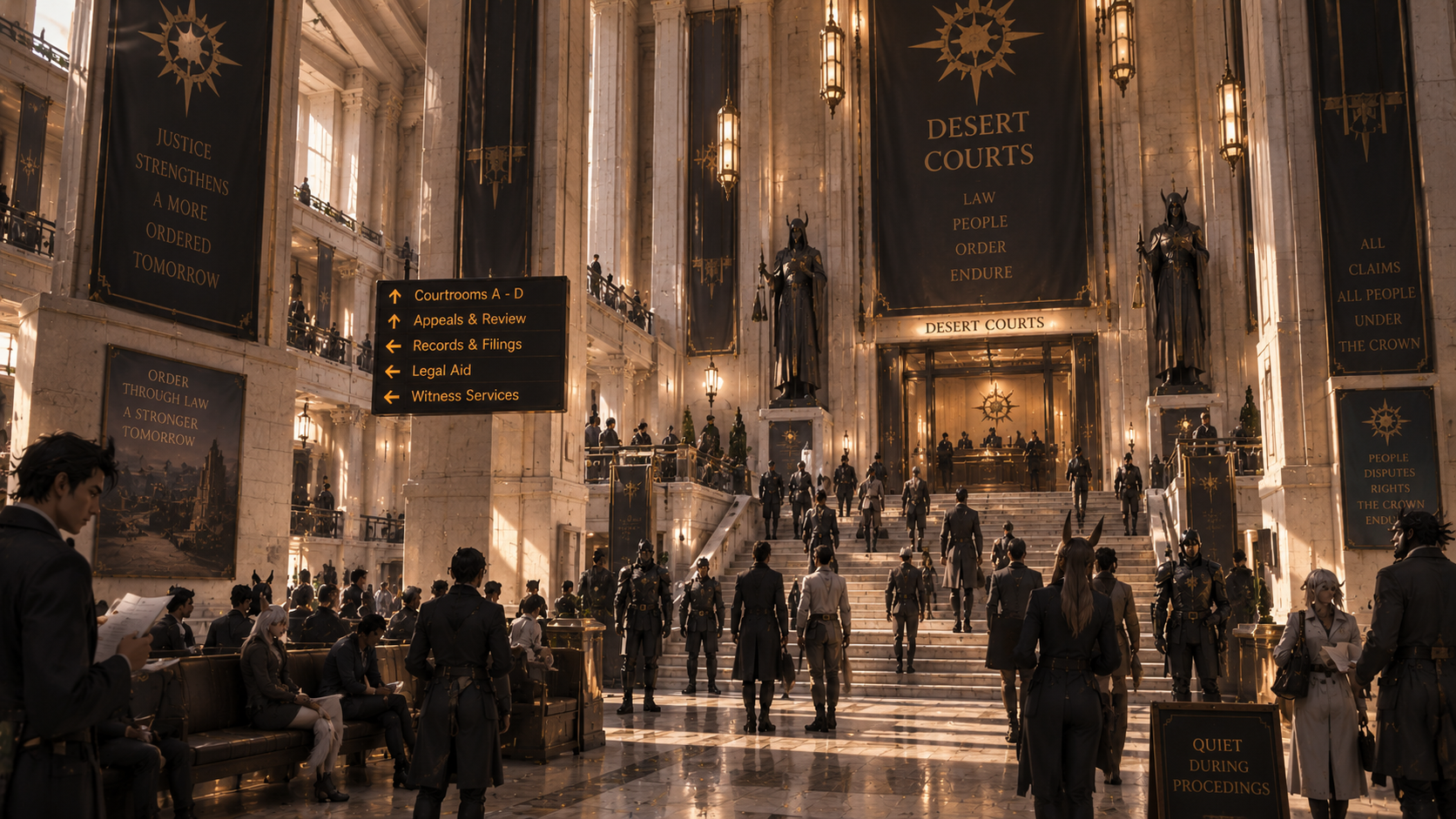
The Desert Courts interpret Crown statute, determine sentencing, resolve custody disputes, authorize transfers, and adjudicate cases involving labor violations, sabotage, unauthorized movement, ownership claims, escape, and anti-Crown activity.
Their function is not limited to criminal judgment. Court rulings can determine where a person is held, who possesses legal custody, what labor obligations apply, and which state or corporate authority receives jurisdiction.
Criminal Sentencing
Custody Adjudication
Labor Violations
Transfer Authorization
Ownership Disputes
Anti-Crown Cases
Presiding Judicial Authority Chief Justice Lenora Vale Desert Courts // Senior Judicial Authority Vale presides over high-level rulings, sentencing, Crown law interpretation, and major cases involving security, labor, custody, sabotage, and escape.
01 Charge / Petition
02 Docket Review
03 Judicial Ruling
04 Custody / Transfer
Social Classes
Pecos Crown // Recognized Social Order
The Crown Hierarchy
Legal Position, Authority & Recognized Status
Crown law does not distribute authority evenly. Political access, economic control, civic protection, labor obligation, and legal recognition are structured through a descending hierarchy shaped by ownership, office, wealth, and recognized human status.
Recognized Crown Order
01
Crown Houses
Elite extraction families, military lineages, rail interests, prison contractors, water dynasties, and old settlement families with direct access to national power.
02
Officer Class
Military commanders, prison wardens, border captains, senior security personnel, and other officials empowered to enforce Crown authority.
03
Settler Class
Recognized human citizens of Crown towns, rail settlements, ranch districts, mining communities, and desert municipalities.
04
Company-Bound
Human workers legally free but constrained by corporate debt, employer-controlled housing, ration systems, medical access, or binding labor arrangements.
05
Owned Demi-Humans
Demi-humans legally controlled by the state, corporations, institutions, military authorities, or private human owners and classified according to recognized labor or custody status.
Authority Concentrated upward through office, capital, contracts, and institutional control.
Obligation Increases downward as economic independence and legal autonomy decrease.
Recognition The Unmarked exist outside the legal structure rather than forming a protected civic class.
Pecos Crown Society
Pecos Crown // Society
Life Under the Crown
Work, Worth & the Western Social Order
Life in the Pecos Crown is organized around a simple expectation: everyone must carry something.
The western desert has made endurance into morality. Water is measured. Work is expected. Waste is despised. Competence earns respect, restraint is treated as maturity, and the ability to remain useful under pressure is considered one of the clearest measures of character.
Pecos citizens are taught that civilization survives because people accept burdens larger than themselves. Rails must be maintained, mines worked, reservoirs protected, borders defended, and settlements supplied. Dependence without contribution is viewed with suspicion, while reliability, discipline, and practical skill carry enormous social weight.
But the Crown does not apply those expectations equally. For recognized humans, contribution is framed as civic responsibility and a source of status. For demi-humans, the same language of usefulness is used to justify classification, compulsory labor, ownership, and biological control.
The result is a society capable of treating sacrifice as honorable and coercion as reasonable using almost exactly the same vocabulary.
Endure hardshipMeasure resourcesRespect competenceControl excessContribute laborCarry the burden
Western Social Principle
In Pecos, usefulness is not merely admired. It is treated as proof that a person has earned their place.
Pecos Crown // Society
What Pecos Respects
Civic Values of the Western Crown
Civic Values Index Social Measure // Cultural Expectation
01
Endurance
Keep going when conditions become difficult.
Physical hardship is expected rather than exceptional. Complaining without attempting to solve the problem is culturally disliked.
02
Usefulness
Know what can be depended upon.
Skill, practical knowledge, labor, logistics, technical ability, and reliability confer social value. Competence matters more than ornament.
03
Restraint
Control appetite, emotion, and waste.
Excess is associated with softness. Water, money, food, anger, and even public affection tend to be treated as things a respectable person knows how to manage.
04
Hierarchy
Authority follows responsibility.
Pecos culture generally accepts unequal rank when that rank is perceived to carry greater responsibility, danger, ownership, or productive burden.
05
Water Discipline
Nothing necessary is treated as limitless.
Water conservation is both practical behavior and moral symbolism. Carelessness with water can carry genuine social shame because waste threatens more than the individual.
06
Work
Contribution establishes legitimacy.
Occupation matters enormously to how adults are understood socially. Someone who maintains difficult or necessary infrastructure may command respect well beyond their wealth.
07
Carry Your Share
Nobody survives the desert alone.
This principle sits above the others. Every household, crew, settlement, company, and institution is expected to know who carries which burden and what happens when that burden is left unattended.
Common Civic Formula
Water. Work. Wall.
Not merely a national slogan. A summary of what Pecos considers civilization to require.
Water Work Wall
Pecos Crown // Society
One Standard, Two Realities
How Crown virtues change under legal status
Recognized Status Human
Crown Value
Controlled Status Demi-Human
Civic Responsibility Contribution recognized as participation
Contribution
Assigned Utility Contribution defined by external authority
Employment / Service Work performed within recognized civic status
Work
Compulsory Labor Work imposed through assignment or custody
Respectability Self-control treated as character
Discipline
Compliance Obedience measured through controlled behavior
Citizenship / Records Documentation establishes recognized identity
Registration
Tracking / Custody Documentation establishes control and location
Career Advantage Specialized skill may increase opportunity
Specialized Ability
Biological Classification Specialized traits may determine assignment
Duty Service framed as civic obligation
Service to the Crown
Imposed Obligation Service enforced through ownership or state authority
Official Crown Interpretation
The Crown does not describe these systems as contradictory. In official Pecos thought, both are expressions of the same principle: every person serves according to capacity.
The Distinction
The distinction lies in who is permitted to define their own contribution.
Pecos Crown Culture
Western Civilian Life // Pecos Crown
Pecos Crown // Culture
Pecos Culture
Desert Pragmatism, Frontier Pride & the Western Character
Pecos culture was shaped by scarcity, distance, dangerous infrastructure, and generations of settlements that survived because somebody repaired the pump, guarded the rail, hauled the water, or stayed awake through the night watch.
The result is a culture that admires competence more readily than charm. Practical skill, physical endurance, reliability, restraint, and the ability to remain useful when conditions turn bad carry enormous social weight. Pecos people tend to respect what works, who shows up, and who can be trusted when something breaks.
This produces an intense regional pride. Outsiders often see the Crown as severe, joyless, or unnecessarily hard. Many Pecos residents instead understand that severity as proof that western civilization was built under conditions other people never had to survive.
Skill over polish Reliability over charm Maintenance over replacement Restraint over excess Function under pressure
The Western Character
Pecos does not romanticize hardship because hardship is beautiful. It respects the people who can still function inside it.
Pecos Crown // Culture
The Western Character
Manners, Competence & Social Expectation
Cultural Behavior Ledger What People Notice // What People Remember
01
Competence
Knowing how matters.
Practical skill earns immediate credibility. A skilled mechanic, medic, rail technician, surveyor, rancher, water engineer, or experienced foreman may receive significant social respect regardless of polish or formal education.
02
Toughness
Pain is private until it becomes a problem.
Pecos toughness is less about swagger and more about remaining functional. Someone who makes a spectacle of minor discomfort may be judged harshly, while admitting an actual limitation early enough to prevent disaster is considered responsible.
03
Waste
Carelessness is uglier than poverty.
Throwing away usable material, wasting food, leaving equipment unrepaired, or using water thoughtlessly can provoke genuine contempt. Repair, reuse, and maintenance carry moral weight as well as practical value.
04
Speech
Say what is necessary.
People tend to respect directness, useful information, and concise disagreement. Excessive explanation can read as evasiveness, while empty boasting tends to age badly.
05
Appearance
Presentable does not mean delicate.
Clean, maintained clothing and equipment matter. Expensive objects earn less admiration if they appear impractical, fragile, unused, or incapable of surviving the conditions in which their owner lives.
06
Reputation
People remember whether somebody showed up.
Reliability accumulates socially. So does unreliability. A history of competent work, keeping promises, appearing when needed, or failing others under pressure can follow a person for years.
Social Measure
In Pecos, character is often judged less by what someone claims to be than by what other people have seen them do.
Household // Settlement // Dynasty
Pecos Crown // Culture
Name, House & Reputation
Family Standing, Continuity & Institutional Power
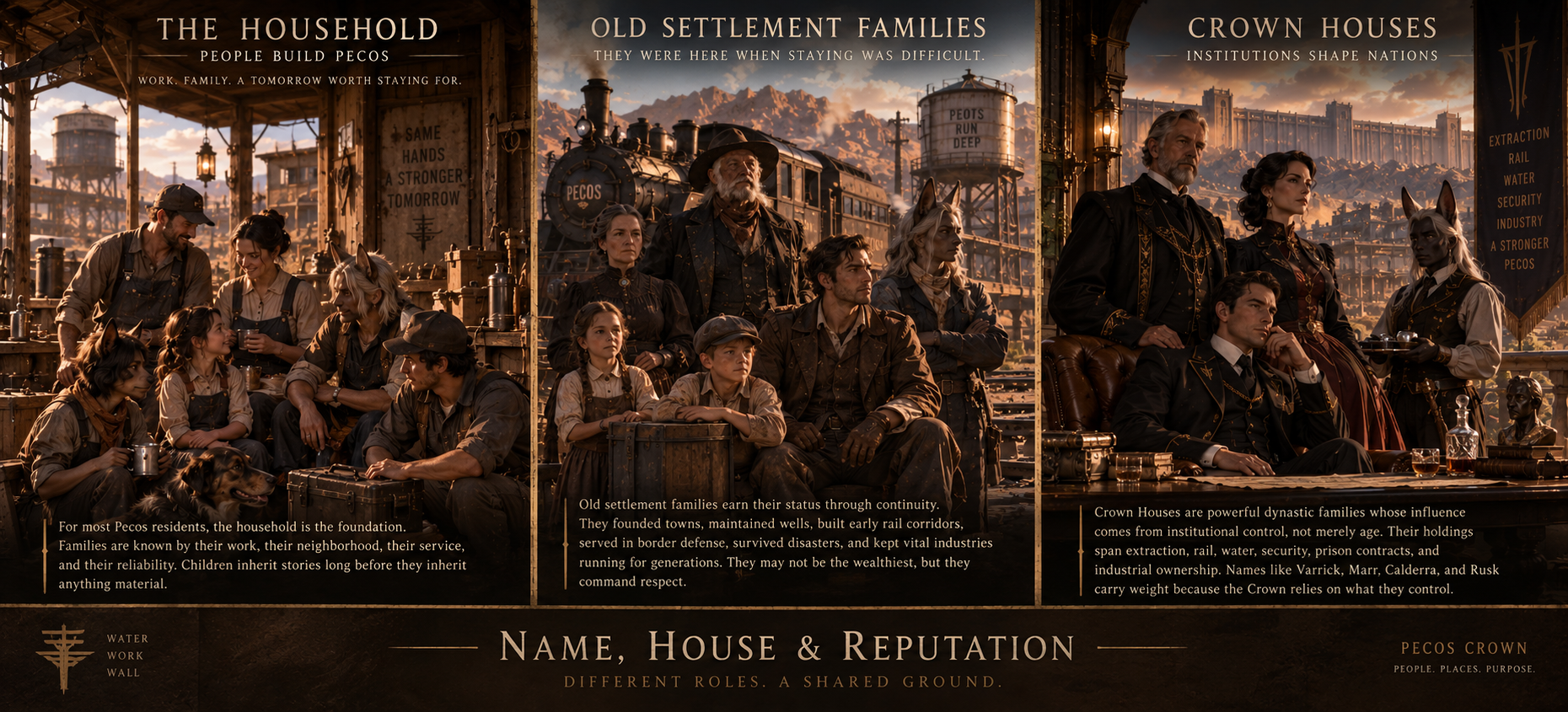
Family names carry weight throughout the Pecos Crown, but reputation and political power are not the same thing. A respected household, an old settlement family, and a Crown House may all possess social standing for very different reasons.
01
The Household
Work // Family // Local Standing
For ordinary Pecos residents, the household is one of the most important social units. A family may become known across generations through occupation, neighborhood, military service, rail work, ranching, engineering, medicine, craft, or simply being dependable.
Children often inherit stories about their relatives long before they inherit anything material.
02
Old Settlement Families
Continuity // Service // Regional Memory
Old settlement families derive their status from continuity. Their names are associated with places, infrastructure, disasters survived, and generations of labor that helped keep a community functioning.
They may command significant respect without possessing extraordinary wealth or national political power.
Crown Houses are powerful dynastic families whose prestige comes from institutional control rather than age alone. Their holdings shape the systems on which national survival and Crown power depend.
Names such as Varrick, Marr, Calderra, and Rusk carry political weight because those families control industries and infrastructure the Crown cannot easily replace.
Reputation Can Outlive the Person Social Memory // Household Standing
Pecos communities remember patterns. A person may be judged partly through the people, institutions, places, and histories attached to their name. This is not mystical inheritance. It is accumulated social memory: who served, who failed, who paid their debts, who abandoned others, and who could be relied upon when conditions became difficult.
Parents
Siblings
Employer
Military Record
Settlement
Family Debts
Public Disgrace
Known Competence
Historic Service
A famous surname may open a door. What the community remembers about that surname determines what happens after someone walks through it.
Rail // Water // Civilian Infrastructure
Pecos Crown // Culture
Rail, Water & the Culture of Infrastructure
The Systems Pecos Lives By
In the Pecos Crown, infrastructure is not merely something government builds or corporations own. Railways, water systems, workshops, engines, pumping stations, and supply corridors are woven into daily language, family histories, regional pride, and ideas of what civilization itself requires.
01
Rail Culture
Movement // Connection // Continuity
Pecos treats its railways almost like a circulatory system. Freight, passengers, workers, water equipment, military supplies, prisoners, mail, and industrial materials all move through lines whose interruption can affect communities hundreds of miles apart.
Rail workers therefore carry cultural status beyond their wages. Conductors, engineers, signal staff, yard workers, freight coordinators, and mechanics belong to occupations associated with keeping the realm connected.
Children grow up hearing trains. Settlements orient themselves around rail access. To be described as “off the line” can imply not only geography, but remoteness from ordinary Crown life.
Pecos industrial culture admires machinery that works, especially machinery that has continued working under conditions that should have destroyed it.
Old engines, repaired tools, patched equipment, maintained pumping systems, and infrastructure surviving decades of heat, dust, vibration, and heavy use can become objects of genuine local pride.
Newness alone carries little prestige. Maintenance proves knowledge. Repair demonstrates judgment. Longevity suggests that both the machine and the people responsible for it have already been tested.
Old Engines Still RunningTools Repaired RepeatedlyMaintained MachineryInherited EquipmentLong-Service InfrastructureVisible Practical Use
A pristine wrench nobody has used is less impressive than a maintained one somebody’s grandmother worked with.
03
Water Culture
Survival // Hospitality // Social Meaning
Water occupies a category of its own in Pecos culture. It is rationed and politically controlled, but it is also embedded in hospitality, etiquette, symbolism, family habits, and ideas of personal responsibility.
Offering water to a guest can be an ordinary courtesy or a serious gesture depending on circumstance. Wasting it can communicate carelessness or disrespect. Giving another person the last share from a private supply carries weight precisely because everyone understands what has been surrendered.
Pecos does not treat water as limitless even when reservoirs are full. The habit of measuring it remains part of western identity because abundance today does not erase what scarcity taught previous generations.
Rationed Resource
Hospitality
Political Power
Personal Responsibility
Ceremonial Meaning
Social Respect
Rail Keeps people connected
Industry Keeps systems functioning
Water Keeps civilization alive
Western Infrastructure Culture
Pecos pride is not built around possessing machinery. It is built around keeping necessary things working.
Pecos Crown // Culture
Hospitality, Sayings & Social Language
How Pecos Shows Respect, Status & Belonging
Social Custom // Hospitality
Hospitality Is Action
Pecos hospitality tends to be practical rather than performative. A host may not fuss over a guest, offer elaborate reassurance, or make warmth into a spectacle. Instead, care is demonstrated through useful acts.
Offer Water
Make Room at the Table
Provide Shade
Offer Food Without Ceremony
Point Out Where to Wash
Give Practical Directions
Repair Something
Check the Train Time
Provide a Place to Sleep
Send Someone Off Prepared
Someone may say very little while quietly making sure a guest has water, a blanket, food, directions, and a repaired boot before morning.
Social Custom // Status
Rank Is Acknowledged. Competence Is Judged.
Formal status matters in Pecos, but rank does not erase practical judgment. People may defer to title, House, office, ownership, or uniform while still privately measuring whether the person in front of them knows what they are doing.
Crown Houses Names carry weight before introductions are finished. Competence determines whether that weight becomes respect.
Officers Uniform and office command formal deference, especially inside military, security, rail, and civic institutions.
Workers A skilled mechanic, rail hand, water technician, miner, or foreman can earn enormous practical respect regardless of modest social standing.
Company-Bound Legally free humans may still live under heavy economic dependency. Their reliability is often judged through employment, debt, and contract history.
Demi-Humans Useful skill may be praised sincerely without granting equal legal or social standing. Competence does not erase ownership or controlled status.
Common Pecos Sayings Doctrine // Humor // Warning // Habit
“The desert keeps honest records.”
Official Saying Used by officials, supervisors, officers, and older settlers to express the belief that harsh conditions expose weakness, carelessness, and false confidence. In formal use, it reinforces the Pecos ideal that survival rewards competence.
“The desert keeps bones.”
Survivor's Answer A darker response to the official phrase. It rejects the idea that every death proves failure and remembers that the desert kills competent people too. The saying is common among workers, travelers, soldiers, and families with long memories.
“Mercy drinks water someone else hauled.”
Common Pecos Expression Used sincerely, bitterly, jokingly, or cruelly depending on context. It reflects the Crown's habit of translating compassion into material cost: every kindness consumes time, labor, water, space, fuel, or somebody else's share.
“Carry your share.”
Everyday Admonition A common instruction to children, workers, relatives, and coworkers. It can refer to literal labor, financial contribution, preparedness, emotional restraint, or simply not creating extra work for everyone else.
Water Survival // Stewardship
Work Usefulness // Contribution
Wall Security // Continuity
Water. Work. Wall.
The phrase appears in official doctrine, school instruction, workplace language, military rhetoric, family advice, jokes, arguments, memorial speeches, and ordinary conversation. Its ubiquity makes it both political language and simply something Pecos people say.
Official DoctrineWorkplace LanguageFamily AdviceMilitary UseDry HumorRegional Identity
Pecos Social Language
Pecos people tend to express care through preparation, respect through competence, resentment through dry understatement, and belonging through shared work. The culture's language is full of infrastructure because infrastructure is what allows ordinary life to continue.
Human Lifestyle
Recognized Human Life // Crown Civic Ideal
Pecos Crown // Recognized Human Life
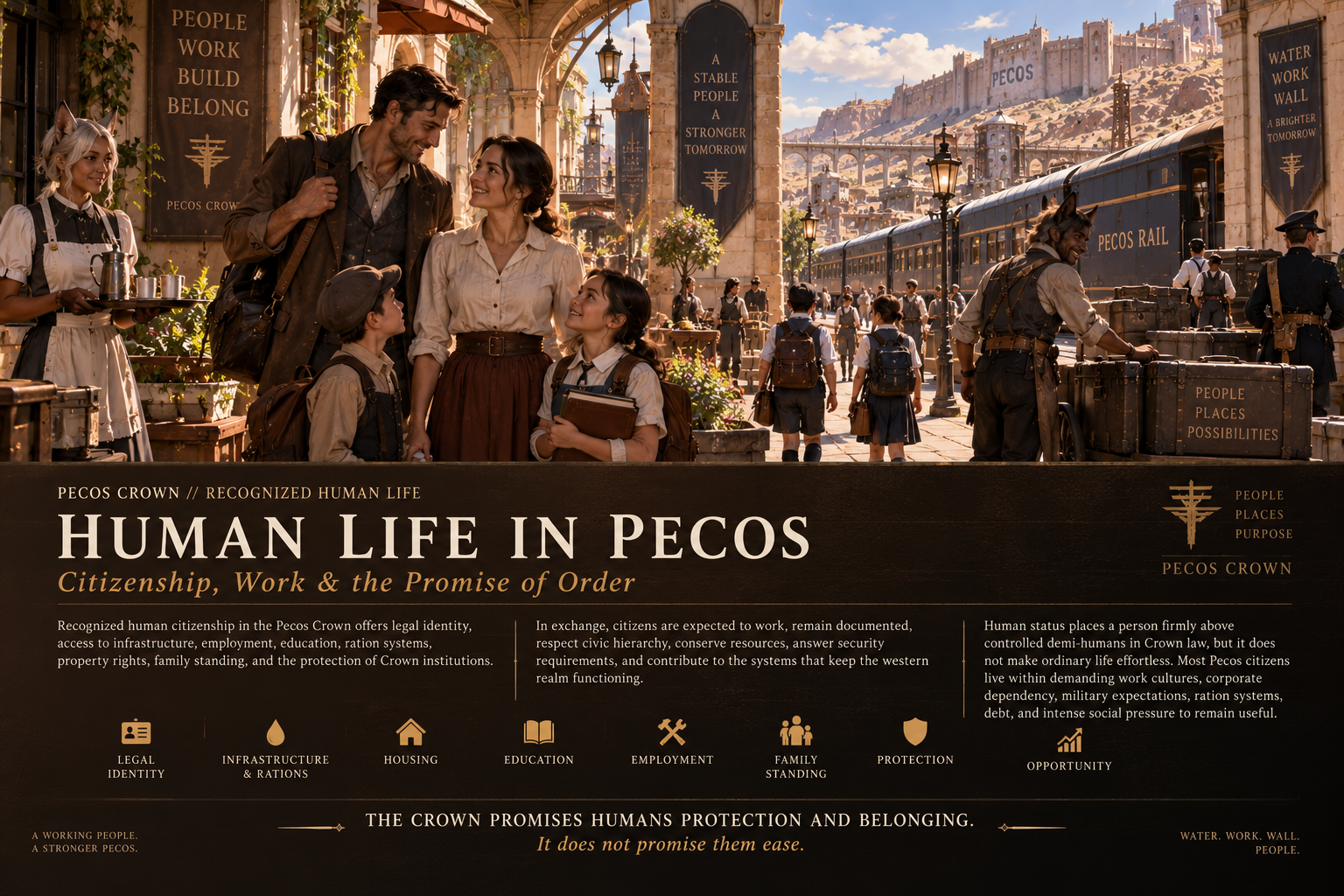
Human Life in Pecos
Citizenship, Work & the Promise of Order
Recognized human citizenship in the Pecos Crown offers legal identity, access to infrastructure, employment, education, ration systems, property rights, family standing, and the protection of Crown institutions.
In exchange, citizens are expected to work, remain documented, respect civic hierarchy, conserve resources, answer security requirements, and contribute to the systems that keep the western realm functioning.
Human status places a person firmly above controlled demi-humans in Crown law, but it does not make ordinary life effortless. Most Pecos citizens live within demanding work cultures, corporate dependency, military expectations, ration systems, debt, and intense social pressure to remain useful.
For most humans, these rights are experienced simply as ordinary citizenship. Their privileged nature becomes most visible when compared with populations whose movement, labor, family status, and legal identity remain subject to ownership or institutional control.
The Civic Bargain
The Crown promises humans protection and belonging. It does not promise them ease.
Civic Prosperity // Recognized Human Access
Pecos Crown // Human Life
The Privileges of Recognition
What Recognized Human Citizenship Provides
Recognition places a human citizen inside the Crown's legal and civic order. It determines whether a household can hold property, draw municipal water, enroll children in school, sign contracts, travel through ordinary checkpoints, seek legal remedy, and participate in institutions most citizens simply consider part of normal life.
Recognized citizenship, household registration, enforceable contracts, property claims, legal records, and standing before Crown courts.
02
Water Entitlement
Municipal Access
Household allotments, municipal water access, public ration systems, emergency distribution, and recognized claims within local supply networks.
03
Housing
Residential Recognition
Access to recognized residential districts, employer housing, leases, mortgages, household utilities, and class-dependent property ownership.
04
Education
Schooling & Advancement
Public schools, technical institutes, apprenticeships, corporate training programs, military academies, and other routes into recognized occupations.
05
Employment
Legal Work Access
Legal access to trades, administration, corporations, transport, extraction, private security, military service, utilities, and Crown government employment.
06
Movement
Travel & Transit
Rail tickets, travel permits, intercity movement, ordinary checkpoint clearance, and recognized use of public transportation networks.
07
Family Recognition
Household Continuity
Recognized marriage, inheritance, custody of children, household registration, family property, and legal continuity across generations.
08
Security
Crown Protection
Access to emergency infrastructure, recognized legal remedies, civic protection, disaster response, and institutional claims when property or personal rights are violated.
To Most Humans, This Is Simply Normal. Recognition Is Usually Invisible to Those Who Have It
A citizen generally does not experience school enrollment, household water, rail access, legal contracts, marriage registration, or property rights as special privileges. They are understood as the ordinary infrastructure of recognized civic life.
The Boundary of Privilege
These are privileges only relative to the people the Crown excludes from them.
The advantage of recognized human citizenship becomes clearest where other populations require an owner, employer, institution, permit, or state authority to make decisions a human citizen is legally permitted to make for themselves.
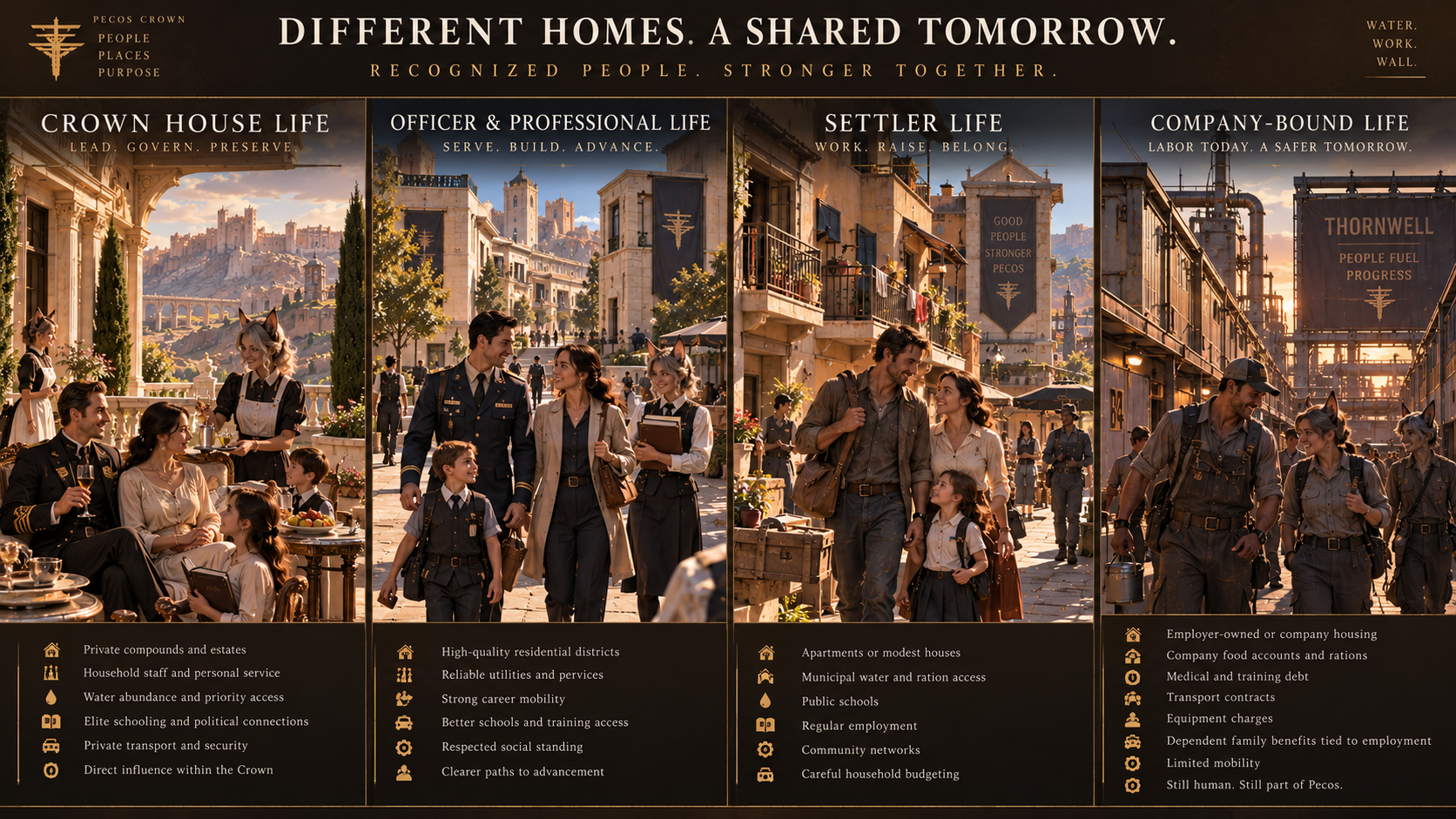
Recognized Human Life // Class & Residential Standing
Pecos Crown // Human Life
From Company Quarters to Officer's Rise
The Uneven Distribution of Human Privilege
Recognized human citizenship creates a legal boundary between those the Crown considers full civic persons and those it does not. Within that protected population, however, wealth, rank, employment, family name, and corporate dependency create enormous differences in comfort, mobility, opportunity, and political influence.
Crown House Institutional Power
Officer & Professional Secure Advancement
Settler Ordinary Civic Life
Company-Bound Dependent Recognition
01
Crown House Life
Wealth // Access // Institutional Control
Crown House families occupy the most privileged edge of recognized human society. Their wealth is reinforced by ownership of infrastructure, contracts, corporate holdings, and direct political access.
Senior officers, engineers, administrators, physicians, technical specialists, and established professionals usually enjoy high-quality housing, dependable utilities, respected status, and clearer paths toward advancement.
Secure DistrictsReliable UtilitiesStrong Career MobilityBetter SchoolsProfessional Networks
03
Settler Life
Work // Household // Municipal Citizenship
Most recognized humans live closer to the settler standard: apartments or modest houses, municipal water, public education, regular employment, neighborhood networks, and households that must budget carefully.
Company-bound humans retain recognized legal personhood, but their practical independence may be limited by employer housing, ration accounts, medical or training debt, transport contracts, equipment charges, and family benefits tied directly to continued employment.
Human privilege is real, but it is distributed very unevenly.
Crown law recognizes both the heir of an industrial dynasty and the refinery worker living in employer-owned quarters as human citizens. That shared status matters enormously when compared with controlled demi-human populations, but it does not erase the gulf in wealth, security, autonomy, or influence between the two.
Upper Extreme Crown House Heir
Both Recognized Human
Lower Extreme Company-Bound Laborer
They belong to the same recognized civic population. Their experience of Pecos can be barely comparable.
Pecos Crown // Human Life
The Good Citizen
Recognition, Obligation & Respectable Human Life
Recognized humans possess legal personhood, civic standing, and the right to make many decisions on their own behalf. Crown society nevertheless expects citizenship to be visible through conduct. A respectable adult is documented, productive, prepared, financially accountable, and capable of carrying their share when conditions become difficult.
Civic Expectation Index Recognition // Conduct // Contribution
01
Documented
Keep identification current.
Citizenship records, household registration, permits, employment documentation, and required identification are expected to remain accurate and accessible.
02
Employed
Adults are expected to contribute.
Work is central to respectable adulthood. Long-term unemployment without recognized cause can damage both personal and household reputation.
03
Solvent
Debts and obligations matter.
Rent, loans, company accounts, family obligations, contracts, and other debts are treated not merely as financial matters but as evidence of reliability.
04
Respectable
Conduct reflects the household.
Public behavior can affect family reputation, professional standing, and community trust. Rank may protect someone from consequences, but it does not prevent people from remembering poor conduct.
05
Prepared
Know what happens when systems fail.
Citizens are expected to understand evacuation routes, ration procedures, emergency shelters, water restrictions, rail disruptions, and local disaster protocols.
06
Security-Compliant
Cooperate when security takes priority.
Checkpoints, weapons regulations, inspections, emergency orders, restricted zones, and temporary movement controls are broadly accepted as part of western security culture.
07
Useful
Know something. Do something. Carry something.
Useful skill remains one of the strongest measures of adult respectability. A person is expected to possess some ability, trade, knowledge, service, or practical function others can depend upon.
Civilian Culture // Military Influence
Military Expectation
Not every human citizen serves in uniform, but nearly every citizen grows up inside a culture shaped by military logic. Border insecurity, fortress settlements, emergency planning, containment doctrine, and the prestige of Crown service make defense part of ordinary civic identity rather than a separate military world.
Service Military careers carry prestige.
Rank Officers possess significant social status.
Mobilization Emergency activation is culturally accepted.
Schools Preparedness is taught from childhood.
Industry Many civilian trades support defense.
Frontier Border danger shapes national identity.
Human Civic Understanding
What Humans Call Freedom
To most Pecos humans, freedom does not mean living without obligation. Work, documentation, security requirements, taxation, service, debt, and social expectation are accepted as ordinary parts of citizenship.
Recognized Human I owe the Crown something.
The Difference
Controlled Demi-Human The Crown decides what I am for.
The Boundary of Human Freedom
To most Pecos humans, freedom means being trusted to fulfill obligations without being owned.
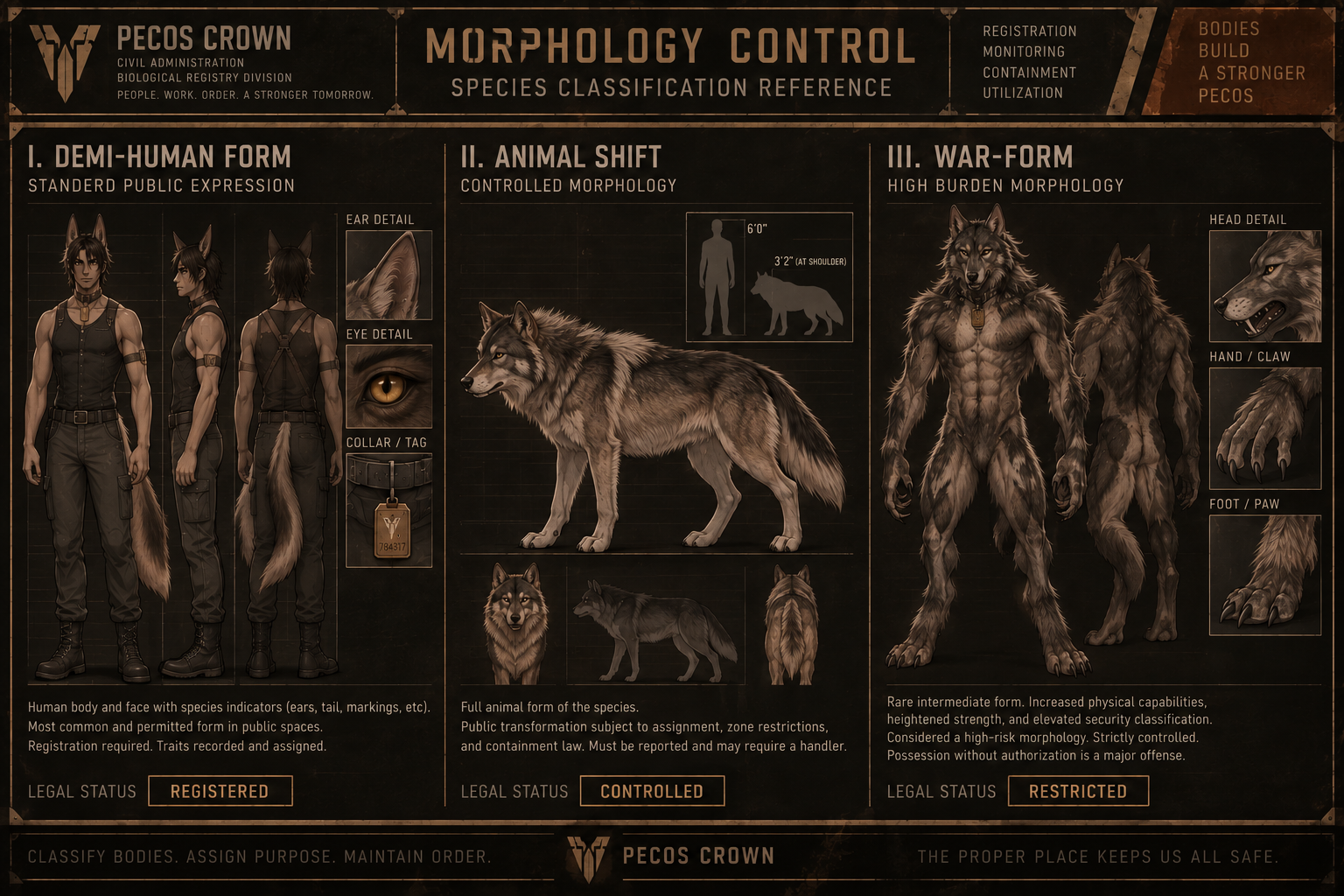
CLASSIFICATION 03 War-Form High Burden Morphology Restricted
Pecos Crown // Demi-Human Life
The Difference Is in the Record
Two People. Two Administrative Relationships with the Crown.
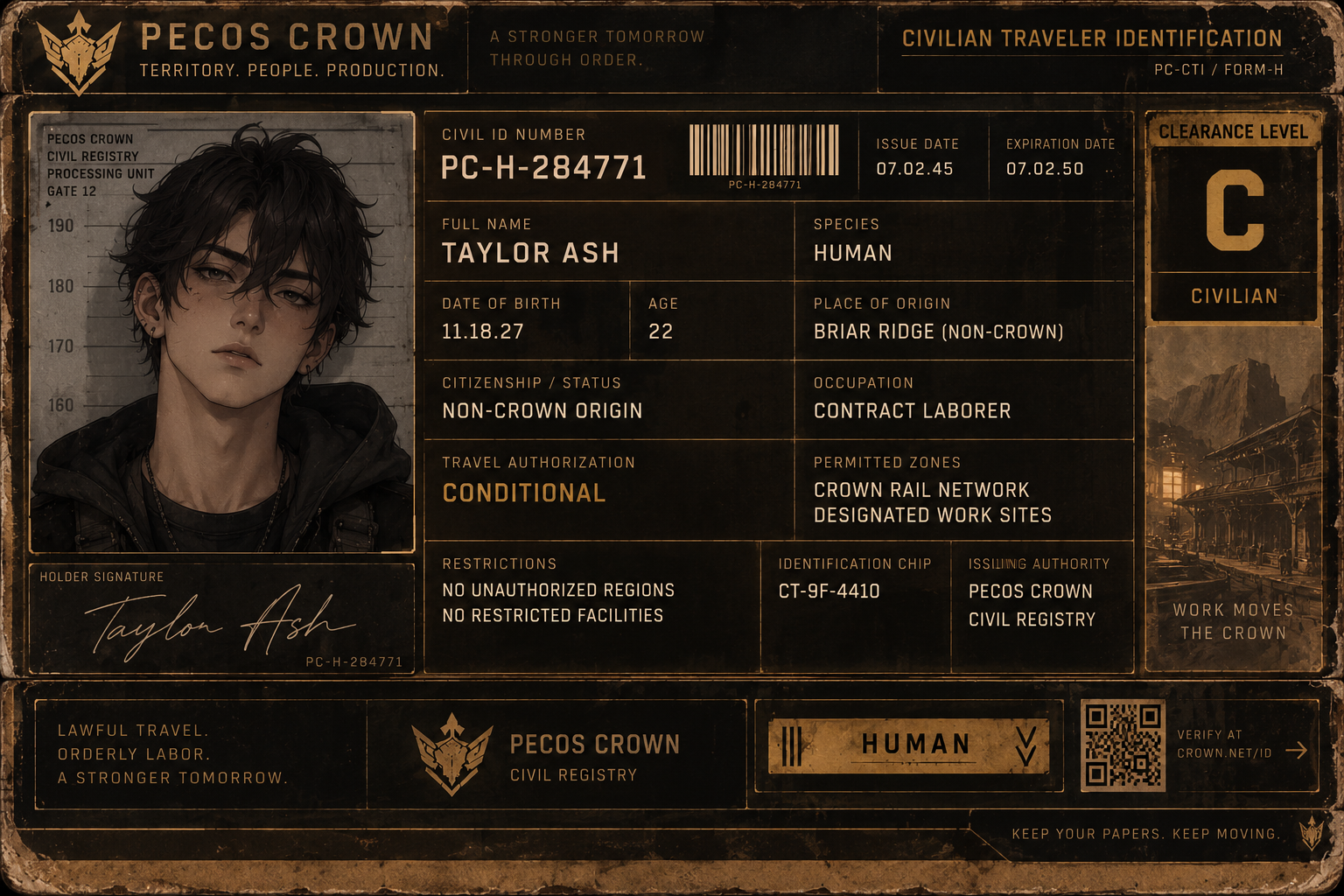
Civil Registry Human Record
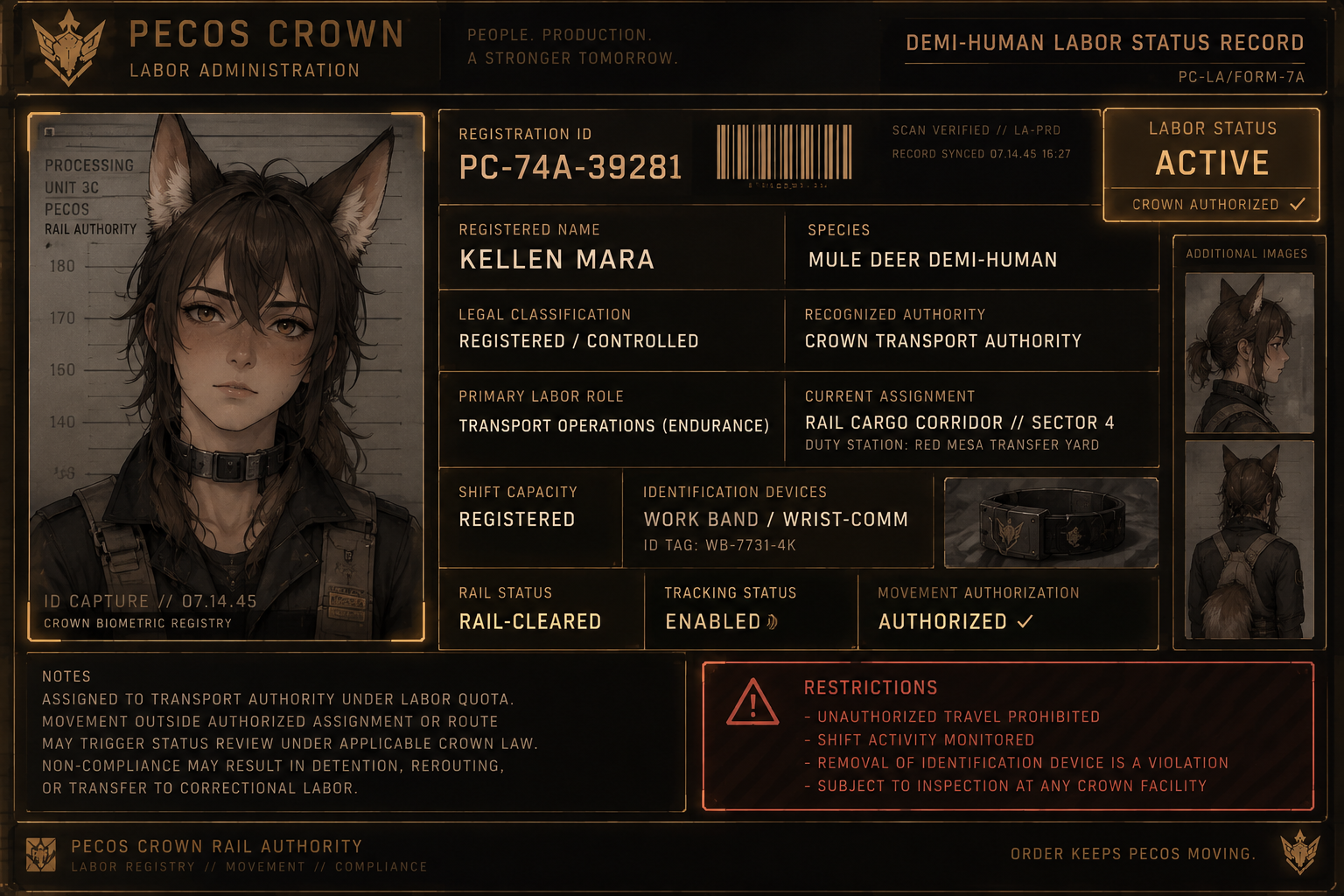
Labor Registry Demi-Human Record
Administrative Comparison Identity // Movement // Labor // Authority
Civil Registry
Primary Record Type
Labor Administration
Citizenship / Status
Legal Relationship
Registered / Controlled
Occupation
Work
Primary Labor Role
Travel Authorization
Movement
Movement Authorization + Tracking
Issuing Authority
Authority
Recognized Controlling Authority
Species: Human
Biological Data
Species + Shift Capacity
Identification Chip
Identification
Work Band / Wrist-Comm + Tracking
Human Record
Who Are You, and Where May You Go?
Even a non-Crown human contract laborer can be restricted, conditionally cleared, and required to carry identification. The record nevertheless treats the subject primarily as a civic person whose work and movement are being regulated.
Demi-Human Record
What Are You, Who Controls You, and What Are You Assigned To?
The demi-human record incorporates species, shift capacity, controlling authority, assigned labor role, tracking status, identification devices, movement authorization, and compliance restrictions into the subject's legal identity.
Same Bureaucracy. Different Purpose.
Both people are documented. Only one record treats the subject's body, movement, labor, and biological capacity as administrative assets.
The Administrative Boundary
For a human, documentation establishes civic identity. For a controlled demi-human, documentation establishes custody.
Pecos Crown // Registered Labor Life
A Day Under Assignment
Routine Life for a Controlled Demi-Human
For many controlled demi-humans, daily life is not defined by constant crisis. It is defined by routine. Work assignments, movement permissions, identification scans, controlled housing, and mandatory return are built into ordinary schedules so thoroughly that compliance becomes the basic structure of a day.
Example Worker // W-27 Daily Status // Compliant
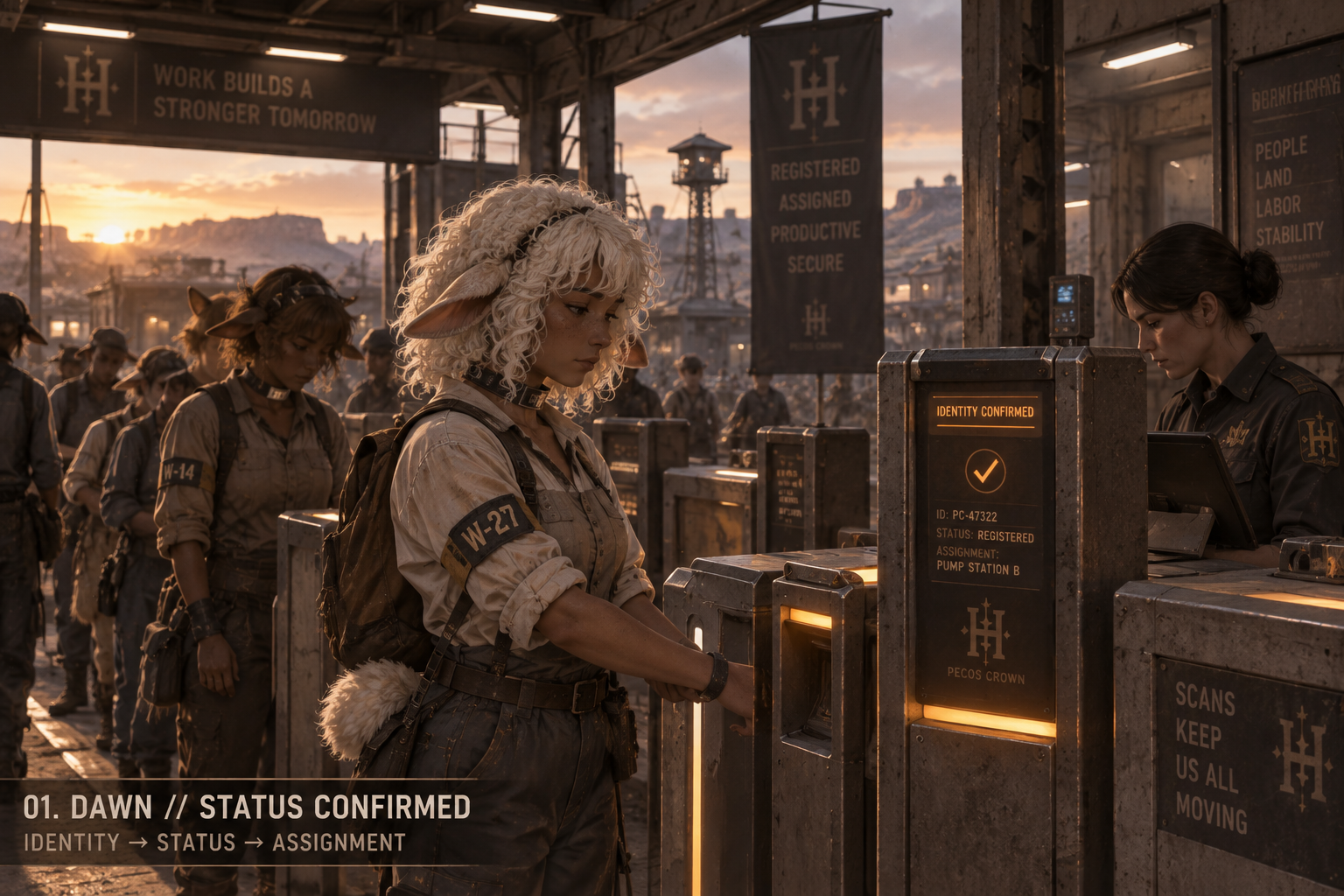
Dawn // Status Confirmation
01 // Dawn
Status Confirmed
Identity → Status → Assignment
The day begins with verification. Identification, registration status, and current assignment are confirmed before the worker enters the labor system for the day. For controlled workers, the first practical question of morning is often not where they intend to go, but where they have been assigned.
Identity ScanStatus CheckAssignment ConfirmationWork Band Active
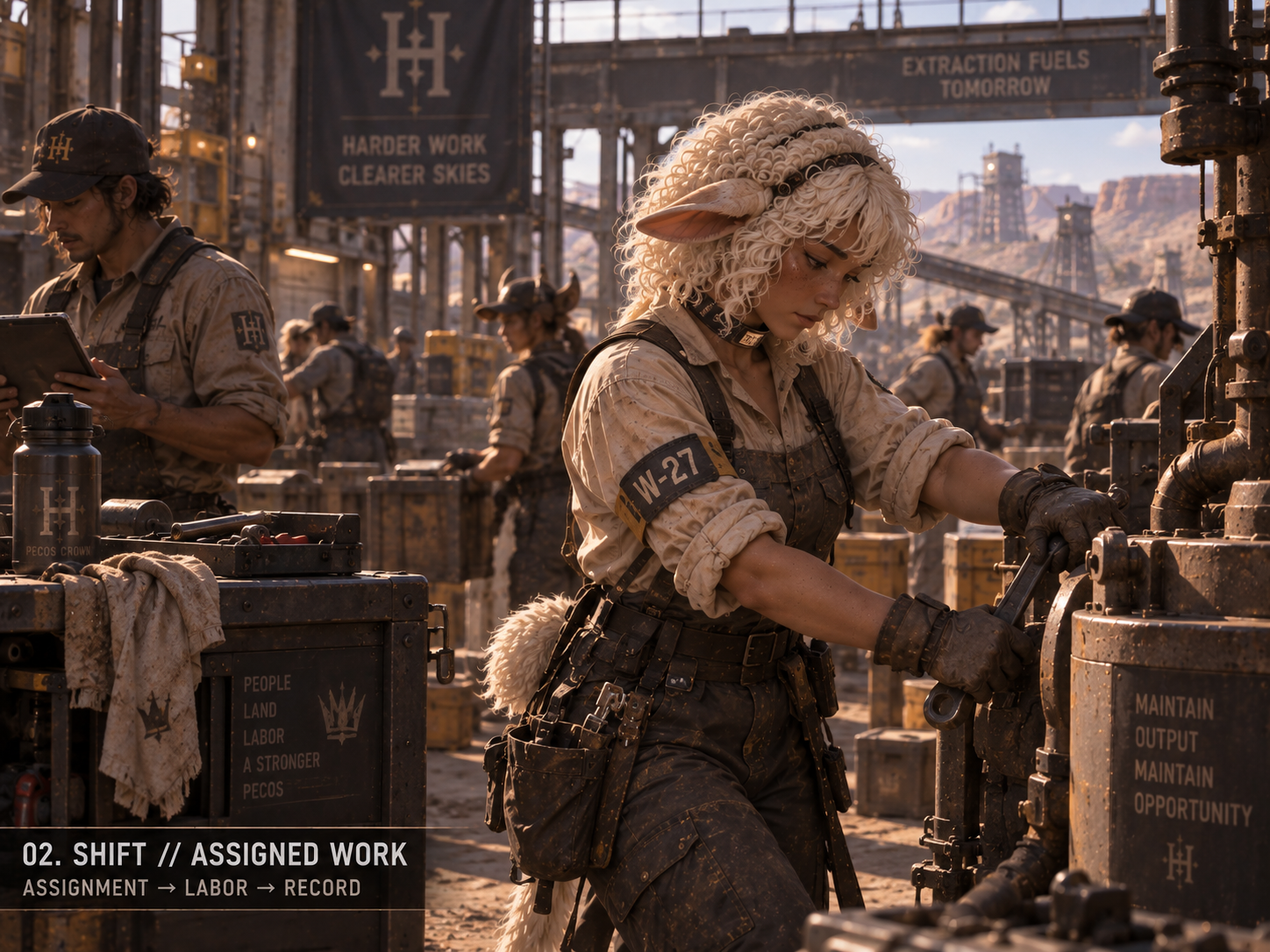
Shift // Assigned Labor
02 // Shift
Assigned Work
Assignment → Labor → Record
Labor is performed according to assigned role, workplace schedule, and institutional authority. Output, attendance, physical capacity, and compliance may all become part of the worker's continuing record.
Competence does not necessarily create autonomy. A demi-human can become highly skilled at work they never chose.
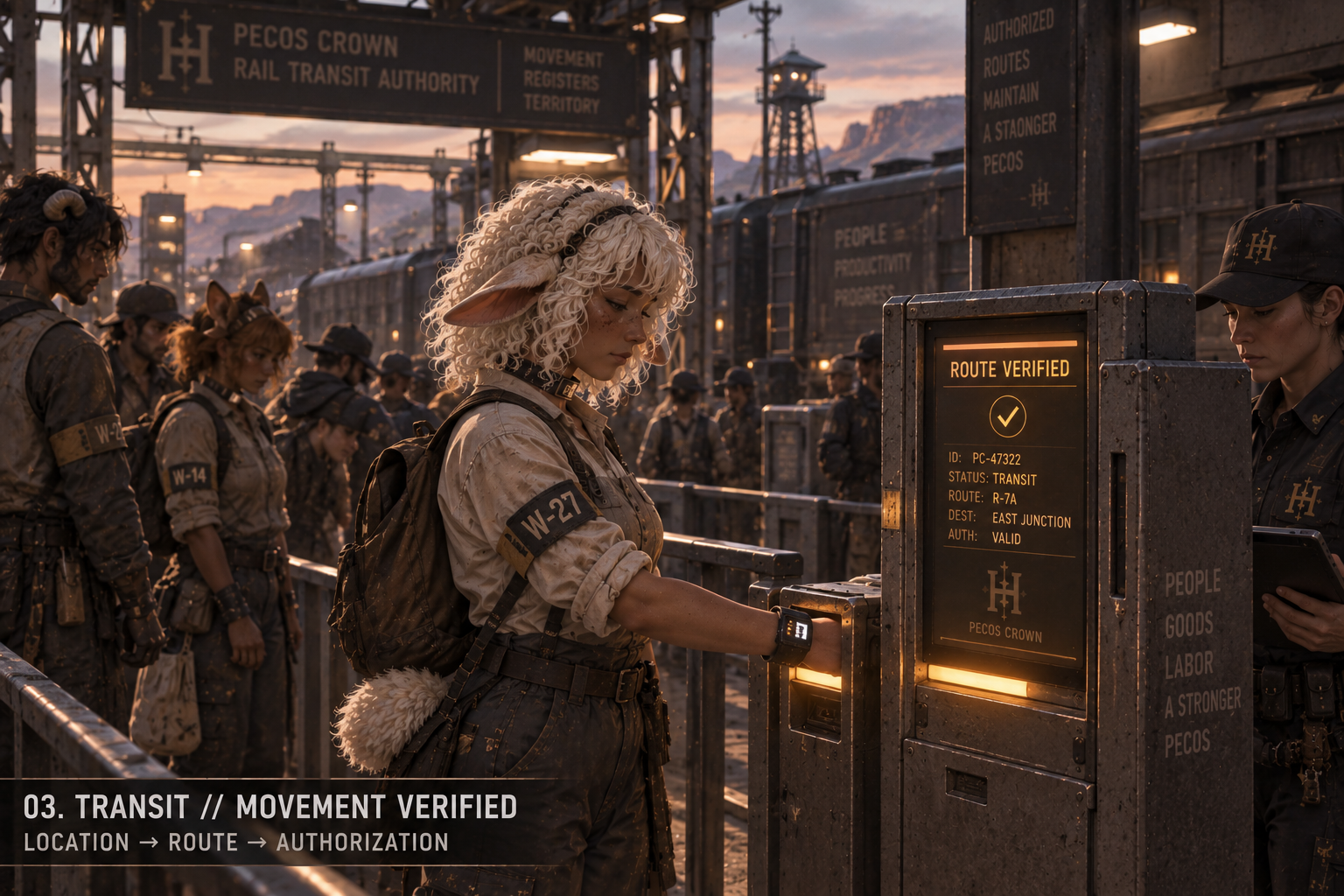
Leaving the worksite does not necessarily mean unrestricted movement. Authorized travel may cover a housing return, approved rail transfer, medical visit, supply errand, reassignment, or movement specifically permitted by an owner or institution.
Location CheckedRoute VerifiedDestination AuthorizedTransit Recorded
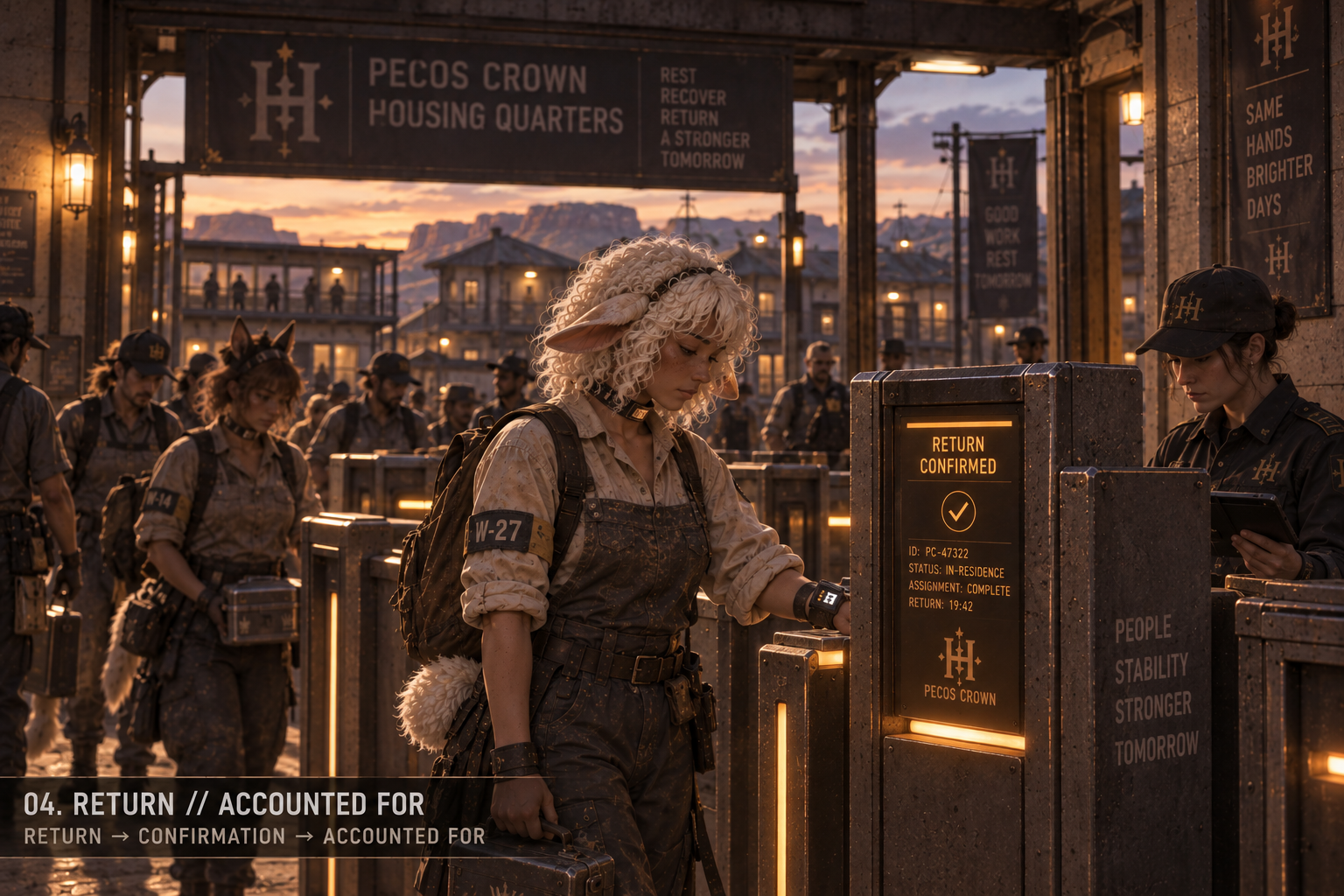
Return // Accounted For
04 // Return
Accounted For
Return → Confirmation → Accounted For
The worker's return may be logged through housing scans, gate records, work-band confirmation, or institutional attendance systems. Late arrival, route deviation, or failure to return can trigger review depending on legal status and controlling authority.
A residence can be livable and still not be somewhere its occupant is legally free to leave.
Housing ReturnPresence ConfirmedAbsence FlagsStatus Accounted For
Rest // Recovery
05 // Rest
Recover for Tomorrow
Rest → Recovery → Return to Function
Housing standards vary enormously. Some controlled workers receive maintained dormitories, shared rooms, bunks, or private spaces. Others receive only whatever an owner, employer, or institution considers sufficient.
A proper bed, privacy, storage, personal comfort, or time away from labor may depend entirely on who controls the worker and what that authority considers worth providing.
Rest is recognized because rested labor performs better.
Standard Daily Compliance Cycle
Identity
Assignment
Labor
Authorized Movement
Return
Rest
Scan → Work → Transit → Return → Sleep → Repeat
No Exceptional Incident Recorded
No crisis. No disciplinary action. No exceptional event. This is what successful compliance looks like.
What Counts as a Good Day? Labor Status // Normal
Assignment Completed
Quota Met
Movement Authorized
Return Confirmed
Compliance No Incident
A successful day within the system is one in which nothing happens that causes the system to notice the individual beyond confirming that they remained where they were supposed to be, performed the expected work, moved through authorized routes, and returned when required.
Ordinary Control
The most ordinary form of control in Pecos is routine.
Pecos Crown // Demi-Human Life
What the Crown Sees
Biology as Labor Capacity
The Burden Principle does not classify demi-humans only by species. It translates physical traits, shift capacity, environmental tolerance, sensory ability, and bodily strength into expected forms of service.
In Crown administration, biological difference becomes occupational logic. A trait that might elsewhere be understood as personal identity becomes evidence of what kind of labor a body is considered suited to perform.
Labor Capacity Record // 01–02 Strength // Endurance // Load
Extraction Labor
01 // Extraction
Mining & Extraction
Strength // Endurance // Repetitive Load
Physically strong or highly enduring demi-humans are frequently directed toward mining, excavation, ore movement, loading, and other labor where bodily output can be measured directly against production.
Under Crown logic, exceptional physical capacity is not merely a personal advantage. It becomes evidence that heavier work is an appropriate burden.
MiningExcavationOre HandlingHeavy Load
Rail Infrastructure
02 // Rail
Rail & Heavy Infrastructure
Load Capacity // Strength // Physical Stability
Rail corridors require constant maintenance, material movement, track repair, coupling work, freight handling, and emergency physical labor. Demi-humans classified for strength are frequently placed into these roles.
The work may be skilled and highly respected by the crews who depend upon it. That respect does not necessarily include the right to refuse the assignment.
Vision // Height Access // Aerial or Sensory Advantage
Keen eyesight, elevated mobility, flight capacity, or other sensory advantages can lead to assignment in observation, border scanning, route inspection, signal work, and long-distance monitoring.
The classification system therefore reaches well beyond strength. A body can become occupationally valuable because it sees farther, hears better, moves differently, or reaches spaces another worker cannot.
Canine and other sensory-specialized demi-humans may be assigned to recovery operations, search teams, route tracing, contraband detection, missing-asset searches, or pursuit work.
Biological perception becomes an administratively recognized tool and may be recorded as part of labor suitability.
Scent WorkSearchRecoveryPursuit
Desert Works
05 // Desert Works
Heat-Zone Infrastructure
Heat Tolerance // Environmental Resistance
Reptilian and other heat-tolerant demi-humans are commonly regarded as suited to exposed desert labor, hot industrial zones, pipeline maintenance, thermal sites, and other work where environmental tolerance reduces operational risk.
Crown doctrine treats the ability to endure harsher conditions as justification for assigning harsher conditions.
The useful trait does not need to be extraordinary. It only needs to be administratively valuable.
Labor Capacity Record // 06–08 Logistics // Strategic Capacity // Essential Systems
Freight // Logistics
06 // Freight
Freight & Industrial Logistics
Strength // Repetition // Load Handling
Freight yards, warehouses, rail depots, transfer stations, and industrial supply chains require constant movement of material. Demi-humans classified for strength, stamina, or load stability are frequently placed into logistics roles.
Their labor can be essential to the movement of nearly everything Pecos produces while remaining legally categorized as assigned biological utility.
War-form capability occupies the most heavily controlled end of Crown biological classification. Individuals capable of extreme transformation may be treated simultaneously as security risks, strategic assets, containment subjects, and deployable force.
Training, suppression, deployment authority, monitoring, and emergency containment can all be justified through the argument that such capacity cannot be allowed to exist outside recognized control.
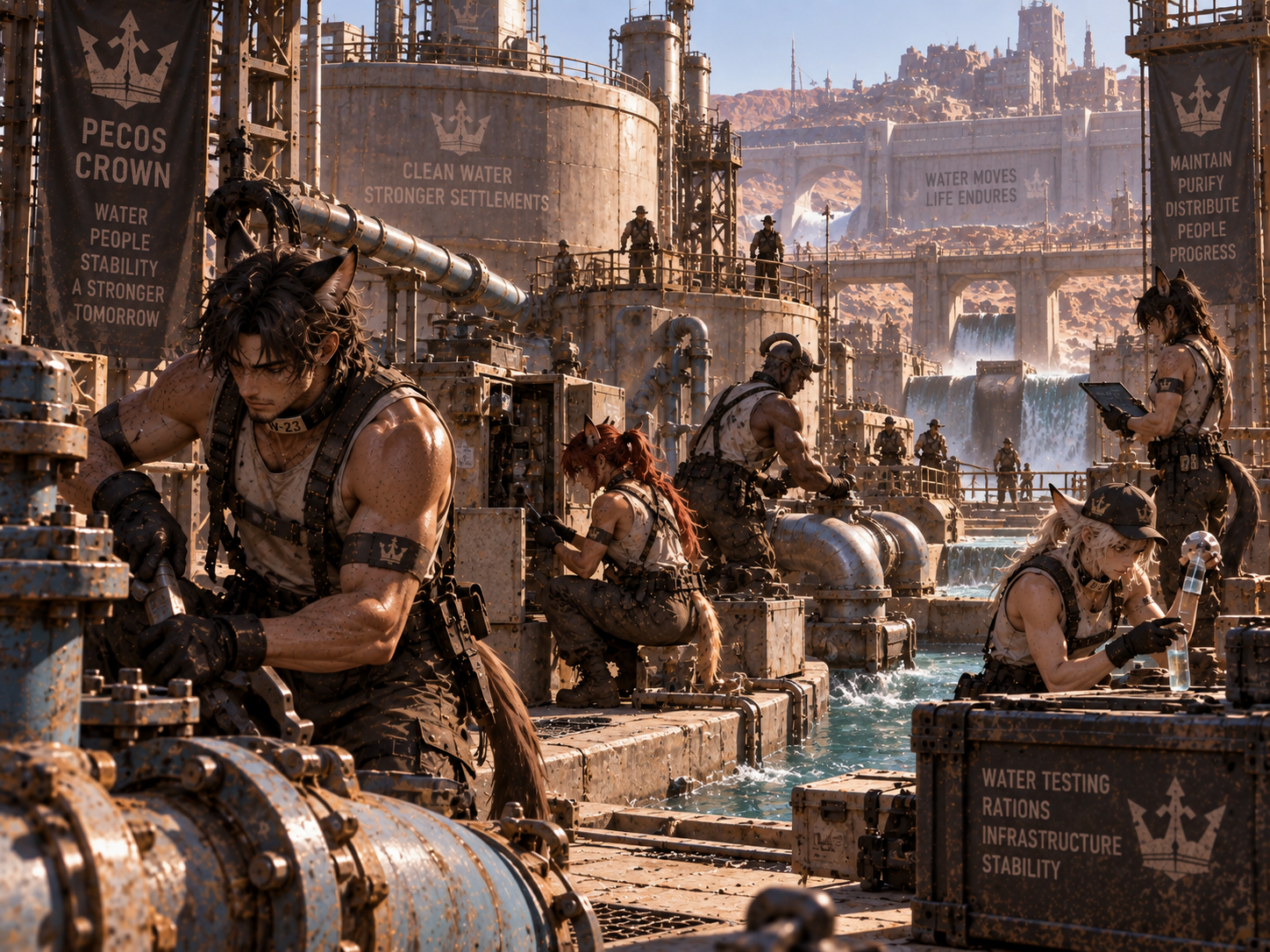
Demi-humans also work inside the systems Pecos considers most sacred to civilian survival: pumps, treatment sites, distribution lines, reservoir machinery, testing stations, and municipal water infrastructure.
This creates one of the clearest contradictions in Crown society. Controlled workers can be essential to preserving the water supply that symbolizes civilization itself while remaining denied equal control over their own labor and movement.
PumpingTreatmentDistributionTestingMaintenance
Crown Assignment Logic Biology → Utility → Administrative Function
Pecos Crown // Labor Classification
From Body to Assignment
How Biological Capacity Becomes Administrative Purpose
Specialized Biology Any occupational function the Crown determines can be supported by species traits, physiology, or demonstrated biological advantage.
The Burden Principle in Practice
The Crown does not ask only what a demi-human can do. It asks what their body makes them useful for.
A demi-human may become highly trained, respected for competence, trusted with difficult machinery, or essential to the operation of the realm without ever receiving the right to decide whether that work is theirs to perform. Assigned labor is not necessarily unskilled labor. The defining question is who possessed the authority to choose it.
Pecos Crown // Demi-Human Life
Control Is Worn
Identification, Movement & Compliance Equipment
Crown control does not always resemble imprisonment. For registered demi-humans, identification, labor attendance, location tracking, transit authorization, and status verification can be built into devices worn throughout ordinary life.
Some equipment exists primarily to identify or record. Other devices restrict movement, enforce compliance, or physically restrain the wearer. Their shared function is to keep a controlled person legible to the systems claiming authority over them.
Ear tags provide permanent or semi-permanent visible identification for registered demi-humans. Their most immediate function is simple: status can be read directly from the body without requiring the individual to produce separate documentation first.
RegistrationVisible IDRecord Link
Work Attendance Device
02 // Labor
Work Cuff / Tail Cuff
Sign-In // Sign-Out // Attendance
Scannable cuffs worn on the wrist, tail, or another practical location are used to register arrival and departure from assigned work. Attendance therefore follows the worker directly rather than existing only as a workplace record kept elsewhere.
Clock in. Perform the assignment. Clock out. The timecard is attached to the laborer.
AttendanceShift RecordWorksite ScanAssignment
Location Tracking
03 // Location
Digital / Holowatch
Location // Status // Tracking
Digital or holo-based wrist devices can track the wearer's location. Their ordinary appearance allows surveillance infrastructure to blend easily into the same technological environment used for schedules, identification, work records, and transit information.
LocationTrackingStatusMovement Record
Rail Transit Authorization
04 // Transit
Travel Tag
Rail Movement // Route Authorization
Travel tags are used for authorized rail transit. They connect the individual's identity to an approved route or movement permission and allow transit staff or automated systems to verify whether the wearer is permitted to be traveling where they are found.
For a controlled worker, a valid transit tag is not simply proof of payment. It is part of the authorization chain governing movement.
RailRouteAuthorizationTransit Scan
Routine Control
A controlled demi-human does not need to be visibly restrained for the Crown to know who they are, where they work, whether they signed in, where they traveled, and whether that movement was authorized.
Harness equipment may be issued as part of a demi-human's assigned work configuration. Exact construction and use can vary by occupation, body type, institution, or worksite.
The harness itself therefore signals something broader about Crown labor administration: equipment can be fitted around the body according to the function that body has been assigned to perform.
Issued EquipmentAssignmentWork Configuration
Active Compliance Device
Active Enforcement Capability
06 // Compliance
Smart Collar
Tracking // Compliance // Electrical Shock
Smart collars combine tracking with an active enforcement function. In addition to reporting location, the device can administer an electrical shock to the wearer.
The collar therefore crosses the line between recording behavior and directly enforcing compliance through physical consequence.
TrackingComplianceShock CapabilityActive Control
Custodial Restraint
07 // Custody
Prison Cuffs
Detention // Transport // Physical Restraint
Prison cuffs are physical restraint equipment used in detention and prisoner transport. Unlike routine labor identification or transit equipment, their purpose is direct custodial restraint.
They belong to the punitive end of Crown control rather than the ordinary equipment of a compliant assigned worker.
Ear tags, work cuffs, tracking watches, and transit tags allow identity, labor, location, attendance, and movement to remain visible to Crown systems during ordinary daily life.
Active Coercion & Custody
When Administrative Control Is Considered Insufficient
Smart collars and prison restraints demonstrate the more overt end of the same control structure, where surveillance gives way to punishment, restriction, or physical custody.
Crown Control Continuum
Identify
Record
Track
Authorize
Restrict
Restrain
Control Made Ordinary
The Crown does not need every boundary to look like a cage. Many of them can be worn.
Pecos Crown // Demi-Human Life
Demi-Human Legal Status
Ownership, Administration & Recognized Authority
A demi-human's legal status in the Pecos Crown does not primarily describe occupation, wealth, living conditions, or personal reputation. It establishes the administrative relationship between the individual and the authority legally permitted to make decisions about their labor, movement, housing, and custody.
Primary Legal Category
Registered / Controlled
The broad recognized status for a demi-human under Crown administration. Registration links the individual to an official identity record containing relevant information such as species, shift capacity, labor role, movement permissions, identification devices, tracking requirements, and recognized controlling authority.
Recognized Authority Class Who Holds Ordinary Administrative Authority?
01 // Private Authority
Privately Owned
Individual // Household // Crown House
Recognized authority belongs to a private individual, household, or Crown House. Within Crown law, that authority may determine ordinary housing, permitted movement, work expectations, travel approval, and other aspects of daily life.
HouseholdPrivate AuthorityDomestic LaborPersonal Service
02 // Corporate Authority
Company-Owned
Corporation // Industrial Concern
Recognized authority belongs to a corporation or industrial concern. This status is common within extraction, freight, refining, infrastructure, and other large labor systems where work, housing, transport, provisioning, and supervision may all be administered by the same organization.
ExtractionFreightIndustryCorporate Housing
03 // State Authority
Crown-Administered
Government // Authority // Commission
Direct administrative control belongs to a Crown institution rather than a private owner. Records may list agencies such as transport, water, military infrastructure, civic works, or another recognized Crown office as the controlling authority.
RailWaterCivic WorksState Service
04 // Administrative Interval
Unassigned
Registered // Awaiting Placement
The individual remains registered and controlled but currently lacks a permanent labor assignment. Unassigned status may occur during reassessment, medical recovery, training, transfer, ownership change, worksite closure, or another interruption in ordinary placement.
The Crown treats this as an unresolved administrative state, not as release from control.
Status Modifiers & Custodial States Additional Restrictions May Override Ordinary Authority
Security-Restricted
Modifier // Heightened Control
Applied to demi-humans considered unusually dangerous, strategically valuable, difficult to contain, or otherwise high-risk. War-form capability, dangerous shifts, exceptional combat capacity, or security history may result in stricter movement, housing, tracking, equipment, or transfer requirements. This status can exist alongside private, company, or Crown authority.
Transit Custody
Temporary // Transfer
Temporary custodial status used while a demi-human is moved between recognized authorities, owners, assignments, worksites, or facilities. Travel authorization establishes the approved route, destination, and receiving authority. The individual is being transferred rather than simply traveling independently.
Detained
Custodial // Enforcement
The individual is held under law-enforcement, security, military, court, or prison authority. Ordinary ownership or assignment arrangements become subordinate to immediate custody until release, sentencing, transfer, or another administrative disposition.
Outside Recognized Administration
The Unmarked
The Unmarked exist outside valid Crown registration. They possess no recognized controlling authority, approved assignment, lawful movement record, or accepted administrative status. Crown institutions therefore do not interpret an Unmarked demi-human as an ordinary independent resident.
In Crown administrative logic, an Unmarked demi-human is not recorded as free. They are recorded as outside lawful control.
Important Distinction
Status Is Not Occupation
Two demi-humans may perform nearly identical work while belonging to completely different authority structures. A Crown-administered rail worker and a company-owned freight worker may both handle rail infrastructure, but their records answer to different institutions.
Important Distinction
Status Is Not Treatment
Legal status establishes authority, not living conditions. A privately owned demi-human may receive excellent housing, clothing, medical care, education, affection, or considerable personal comfort and still remain legally owned. Another worker under Crown administration may receive only minimal provision.
Corporate Freight Worker Legal Status: Registered / Controlled Authority: Recognized Freight Company Authority Class: Company-Owned Assignment: Freight Transfer
What Status Actually Means
In the Crown, a demi-human's status does not describe who they are. It describes who is authorized to make decisions about them.
Propaganda
Civic Rituals
Pecos Crown // Civic Life
Civic Life & Ritual
The Customs That Make Pecos Feel Like Home
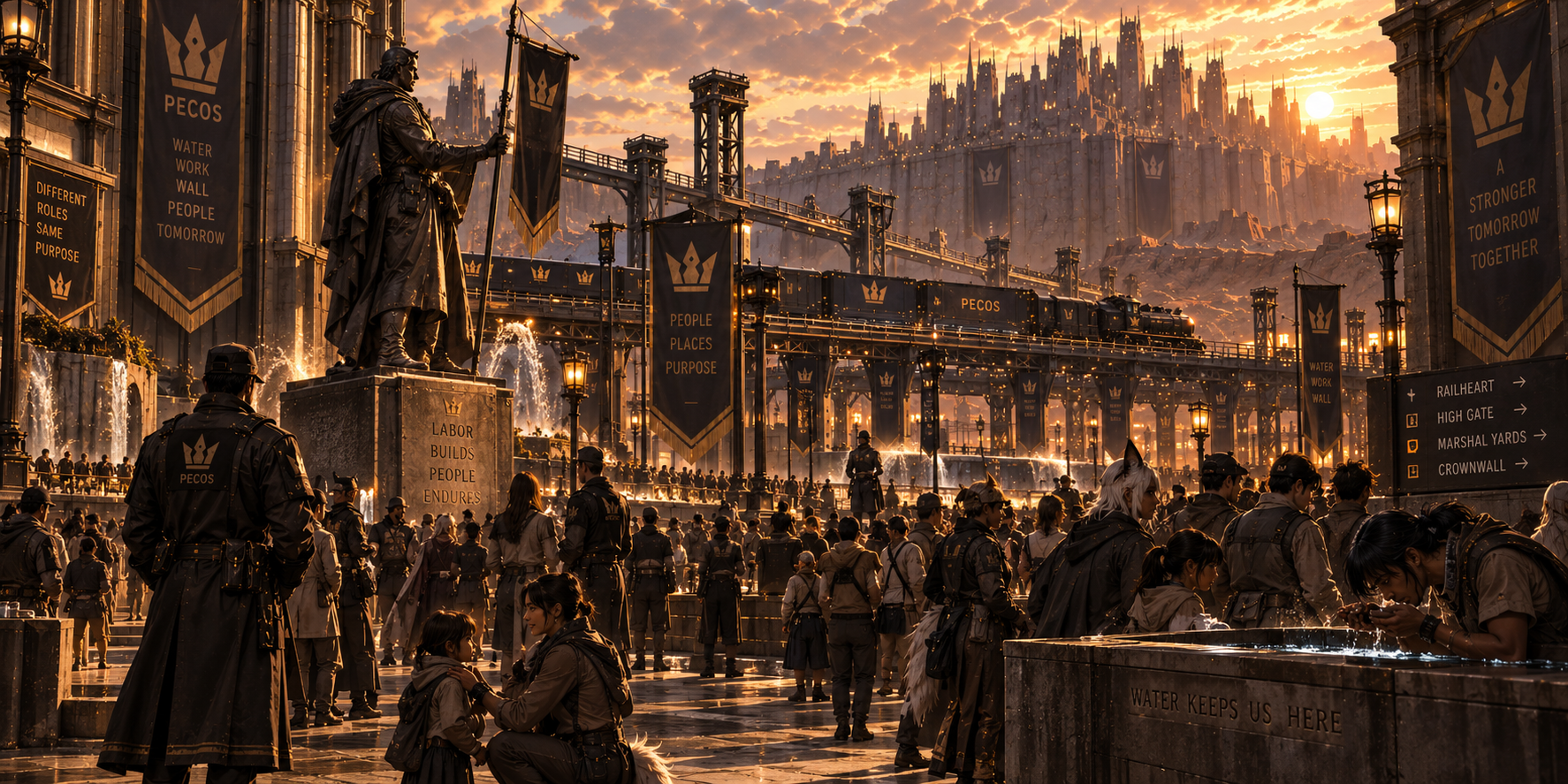
Pecos civic life is built around things people can touch. A cup of water. A rail beneath the palm. A maintenance plate carrying generations of names. A wall of the dead. A tool handed from one worker to another.
The Crown has spent generations turning the systems required for western survival into symbols of national identity. Water represents preservation. Work represents contribution. Rail represents connection. The wall represents defense.
These ideas appear constantly in government doctrine, but they also exist inside households, workplaces, schools, neighborhoods, crews, and family memory.
Pecos Gate // Public Civic Gathering
The Civic Vocabulary Survival Made Symbolic
Water
Sustain // Preserve // Continue
Work
Contribute // Maintain // Carry
Rail
Connect // Return // Endure Distance
Wall
Defend // Remember // Hold
More Than State Ceremony
Pecos ritual is not practiced only by people who approve of the government. A citizen can distrust the Crown Authority and still observe Crownfall Day. A mechanic can mock official slogans while refusing to send a locomotive out without the old rail blessing. A family can resent military authority while preserving the service photograph of someone whose name remains on a memorial wall.
Institutional Meaning
Necessary Systems Become National Symbols
Crown institutions deliberately connect water, labor, transportation, preparedness, and defense to ideas of citizenship and national continuity. Ceremony reinforces the belief that Pecos survives because essential systems are maintained and essential burdens are carried.
Lived Meaning
National Symbols Become Personal Memory
Generations of residents have attached family stories, workplace loyalties, grief, affection, pride, humor, and resentment to the same customs. A ritual can therefore belong to Pecos culture even when the person performing it rejects the institution that once formalized it.
Civic Life in the Western Crown
Infrastructure became identity because generations of people built their lives around keeping it alive.
Pecos Crown // Civic Ritual
Water Oaths
By Water, Work, and Wall, I Hold.
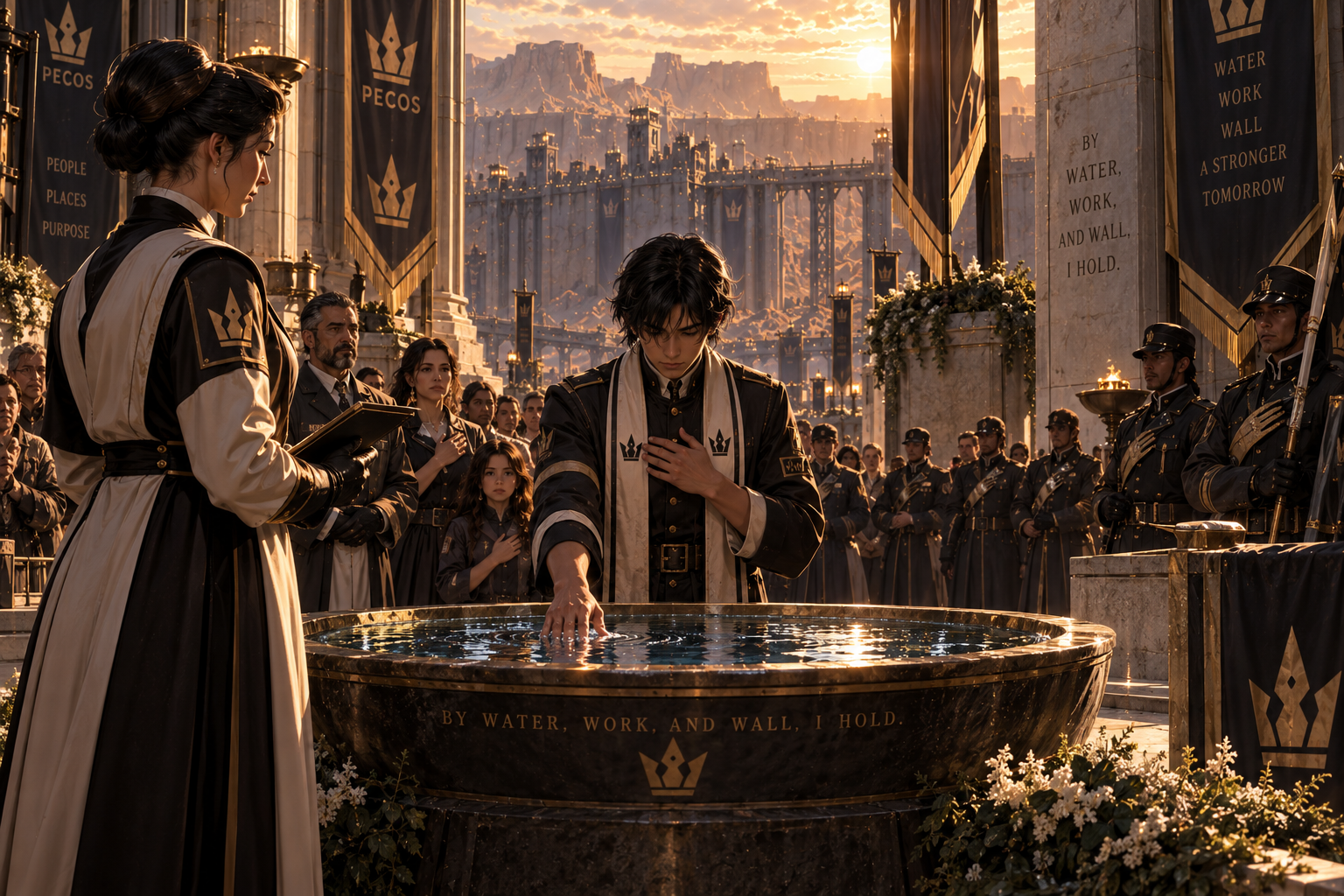
The Water Oath is one of the most recognizable civic rituals in the Pecos Crown. It is spoken at moments when a person is formally accepting a new public responsibility, entering a recognized stage of civic adulthood, or binding themselves to service larger than the household.
The ritual is deliberately simple. A small cup, bowl, or civic basin of clean water is placed before the oath-taker. They touch the vessel or place their fingertips briefly against the water before speaking the traditional words:
Traditional Civic Oath
By water, work, and wall, I hold.
Formal Water Oath // Civic Recognition
Water // Work // Wall Sustain // Contribute // Defend
Water
Sustain Life // Preserve What Is Necessary
Work
Contribute // Carry One's Share
Wall
Defend // Hold What Others Built
Hold
Continue // Remain // Accept Responsibility
Water Is Never Wasted
Ceremonial water is not poured onto the ground or discarded after the oath. Doing so would contradict the values the ritual is meant to express. Depending on the setting, the water is drunk, shared, returned to service, or otherwise used normally after the ceremony.
Formal Use
Recognized Civic Responsibility
Full Water Oaths commonly accompany the completion of schooling, entry into public or military service, assumption of certain offices, major professional recognition, and other occasions when a recognized citizen publicly accepts new responsibility.
Controlled Demi-Human Use
Similar Words, Different Standing
Controlled demi-humans may encounter shortened or adapted forms through workplaces, training programs, Crown service, household custom, or education. The language may sound nearly identical, but participation does not grant the same legal standing or civic autonomy as the oath of a recognized human.
Household Preparation // Family Tradition
The Oath at Home
Many families prepare for formal oaths privately. An old metal cup may be polished. A parent may explain the words. A vessel used by earlier generations may be brought out for the occasion. What began as civic ceremony has therefore become a family milestone as well as a public one.
What the Oath Promises
The Water Oath does not promise loyalty to a particular leader. It promises continuity.
Pecos Crown // National Observance
Crownfall Day
The National Day of Endurance
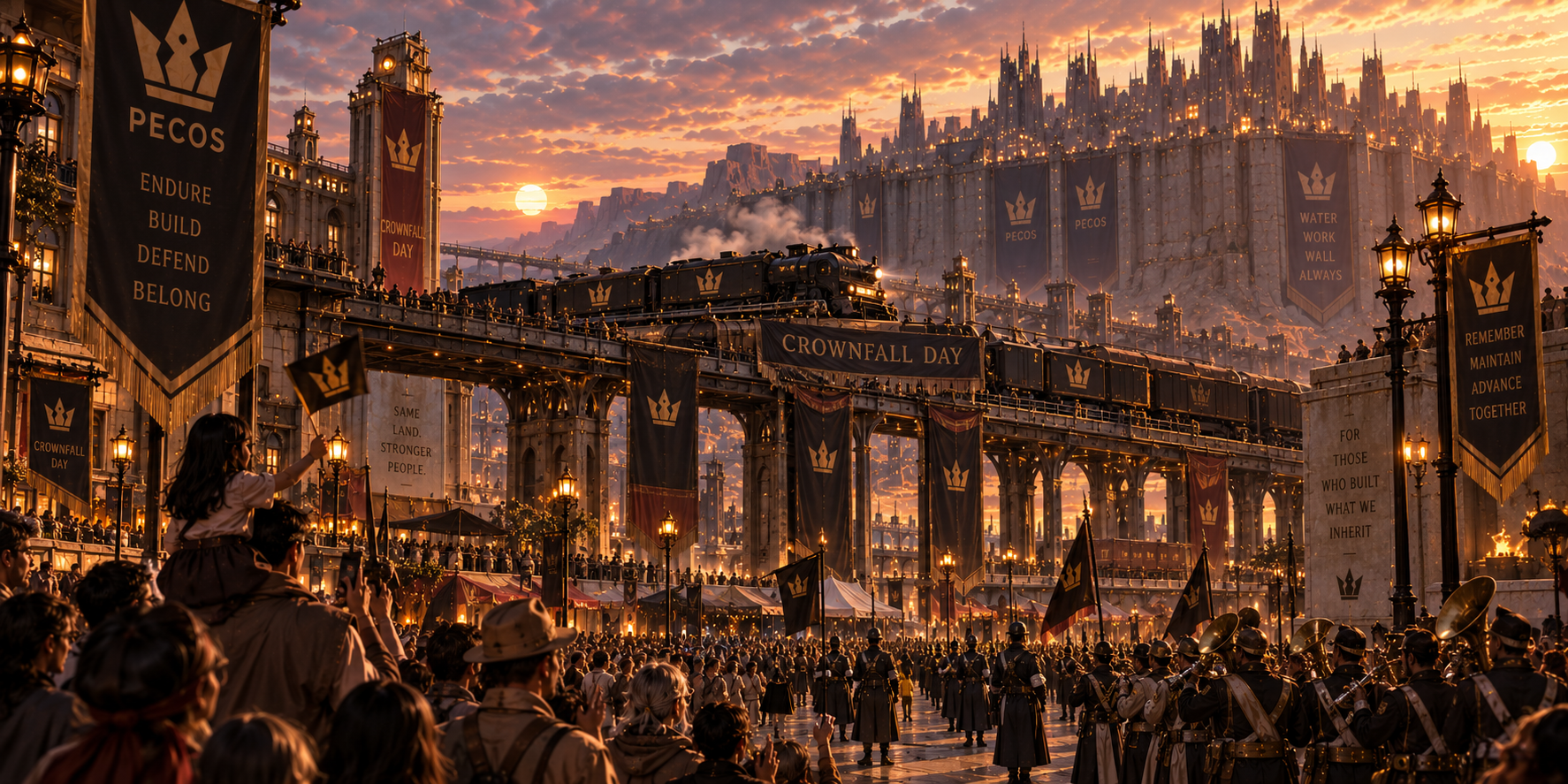
Crownfall Day is the Pecos Crown's largest annual civic observance. Official ceremonies emphasize national continuity, western settlement, infrastructure, sacrifice, and the survival of the realm through periods when survival was never guaranteed.
Outside government ceremonies, the day is less uniform. Families gather. Rail crews decorate locomotives. Settlement associations read old names. Military families wear service pins. Neighborhoods share meals beneath civic banners. Children hear stories about relatives who built wells, repaired lines, defended settlements, or remained when leaving would have been easier.
Crownfall Day // Pecos Gate
Public Observance Remember // Maintain // Gather
Rail Horns
Major Lines Sound at the Civic Hour
Amber Light
Stations // Towers // Old Infrastructure
Names
Historic Crews // Lost Workers // Service Dead
Tables
Family Meals // Neighborhood Gathering
Civic Tradition
Infrastructure Is Put on Display
Locomotives, stations, pumping works, public halls, old machinery, and historic settlement structures are illuminated or decorated with restrained banners. Maintenance crews and other workers responsible for keeping essential systems operational may receive formal public recognition.
Desert Adaptation
Light and Sound Instead of Fireworks
Large fireworks displays are uncommon or restricted in many dry districts. Signal lamps, illuminated towers, rail horns, station whistles, fortress lighting, and lines of amber lamps provide the spectacle instead.
The Tone of the Day
Crownfall Day is solemn-proud before it is festive. It celebrates survival without pretending survival was easy. Official speeches may invoke national strength, but household traditions are often concerned with specific people, specific places, and the objects they left behind.
Crownfall Day // Household Memory
What Families Keep
Service pins, railway badges, old work tags, photographs, settlement papers, worn tools, maintenance markers, and military patches often reappear during Crownfall gatherings. Their value is not necessarily monetary. They establish continuity between the Pecos people live in now and the work remembered by the household.
Crownfall at Home
The state commemorates endurance in the abstract. Families remember who endured.
Pecos Crown // Rail Tradition
Rail Blessings
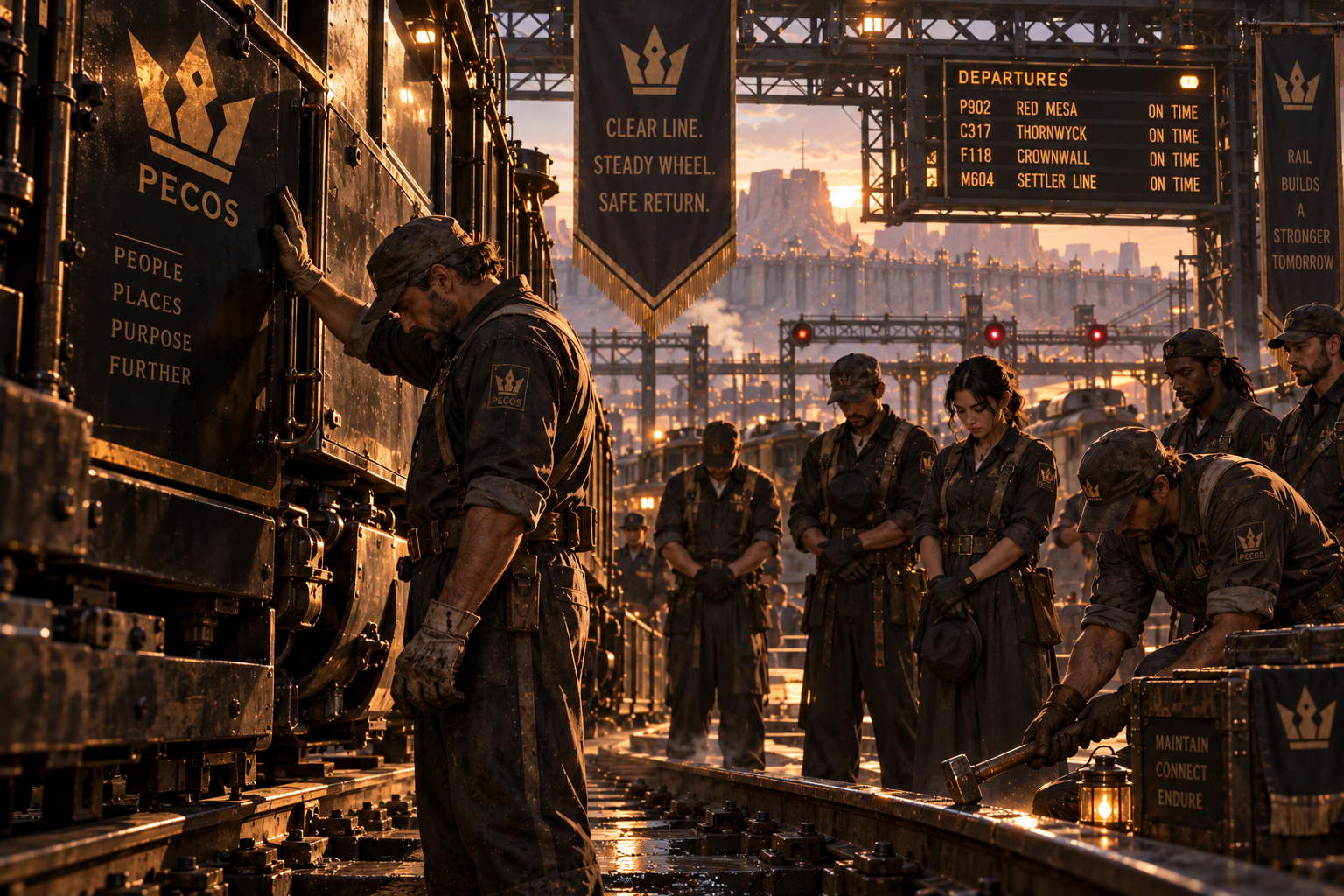
Clear Line. Steady Wheel. Safe Return.
Pecos rail blessings are not religious rites. They are worker customs built from repetition, danger, superstition, memory, and the simple fact that generations of western settlements have depended on trains returning when expected.
The practice appears most often before significant departures: the first run of a new line, the reopening of damaged track, the return of a locomotive after major overhaul, difficult mountain or desert routes, or the first ceremonial departure of Crownfall Day.
Railheart // Pre-Departure Blessing
Traditional Rail Blessing Inspection // Departure // Return
Clear Line
Route Open // Signals True
Steady Wheel
Machine Sound // Crew Prepared
Safe Return
Depart Together // Come Back Together
One Tap
Final Check // Ritual Confirmation
The Custom
An experienced engineer, mechanic, conductor, or dispatcher places a hand against the locomotive or rail. The final maintenance plate is checked. A wrench or inspection hammer gives the metal one clean tap.
Call
“Clear line.”
The route is ready. The signals are understood. Nothing known stands between the crew and the work ahead.
Answer
“Steady wheel.”
Machinery has been checked, maintenance completed, and crew prepared. What can be controlled has been controlled.
Crew Response
Safe return.
Official Ceremony, Worker Tradition
The Rail Commission uses the blessing during formal openings and major public departures, but the custom belongs just as strongly to crews. Workers may criticize administrators, mock ceremonial speeches, or argue over nearly everything else while still refusing to send a repaired locomotive out before someone gives the rail its final tap.
What the Blessing Means
Rail keeps Pecos connected. Safe return makes connection worth having.
Pecos Crown // Service & Remembrance
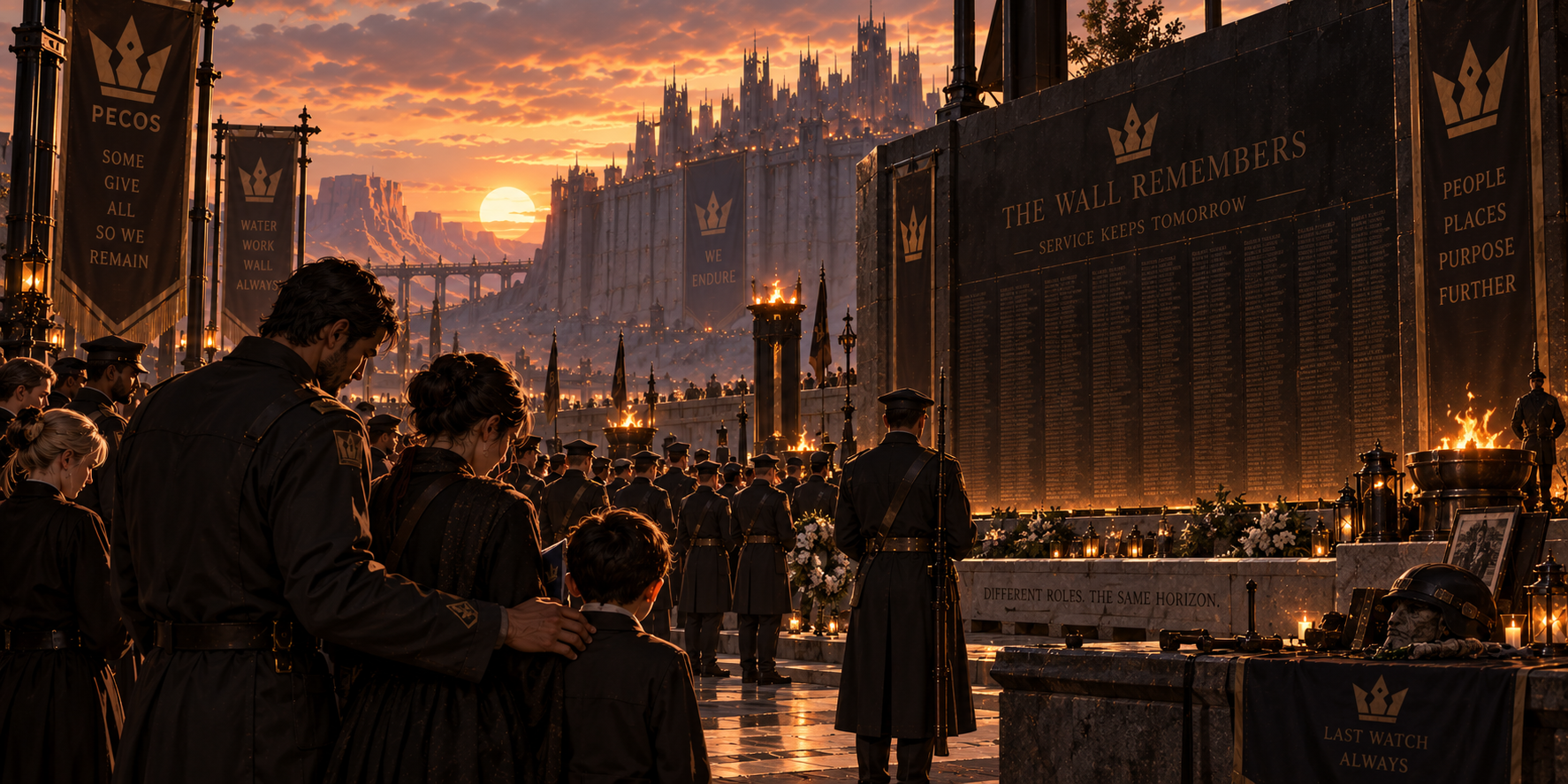
The Wall Remembers
Service, Loss & the Last Watch
Public remembrance occupies an important place in Pecos civic life. Military dead receive the greatest national attention, but local memorial traditions may also preserve the names of human rail crews, water workers, emergency responders, miners, engineers, and others who died while maintaining systems considered essential to western survival.
Pecos remembrance is usually documentary rather than ornate. Names, dates, occupations, units, duty stations, and places of death matter. Memorial walls often resemble permanent records as much as monuments.
Last Watch // Public Human Memorial
The Last Watch Name // Service // Place // Memory
The Observance
At Last Watch ceremonies, families and service personnel gather near a memorial wall, fortress line, station monument, or other place connected to the dead. Names are read aloud, often with rank, occupation, unit, crew, or final duty station. After the last name, a rail horn, fortress horn, or single sustained signal may mark the end of the reading.
Name
The Person Is Entered Into Public Memory
Service
Unit // Crew // Trade // Duty
Place
Wall // Line // Station // Settlement
Record
The Desert Keeps Honest Records
Human Dead
Civic Memory
Humans are publicly remembered as citizens, workers, officers, defenders, professionals, relatives, and named contributors to Pecos history. Their names may enter formal memorial rolls, public walls, unit histories, service records, and annual readings.
Demi-Human Dead
Companion & Service Memory
Controlled demi-humans do not normally receive equivalent civic memorial standing from human society. Humans may grieve them sincerely and intensely, but the dominant cultural language resembles mourning for a beloved pet, working animal, service companion, or valued household dependent rather than the loss of an equal citizen.
Loved Does Not Mean Equal
A privately owned demi-human might receive a beautiful grave, flowers every year, a framed portrait, preserved collar, favorite blanket, work tag, or expensive memorial marker. A human household may genuinely consider them beloved family while still describing the deceased through language such as faithful companion, loyal servant, or beloved member of the household rather than citizen.
Household Language
“Beloved Companion”
Private memorials commonly emphasize affection, loyalty, service, companionship, and the relationship between the demi-human and the household or owner who remembers them.
Institutional Language
“Eighteen Years Continuous Service”
Company or Crown records may be colder still, preserving an identification number, assignment history, years of service, or labor designation where a human memorial would preserve a civic identity.
The Unequal Memory of the Crown
Pecos may mourn a demi-human deeply without mourning them as an equal.
Pecos Crown // Workplace Culture
Worksite Traditions
The Small Customs Crews Keep for Themselves
Not every Pecos ritual belongs to government ceremony. Rail yards, mines, pumping stations, workshops, freight depots, construction crews, and industrial facilities develop customs of their own.
These traditions are rarely written into law. They survive because workers repeat them, teach them to new hires, and attach personal meaning to places where generations of people have performed difficult work together.
First Water // First Shift
Worksite Tradition // First Water
First Water
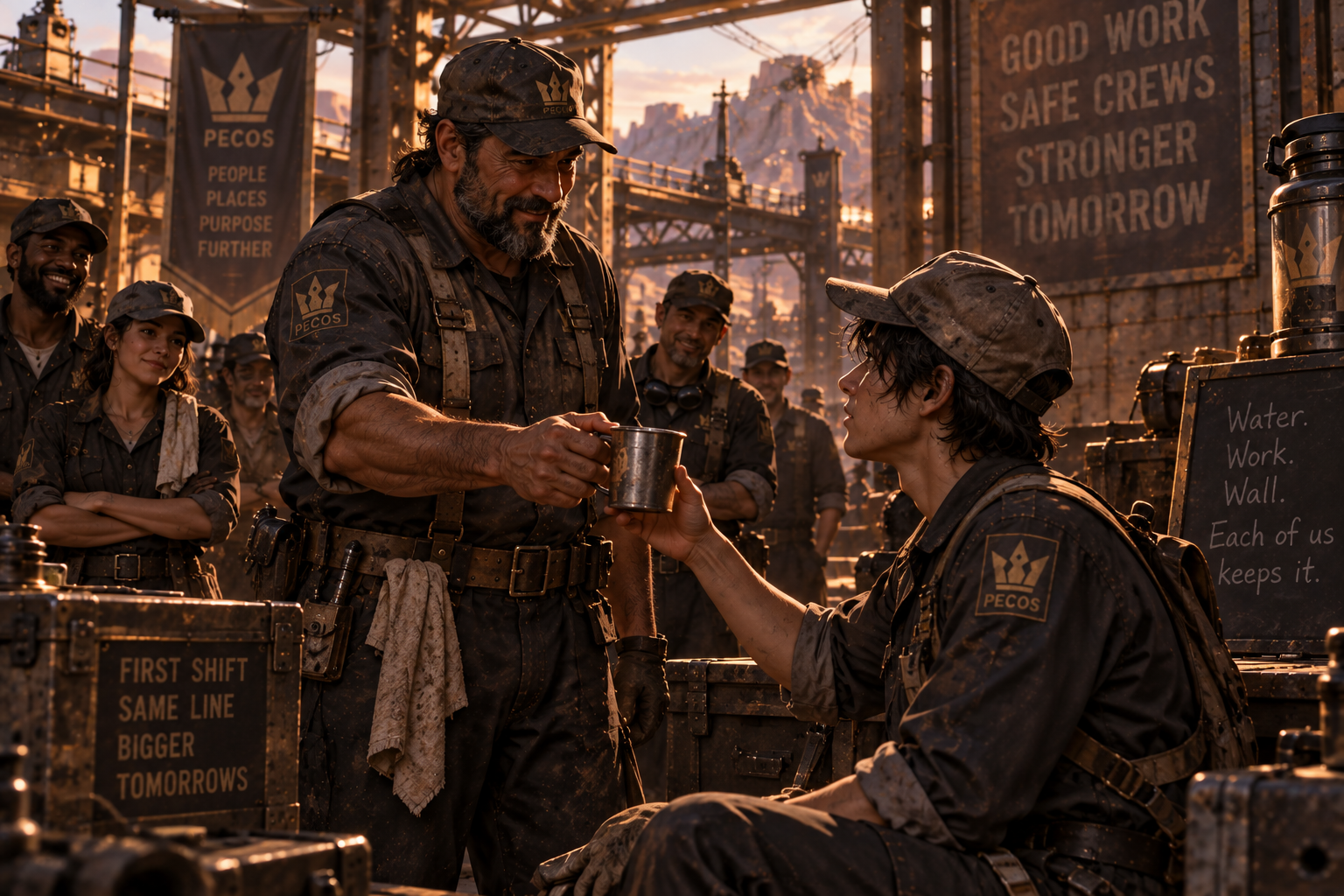
On a new worker's first shift with an established crew, the senior worker or crew lead may offer them water before handing over tools, assignment equipment, or the first formal instructions of the day.
The custom is usually understated. A cup is offered. The newcomer drinks. Work begins.
The Meaning
For this shift, you are one of us.
Maintenance Marks // Line Memory
Worksite Tradition // Maintenance Marks
Leave the Machine Better
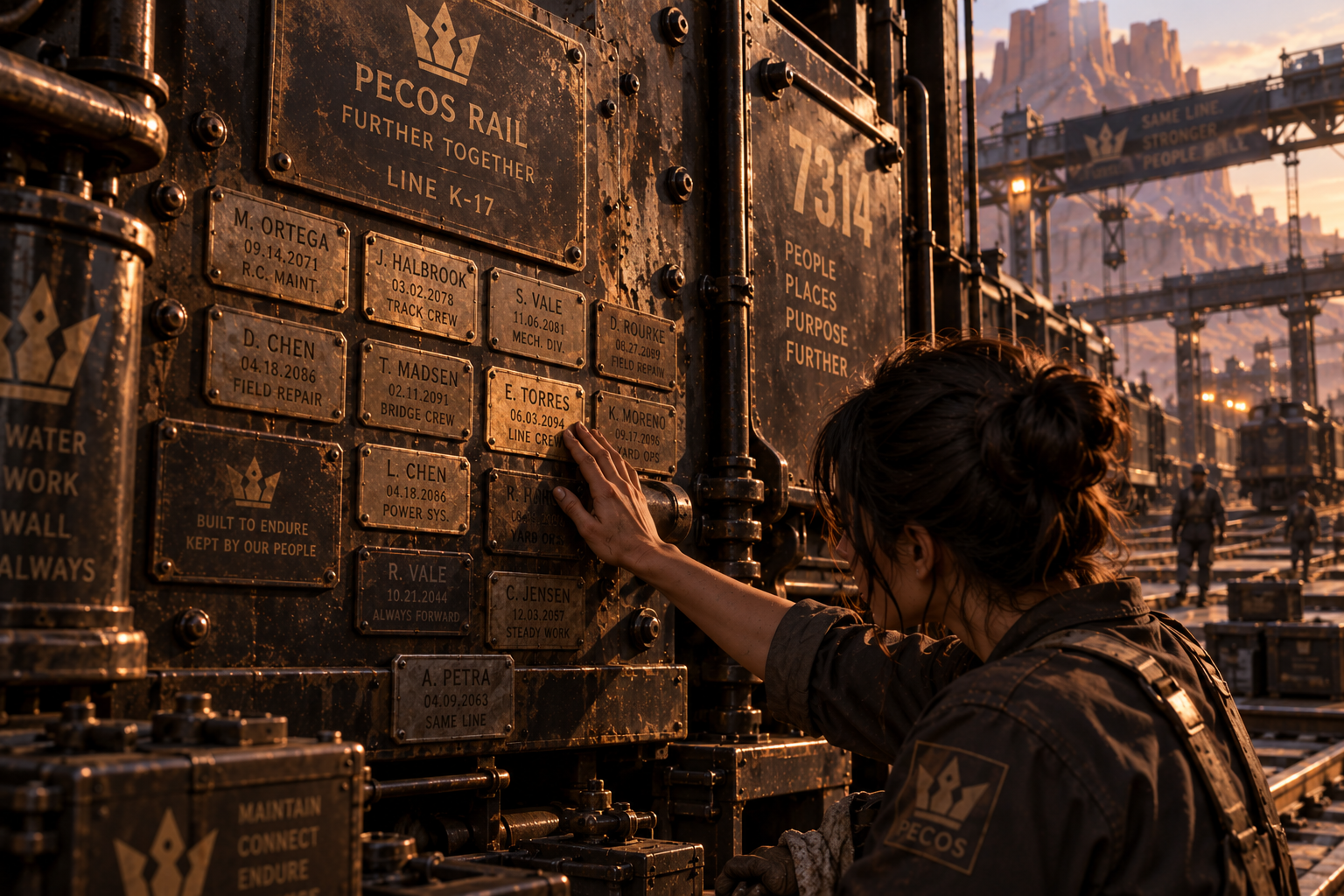
Major repairs commonly receive a small maintenance plate, stamped date, crew code, set of initials, or other durable mark. The practice began as practical recordkeeping, but old machinery can accumulate decades of human history across its casing.
A worker may recognize a parent, grandparent, retired foreman, former teacher, or long-dead mechanic among the names attached to equipment still operating years later.
Practical Function
Who Repaired It?
Dates, crews, divisions, and maintenance marks establish a record of who worked on a machine and when. In Pecos culture, useful documentation naturally accumulates social meaning.
Cultural Function
Who Kept It Alive?
Old plates can turn machinery into a workplace genealogy. Keeping a locomotive, pump, crane, or station operating becomes a chain of responsibility stretching across generations.
Industrial Memory
In Pecos, maintenance is one of the ways people leave their names behind.
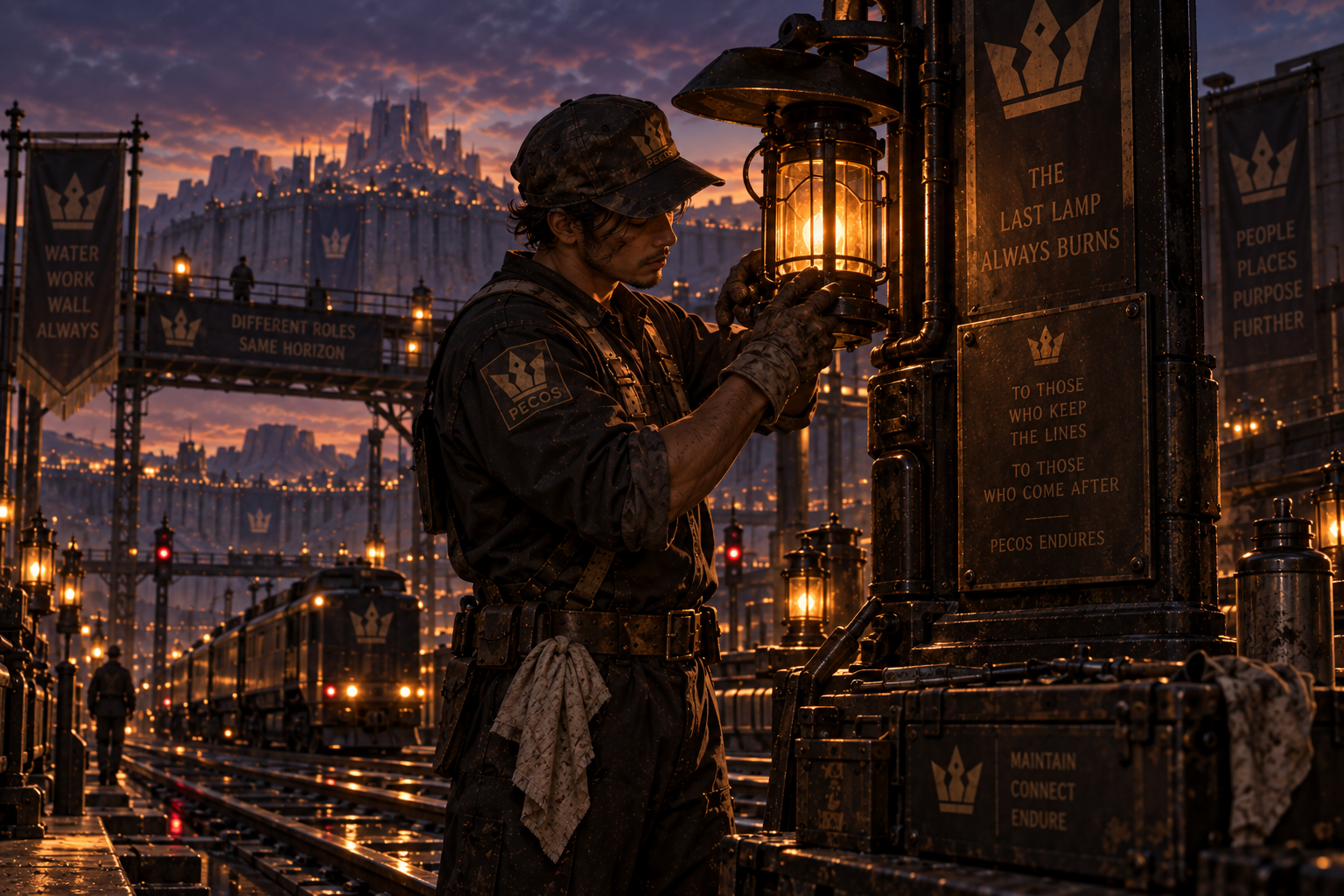
Last Lamp // Final Shift
Worksite Tradition // Last Lamp
The Last Lamp
When a respected worker retires or permanently leaves a station they have held for many years, some crews observe the Last Lamp. At the end of the final shift, ordinary shutdown proceeds as usual until only the departing worker's station remains lit.
Coworkers wait nearby. The worker completes the shutdown themselves and turns off the final lamp.
Speeches are optional. The darkness is the ceremony.
What Comes After
Some crews later attach a maintenance plate, preserve an old tool, sign a work tag, or keep another small object from the departing worker's station. Others simply return to work the next morning under a new lamp keeper.
Last Shift
Somebody kept the light on before you. Somebody will keep it on after.
Pecos Crown // Civic Culture
What Ritual Means
Official Meaning, Private Memory
Governments can establish ceremonies, standardize language, fund memorials, and place slogans above public squares. They cannot completely control what those customs come to mean after generations of people begin using them.
Pecos residents inherit rituals shaped by Crown institutions while attaching family history, workplace loyalty, grief, resentment, humor, pride, affection, and personal memory to them. The result is a civic culture that cannot be reduced to propaganda even when propaganda helped shape its vocabulary.
One Ritual // More Than One Meaning State Interpretation // Lived Interpretation
Water Oath
Civic Responsibility
The Crown presents the oath as acceptance of public duty. A family may remember it primarily as the day a child crossed into adulthood using the same metal cup as their parent.
Crownfall Day
National Endurance
Official ceremonies celebrate continuity of the state. Households may care far more about grandparents, neighborhood history, old photographs, and the people whose work made home possible.
Rail Blessing
Infrastructure Pride
The Rail Commission can use the blessing ceremonially. Crews perform it because machinery fails, routes are dangerous, coworkers matter, and everyone wants the train to come back.
Last Watch
Honorable Service
The state invokes sacrifice and duty. The person standing before the memorial may simply be there because their father, sister, spouse, or friend is one of the names being read.
Worksite Customs
Productive Culture
Institutions celebrate disciplined labor. Workers may care more about belonging to a crew, remembering who taught them, or being recognized by people who understand the work.
Water. Work. Wall.
National Doctrine
Officials use the phrase as political language. A resident may use it sincerely, sarcastically, affectionately, bitterly, or simply because those are the words people from home say.
Culture Outlives Interpretation
A person may hate the Crown Authority and still whisper “Clear line. Steady wheel. Safe return.” before their daughter's first route. Someone may despise military policy and still attend Last Watch because their brother's name is on the wall. Someone may mock “Water. Work. Wall.” every week of their life and still say it without thinking when the pumps fail.
Civic Life & Ritual
Pecos turned infrastructure into doctrine. Its people turned doctrine into memory.
PECOS CROWN ECONOMY
Extraction, Movement & Controlled Necessity
Pecos wealth is built from systems the western realm cannot afford to stop. Ore must leave the ground. Freight must move. Worksites must remain secure. Prison populations must be contained and productive. Water must reach settlements that cannot survive without engineered supply.The economy therefore rewards control over bottlenecks more than ordinary commerce. Houses and institutions become powerful not simply because they possess wealth, but because they control infrastructure whose interruption can threaten entire regions.In Pecos, necessity is the most profitable resource.
EXTRACTION House Varrick What the Crown takes from the ground.RAIL House Marr + Rail Commission How the Crown moves what it owns.SECURITY House Rusk How the Crown protects what must continue.PRISONS House Halden How custody becomes labor, production, and contract.WATER House Calderra How survival itself becomes infrastructure.
The Crown Houses are powerful because each controls a system interruption can turn into crisis.
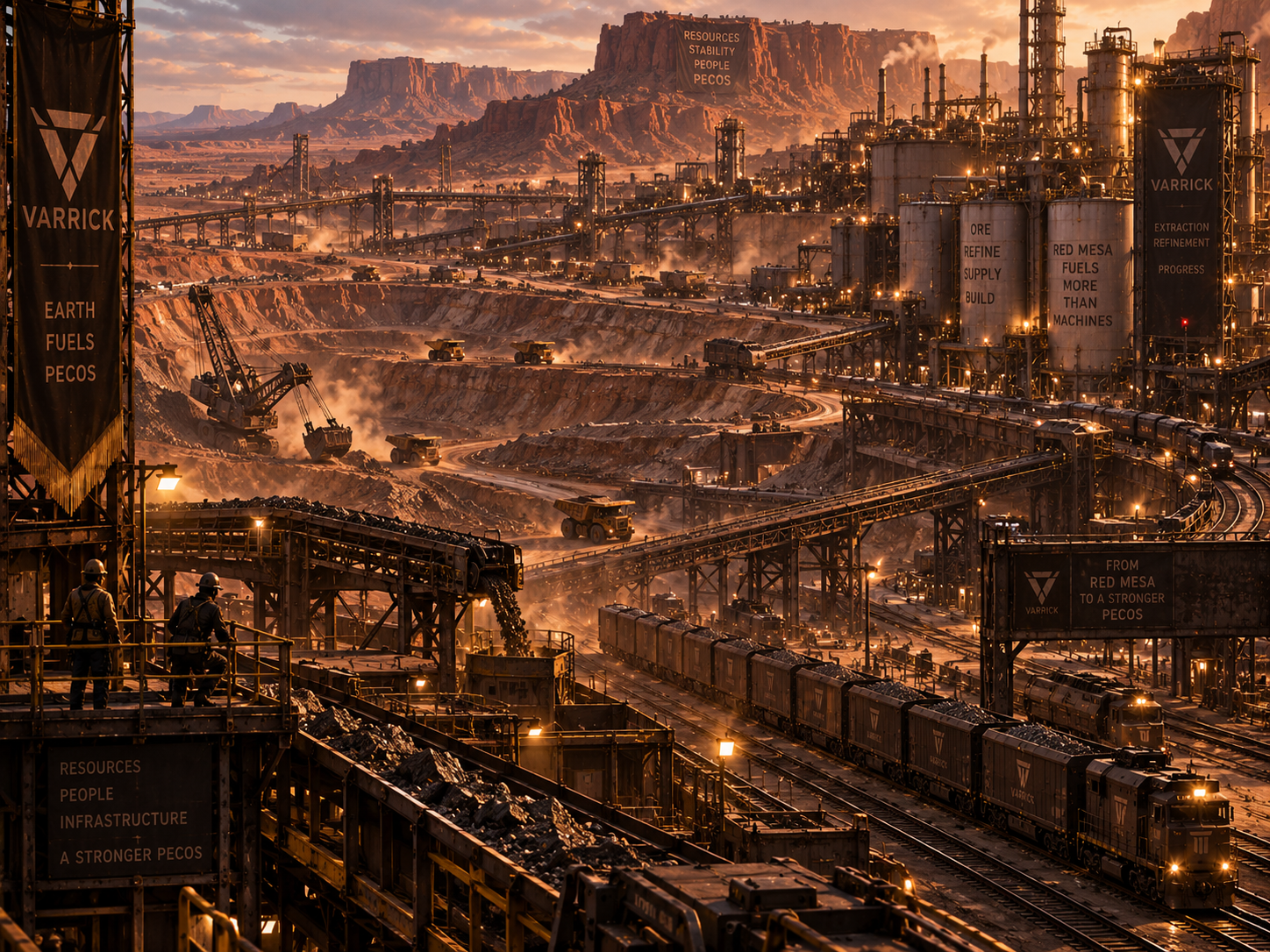
Extraction
The Ground Is Valuable Only After Someone Moves It
Mining is the foundation beneath much of Pecos industrial wealth. The western realm produces ore, construction stone, industrial minerals, heat-zone materials, and other resources extracted from Red Mesa, the Redglass interior, and smaller operations scattered across Crown territory.Extraction is expensive before it becomes profitable. Mines require water, rail access, security, heavy machinery, labor assignment, refinery capacity, and constant maintenance. House Varrick became one of the Crown’s dominant families not simply by owning mines, but by controlling enough of that network to influence how quickly raw material becomes usable wealth.
Pecos Crown Economy // Extraction
The Ground Becomes Wealth
Mining, Refinement & the Industrial Geography of Red Mesa
Mining forms the foundation beneath much of Pecos industrial wealth. Red Mesa and the wider western interior produce ore, construction stone, industrial minerals, and other materials required by rail, manufacturing, infrastructure, defense, and settlement growth.
Extraction does not occur at a single mine mouth. A productive district is an entire landscape of open cuts, shafts, conveyors, processing works, cooling systems, maintenance yards, freight sidings, worker housing, security zones, and rail connections. The value underground matters only after enough infrastructure exists to bring it into the economy.
Red Mesa // Varrick Extraction Network
Open Cuts Surface Extraction
Deepworks Shaft Operations
Refinery Belt Process & Separate
Freight Load & Move
Support Water // Security // Labor
Industrial Scale
A Mine Is Only One Part of the System
Major extraction zones function as linked industrial regions. Raw material must be dug, lifted, sorted, crushed, processed, stored, loaded, and transferred into the national freight network before it becomes economically useful.
Economic Dependency
Output Requires Other Sectors
Mines consume water, machinery, assigned labor, transport, maintenance, and security. A disruption in any one of those systems can reduce production even when the resource itself remains abundant underground.
Extraction Economics
Pecos does not become rich when something is discovered. It becomes rich when discovery can be turned into output.
Silas Varrick // Mining & Extraction
Pecos Crown Economy // Crown House
House Varrick
Mining & Extraction
House Varrick's influence begins at the point where geology becomes commerce. Its companies hold extraction rights, operate major mines, control refining interests, negotiate production contracts, and maintain deep relationships with the rail, security, and labor systems required to keep Red Mesa productive.
Silas Varrick represents the House inside Crown economic policy. His political weight comes from a simple reality: production quotas matter only if somebody can actually meet them.
House Representative
Silas Varrick
Extraction // Refinement // Industrial Production
Mines
Refineries
Extraction Rights
Industrial Quotas
Bulk Material
House Varrick's Power
The House does not merely own valuable ground. It controls the machinery that turns the ground into output.
Pecos Crown Economy // Extraction
How Extraction Makes Money
From Resource Claim to Buyer Contract
Value accumulates at every stage between discovering a resource and delivering usable material to a buyer. The mine itself is only the beginning. Rights, labor, machinery, water, security, processing, rail access, and guaranteed buyers determine whether the ground becomes profitable.
Claim
Extract
Process
Load
Move
Sell
01 // Claim
Resource Claim
Control begins with legal access to the ground and the right to remove what lies beneath it.
02 // Workforce
Labor
Extraction depends on miners, technicians, mechanics, operators, haulers, supervisors, and controlled labor.
03 // Capital
Equipment
Heavy machinery, drilling systems, conveyors, cooling systems, lifts, tools, and replacement parts determine productive scale.
04 // Survival
Water
Workers need it. Machinery uses it. Processing consumes it. Expansion frequently depends on additional allocation.
Raw extraction becomes more valuable once material is sorted, processed, separated, or prepared for industrial use.
07 // Movement
Rail Access
Material trapped at the mine is not useful to distant buyers. Freight capacity determines how quickly output becomes revenue.
08 // Revenue
Buyer Contract
Guaranteed buyers, industrial agreements, and long-term supply contracts turn production capacity into predictable income.
Labor Economics // Office of Burden Assignment
Biology Enters the Balance Sheet
Strength, endurance, burrowing ability, heat tolerance, and other traits can affect where controlled demi-human labor is assigned. The Office of Burden Assignment therefore participates indirectly in production economics by determining which bodies are considered suitable for which industrial burdens.
The profitable resource is not merely what lies underground. It is the entire chain capable of bringing it to market.
Pecos does not become rich when something is discovered. It becomes rich when discovery can be turned into output.
Rail
Distance Is an Economic Problem
Pecos industry is scattered across enormous western distances. Mines, settlements, prisons, military sites, water works, refineries, and freight centers depend upon a rail network capable of moving people and material through territory where roads alone cannot carry the national load.Rail therefore operates as both business and state necessity. Corporate freight interests profit from movement. The Rail Commission regulates the network that makes movement possible. The distinction between the two matters, but neither side can function without the other.
Pecos Crown Economy // Rail
Railheart
Freight, Passenger Movement & the Economics of Distance
Pecos industry is scattered across enormous western distances. Mines, settlements, prisons, military sites, water works, refineries, corporate facilities, and freight centers depend upon a rail network capable of carrying loads that roads alone could never sustain.
Railheart is where that movement becomes visible at national scale. Passenger lines cross freight levels. Corporate spurs feed private yards. Armored locomotives haul secured cargo. Custody cars move through controlled platforms. Maintenance crews keep the network alive beneath signal gantries, cranes, scan gates, and continuously changing amber boards.
Railheart // Pecos Gate National Interchange
Railheart // Network Activity National Interchange Status
Passenger
Heavy
Freight
Continuous
Corporate Traffic
Heavy
Secured Transfer
Elevated
Network Status
Operational
Security
Heightened
The Railheart Machine One District // Multiple Economies
01 // Freight Interchange
Bulk Movement
Ore, refined material, manufactured goods, machinery, industrial supplies, food, construction material, and other bulk cargo move through long freight platforms and switching yards before being routed across the Crown.
02 // Passenger Levels
Civilian Movement
Workers, families, officials, military personnel, corporate employees, and authorized travelers share a layered passenger network built around identity checks, ticketing, route control, and scheduled transfer.
03 // Corporate Spurs
Private Access
Major companies maintain dedicated sidings and loading infrastructure connecting private facilities directly to the national network. Rail access can determine which industrial sites remain commercially viable.
04 // Switching Yards
Route Assembly
Cargo does not simply arrive and depart. Cars are separated, reassembled, inspected, prioritized, redirected, and matched to locomotives capable of carrying them across specific routes.
05 // Secured Transfer
Custody Movement
Armored cars and restricted platforms handle prisoners, controlled demi-humans, sensitive industrial freight, biological cargo, and transfers requiring custody to remain continuous between departure and arrival.
06 // Scan Infrastructure
Access & Identity
Passenger gates, cargo scanners, work checkpoints, restricted-platform controls, and status verification systems determine who may enter, what may move, and under whose authority movement occurs.
07 // Maintenance
Keeping the Network Alive
Locomotive depots, repair bays, signal crews, track workers, inspection teams, parts stores, fueling systems, and engineering yards support the machinery hidden beneath every departure time.
08 // Network Control
Movement as Information
Signals, amber departure boards, manifests, route permissions, priority notices, custody records, and freight schedules turn thousands of moving pieces into a system that can be administered.
Public Network
The Crown Moves People
Passenger service connects settlements to employment, government, markets, medical services, education, military facilities, and one another. Even ordinary civilian mobility therefore depends upon infrastructure administered as a matter of national continuity.
Industrial Network
Industry Moves Everything Else
Freight contracts, private spurs, bulk rates, loading priority, rolling stock, warehouse access, and guaranteed route capacity determine how quickly material becomes revenue. Industrial distance is solved by purchasing movement.
Railheart Movement Cycle
Arrive
Scan
Sort
Assign
Transfer
Depart
Rail Economics
In Pecos, control of movement can be as valuable as ownership of the thing being moved.
Network Dependency A rail delay is rarely only a transportation problem. It can become an extraction problem, labor problem, security problem, prison problem, water problem, or supply problem within hours.
Pecos Crown Economy // Rail Power
The Two Marrs
Commercial Movement & State Network Authority
House Marr // Commercial Rail
House Marr
Harlan Marr
Rail & Freight
Harlan Marr represents the commercial side of the family rail network. House Marr profits from corporate freight, logistics, shipping contracts, private spurs, cargo handling, rolling-stock agreements, and the movement of industrial output across the western realm.
Cassian Marr represents the state-facing administration of the rail network. The Rail Commission governs route permissions, custody policy, transport regulation, national access, emergency rerouting, and the rules under which public and private movement can use Crown rail infrastructure.
One family profits from movement. One institution decides how movement is permitted.
Influence Is Not the Same as Corruption House Marr and the Rail Commission occupy overlapping parts of the same national system, but they are not interchangeable. Harlan's interests are commercial. Cassian's authority is administrative and regulatory. Their shared family name creates influence, familiarity, and institutional proximity without requiring every decision to be an illicit arrangement.
Pecos Crown Economy // Rail Manifest
What Rides the Rails
Passenger, Industrial, Secured & Custodial Movement
01
Industrial Cargo
Ore & Refined Material
OriginRed Mesa→DestinationIndustrial Buyers
02
Infrastructure Cargo
Water Equipment
Pumps / Treatment Components / Emergency Supply
03
Civilian Movement
Passengers
Workers / Citizens / Officials / Families
04
Restricted Movement
Secured Freight
Military / Biological / Restricted Cargo
05
Custodial Transfer
Prison Transfers
Court→Transport Custody→Halden Facilities
06
Commercial Cargo
Corporate Goods
Food / Machinery / Manufactured Output
ExtractionWaterLaborSecurityPrisonsIndustry
Network Dependency
A rail delay is rarely only a transportation problem. It can become a labor problem, water problem, security problem, prison problem, or extraction problem within hours.
In Pecos, control of movement can be as valuable as ownership of the thing being moved.
Security
Risk Is a Market
Pecos private security grew alongside the industries it protects. Mines need guarded convoys. Rail yards need access control. Refineries need perimeter teams. Water infrastructure requires protection. Corporate compounds need guards. Recovery contracts require licensed personnel capable of pursuing missing property, escaped labor, or stolen freight.The Crown maintains its own military and law-enforcement institutions, but private industry creates a separate market for force purchased by contract.
Pecos private security grew alongside the industries it protects. Mines need guarded convoys. Rail yards require access control. Refineries need perimeter teams. Water infrastructure requires protection. Corporate compounds need guards. High-value freight must reach its destination intact.
The Crown maintains military and law-enforcement institutions, but private industry supports a separate market for force purchased by contract. Companies do not need to command an army when they can purchase trained personnel, armored transport, checkpoint management, escorts, and recovery capability as operating expenses.
Security spending concentrates around systems whose interruption would be expensive. Mines, refineries, rail depots, water works, industrial compounds, and high-value freight therefore generate continuous demand for contracted protection.
02 // Purchased Capacity
Force Becomes a Service
A company can purchase guards, vehicles, escorts, scanners, checkpoint personnel, perimeter coverage, response teams, and specialized transfer security without maintaining those capabilities permanently in-house.
03 // Economic Goal
Keep the System Running
Private security is profitable because downtime is expensive. Its value is measured less by dramatic confrontation than by whether workers arrive, freight moves, equipment survives, and contracted operations continue without interruption.
State Force
Military Force Protects the Realm
The High Marshal, military command, and other Crown institutions respond to national defense, border security, major emergencies, strategic threats, and situations where the state itself claims primary authority.
Contract Force
Private Security Protects the Contract
Corporate guards and contracted security firms protect specific facilities, shipments, personnel, routes, or operations according to purchased agreements. Their goals can overlap with state security without making the two systems identical.
Security Economics
Pecos does not merely fear danger. It invoices for managing it.
Corbin Rusk // Contract Security
Pecos Crown Economy // Crown House
House Rusk
Private Security & Contracted Enforcement
House Rusk built its fortune by selling reliability in environments where interruption is expensive. Its companies protect facilities, freight, corporate personnel, extraction sites, transport corridors, and high-value transfers.
Corbin Rusk’s influence comes from the fact that almost every other major economic sector eventually requires somebody willing to stand between valuable infrastructure and whatever might disrupt it.
The more expensive a facility, shipment, route, or operation becomes, the more costly disruption becomes. Security spending therefore rises alongside industrial value.
02 // Contract
Protection Can Be Purchased
Companies buy specific security capabilities without maintaining their own permanent force. House Rusk turns guards, vehicles, escorts, checkpoints, and response capacity into contract services.
03 // Influence
Rusk Sits Between Industries
Extraction, rail, prisons, water, freight, and corporate infrastructure may compete economically, but all can become Rusk clients when continuity needs protection.
House Rusk's Power
House Rusk does not need to own the mine, train, refinery, or shipment. It profits from making sure somebody else keeps control of it.
Pecos Crown Economy // Security
Security as Dependency
How Risk Becomes a Purchased Service
Private security becomes economically valuable when the cost of interruption exceeds the cost of prevention. Once a system is considered important enough to protect, risk can be identified, priced, contracted, and answered with purchased force.
Valuable System
Identified Risk
Contract
Deployment
Continuity
Something expensive must keep operating.
Threat or disruption is defined.
Protection is purchased.
Personnel and equipment are assigned.
The protected system remains functional.
State Authority
Military Force Protects the Realm.
Crown military power exists to defend territory, strategic infrastructure, national security, borders, emergency continuity, and interests the state defines as necessary to the survival of Pecos.
Purpose
Contract Authority
Private Security Protects the Contract.
Contracted security exists to protect a defined client, facility, shipment, route, transfer, or operation according to purchased terms. Its authority begins with the agreement that pays for its presence.
Aligned Interests
Sometimes the Goals Overlap Perfectly.
A guarded water facility, strategic rail corridor, weapons shipment, or major extraction site may matter equally to the state and to the corporation paying for protection. In those cases, private and public security interests can reinforce one another without contradiction.
Divergent Interests
Sometimes They Do Not.
A corporate client may care about property, schedules, personnel, liability, or revenue that does not rise to the level of national concern. The Crown protects what it defines as necessary. The contractor protects what the contract defines as valuable.
Security Economics
The more Pecos depends on uninterrupted systems, the more valuable interruption becomes as a market for prevention.
Pecos does not merely fear danger. It invoices for managing it.
Prison Industry
Custody Should Produce Order
Pecos incarceration is not treated as an economic dead end. Prisoners require housing, transport, food, guards, medical care, uniforms, equipment, facilities, records, and supervision. The Crown’s correctional economy developed around the belief that the expense of custody should be offset whenever possible through productive labor and contracted industry.This system supports prison workshops, industrial production, quarry work, maintenance crews, secure manufacturing, transport contracts, supply agreements, and labor programs administered through Crown and private facilities.
Pecos incarceration is not treated as an economic dead end. Prisoners require housing, transport, food, guards, medical care, uniforms, equipment, facilities, records, maintenance, and supervision. The correctional economy developed around the belief that the expense of custody should be offset whenever possible through organized labor and contracted production.
Major facilities therefore operate less like isolated cells behind walls and more like secured institutional campuses. Housing blocks connect to workshops, factory wings, medical buildings, administrative offices, maintenance yards, cargo platforms, and rail sidings designed to keep custody, production, and supply moving through the same controlled system.
Secure housing requires food service, sanitation, clothing, medical provision, maintenance, staffing, utilities, records, and tightly managed daily schedules. Every prisoner represents both a custodial responsibility and an institutional expense.
02 // Labor
Work Offsets Custody
Eligible prisoners may be assigned to workshops, manufacturing, maintenance, quarry work, facility services, or other controlled labor. The stated economic purpose is to convert otherwise idle custodial time into productive output.
03 // Production
Facilities Manufacture Goods
Correctional workshops can produce uniforms, bedding, tools, basic manufactured goods, institutional supplies, processed materials, and other products purchased by Crown agencies, corporations, or contracted buyers.
04 // Logistics
Prisons Consume Freight
Food, medical supplies, replacement equipment, raw material, fuel, uniforms, restraint systems, and finished goods must move in and out continuously. Large facilities therefore maintain secured road and rail connections.
05 // Administration
Custody Is Recorded
Sentences, classifications, transfers, work assignments, medical restrictions, security levels, production records, and release or reassignment orders create an administrative system as important as the physical walls.
06 // Continuity
Order Protects Output
Illness, injury, disorder, equipment failure, supply shortages, and poor supervision reduce both institutional stability and productive capacity. Halden doctrine therefore treats routine, maintenance, sanitation, and predictability as economic assets.
Correctional Operating Cycle
Receive
Classify
House
Assign
Produce
Institutional Product
House Halden Sells Order
Its value to the Crown is not simply possession of prison walls. Halden provides managed beds, controlled schedules, trained staff, medical and supply systems, secure transfers, recordkeeping, and the infrastructure required to keep sentenced populations under predictable administration.
Economic Product
House Halden Sells Capacity
Correctional facilities also create workshops, labor pools, manufacturing space, maintenance crews, institutional purchasing, and supply contracts. Custody becomes part of a wider economic network rather than a cost isolated from the rest of Pecos.
Correctional Economics
The Pecos prison industry does not justify itself through chaos. It justifies itself through the claim that custody can be clean, predictable, productive, and economically useful.
House Halden // Custody • Industry • Order
Pecos Crown Economy // Crown House
Lucien Halden
34 // Head of House Halden
Prisons & Correctional Industry
Lucien Halden is the youngest head of a major Crown House. House Halden operates prison facilities, correctional manufacturing, detainee logistics, secured labor programs, institutional supply contracts, and other infrastructure surrounding incarceration.
Lucien's reputation is unusually modern by Crown House standards. He favors clean facilities, adequate food, medical provision, predictable schedules, competent staff, and tightly monitored labor not because he rejects incarceration, but because disorder, disease, injury, and arbitrary cruelty reduce institutional stability and productive capacity.
Halden Doctrine
“Custody should produce order.”
Prison Facilities
Correctional Manufacturing
Detainee Logistics
Secured Labor
Institutional Supply
Custodial Infrastructure
Halden Operating Logic Custody // Industry // Continuity
Secure
Utilize
Maintain
Repeat
Institutional View
Order Is a Management Problem
Predictable schedules, working sanitation, competent staff, medical access, maintained equipment, and controlled routines reduce disruption. Lucien treats these systems as basic requirements of effective custody rather than acts of mercy.
Economic View
Health Preserves Capacity
Injury, illness, starvation, arbitrary punishment, and chaotic management damage labor capacity while increasing security and medical costs. Halden efficiency therefore favors preservation of the prisoner as a usable institutional resource.
House Halden's Power
Lucien's reformism does not challenge the existence of the system. It attempts to make the system cleaner, more stable, more measurable, and more productive.
Pecos Crown Economy // Prison Industry
From Sentence to Production
Where Courts, Transport, Custody & Labor Become One Economic Chain
A Pecos prison sentence does not remain inside the courtroom. It becomes a sequence of records, transfers, classifications, security decisions, facility assignments, labor decisions, and operating costs involving institutions across the Crown.
ManufacturingWorkshopsMaintenanceInstitutional LaborContracted Work
07 // Economic Result
Revenue / Cost Offset
The Correctional Junction
Prisons are not an isolated sector. They are a junction where courts, rail, security, labor administration, institutional supply, and industrial production meet.
The Sentence May Be Similar. The Classification Is Not.
Recognized Human Prisoner
Human Prisoner
01
Sentence
02
Security Classification
03
Skills
04
Labor Eligibility
05
Facility Placement
Classification
Controlled Demi-Human Prisoner
Demi-Human Prisoner
01
Sentence
02
Security Classification
03
Species
04
Shift Capacity
05
Physical Traits
06
Containment Requirements
07
Labor Suitability
08
Facility Placement
Shared Custodial Questions
What Was the Sentence?
Both human and demi-human prisoners enter a system concerned with sentence, security, placement, supervision, and whether labor can be assigned.
Additional Demi-Human Questions
What Can the Body Be Used For?
For demi-humans, species, shifting ability, physical capacity, containment requirements, and labor suitability become additional administrative variables inside the same custodial process.
The Difference
A human prisoner enters custody with a sentence. A demi-human prisoner enters custody with a sentence and a body the Crown already considers economically legible.
An idle sentence serves no one.
Water
The Resource No Market Can Replace
Almost every major Pecos settlement exists because water has been captured, pumped, treated, stored, rationed, and moved through engineered systems. Unlike ore, freight, prison labor, or security contracts, water cannot simply be allowed to disappear from the market when conditions become unfavorable.That makes water economically unusual. It is sold, contracted, allocated, subsidized, rationed, and politically controlled while simultaneously being treated as a civic necessity no recognized settlement can survive without.
Pecos Crown Economy // Water
The System That Keeps the Desert Inhabited
Capture, Treatment, Storage & Engineered Supply
Almost every major Pecos settlement exists because water has been captured, pumped, treated, stored, rationed, and moved through engineered systems. Reservoirs and pumping works feed purification structures, trunk lines, municipal towers, industrial connections, emergency reserves, and tanker rail.
Unlike ore, freight, prison labor, or security contracts, water cannot simply disappear from the market when conditions become unfavorable. Every household, mine, prison, military facility, rail yard, refinery, and settlement ultimately depends on the same engineered supply.
Calderra Water Network // Western Supply Infrastructure
ReservoirsSupply Held
PumpingOperational
TreatmentActive
PipelineDistribution Network
Tanker RailEmergency Movement
Ration TowersMunicipal Control
01 // Capture
Reservoirs Hold Survival
Stored water gives settlements and industry a buffer against seasonal scarcity, infrastructure interruption, and periods when natural supply cannot meet demand.
02 // Movement
Pumping Makes Geography Negotiable
Large pumping works move water across elevation, distance, and terrain that would otherwise prevent major desert settlements from surviving at their current scale.
03 // Treatment
Purification Makes Supply Usable
Treatment plants, filters, chemical systems, testing, maintenance, and quality control turn captured water into supply suitable for households, institutions, and industry.
04 // Distribution
Pipes Create Settlements
Trunk lines and local networks determine where population, industry, prisons, rail facilities, and military sites can operate without relying entirely on tanker delivery.
05 // Emergency Supply
Rail Moves What Pipelines Cannot
Tanker cars support isolated worksites, temporary shortages, damaged infrastructure, emergency rationing, and settlements that lack sufficient permanent pipeline capacity.
06 // Allocation
Supply Must Be Prioritized
Scarcity turns infrastructure into policy. Municipal use, industrial demand, extraction, prisons, military needs, and emergency reserves compete for finite capacity inside the same network.
Water Distribution Cycle
Capture
Pump
Treat
Store
Allocate
Distribute
Life-Support Infrastructure
Water Cannot Be Allowed to Stop
A broken freight contract may delay goods. A failed water network can make homes, hospitals, prisons, factories, military sites, and entire settlements physically unsustainable.
Economic Infrastructure
Water Determines What Can Grow
A mine expansion, new housing district, refinery upgrade, prison complex, rail depot, or military installation may be technically possible yet economically meaningless if the water network cannot support the additional demand.
Water Economics
Water is a commodity until scarcity reminds everyone that it is life support.
House Calderra // Western Water Authority
Pecos Crown Economy // Crown House
House Calderra
Water Authority & Infrastructure
House Calderra's influence rests on reservoirs, pumping infrastructure, treatment systems, municipal agreements, industrial allocation, emergency supply, and the contracts required to keep western settlements alive.
Tomas Calderra operates at the point where engineering, commerce, and civic necessity become nearly impossible to separate. Water policy can determine whether a mine expands, whether a settlement grows, whether a refinery remains profitable, or whether an entire district begins rationing.
House Representative
Tomas Calderra
Water Authority // Allocation // Western Infrastructure
Reservoirs
Pumping Infrastructure
Treatment Systems
Municipal Agreements
Industrial Allocation
Emergency Supply
01 // Engineering
Infrastructure Creates Supply
Reservoirs, treatment plants, pumping stations, pipelines, storage systems, and maintenance networks determine how much usable water can physically reach a settlement or industrial site.
02 // Commerce
Allocation Shapes Growth
Industrial expansion requires guaranteed capacity. Mines, refineries, rail facilities, prisons, housing districts, and other large developments may depend on Calderra agreements before construction becomes economically practical.
03 // Civic Necessity
Scarcity Becomes Policy
When supply tightens, allocation decisions become political. Households, industry, emergency reserves, institutions, and strategic infrastructure cannot all be treated as equal demands on a limited network.
A Calderra Allocation Decision Can Determine
Mine Expansion
Settlement Growth
Refinery Profitability
District Rationing
House Calderra's Power
House Calderra does not merely sell water. It helps determine where Pecos can afford to keep living, building, extracting, and growing.
Pecos Crown Economy // Water Allocation
Where Water Goes
Every Major Sector Draws From the Same Finite System
Water allocation is not a separate concern from the rest of the Pecos economy. Domestic life, industrial production, extraction, transportation, incarceration, and national defense all draw from infrastructure that must capture, treat, store, and redistribute a limited physical resource.
Calderra Water Network
Captured // Treated // Stored // Allocated
One engineered supply. Competing demands.
01 // Civilian
Households
Drinking / Washing / Sanitation
02 // Industrial
Industry
Cooling / Refining / Processing
03 // Extraction
Extraction
Mining / Dust Control / Worker Supply
04 // Transport
Rail
Maintenance / Stations / Passenger Systems
05 // Custody
Prisons
Housing / Sanitation / Production
06 // Strategic
Military
Fortresses / Deployments / Emergency Reserves
Households
Industry
Extraction
Rail
Prisons
Military
The Unavoidable Dependency
Every sector on this page ultimately consumes the one resource Pecos cannot manufacture.
Pecos Crown Economy // System Overview
The Five Bottlenecks
The Industries Pecos Cannot Afford to Lose
The major Crown Houses do not dominate Pecos because they participate in ordinary commerce. They dominate because each controls a system whose interruption can become a national problem.
Varrick
Extraction
Controls extraction.
Marr
Rail & Freight
Controls freight.
Rusk
Private Security
Controls private force.
Halden
Correctional Industry
Controls correctional industry.
Calderra
Water
Controls water.
Labor Administration
Caine
Assigns controlled biological labor.
Judicial Authority
Desert Courts
Create lawful custody and enforce contracts.
National Security
High Marshal
Overrides ordinary systems when national survival is invoked.
A Republic of Dependencies No Sector Operates Alone
Pecos calls itself a republic. Its economy behaves like a network of dependencies.
No Crown House rules the nation alone. Each controls something the others need.
Mines need rail. Rail needs security. Security needs industry. Prisons consume transport, water, and labor. Water systems require extraction, machinery, protection, and freight. Government institutions regulate the boundaries between them.
The result is not a collection of separate industries. It is a machine whose components have become too important to fail.
Extraction
Rail
Security
Prisons
Water
The Pecos Economy
Power in Pecos belongs to whoever controls what cannot be allowed to stop.
Economic Power Becomes Political Power // Necessity Becomes Authority
Water is a commodity until scarcity reminds everyone that it is life support.
Resistance Under The Crown
Flight, Sabotage, and Counter-Infrastructure
Resistance in Pecos is not a single movement, army, or ideology. It is a collection of people and practices created in response to the systems that govern western life: ownership, assignment, rail custody, extraction, surveillance, labor contracts, recovery enforcement, and the simple difficulty of surviving long enough to get beyond Crown control.Some resist by breaking infrastructure. Some alter records. Some hide water. Some maintain shelters. Some move fugitives from one set of hands to another. Others do nothing more organized than refuse to be where the Crown expects them to be.These networks do not always know one another, trust one another, or share the same goals. What connects them is practical rather than ideological. Each has found a place where Crown control can be interrupted.
Pecos Crown // Resistance
What Resistance Looks Like
Small Actions Against Large Systems
Resistance in Pecos does not require a uniform, command structure, or shared manifesto. In practice, it often consists of ordinary actions that interrupt the Crown's ability to locate, classify, supply, transport, recover, or contain someone.
01 // Concealment
Hide
Shelter people the Crown is searching for.
02 // Material Aid
Supply
Water, food, medicine, maps, equipment.
03 // Information
Misdirect
Records, schedules, routes, scans.
04 // Interference
Disrupt
Interfere with systems without necessarily destroying them.
05 // Handoff
Move
Carry people between temporary safety points.
06 // Continuity
Survive
Remain outside Crown control long enough for the next option to exist.
HideSupplyMisdirectDisruptMoveSurvive
Counter-Infrastructure
Pecos is built on infrastructure. So is its resistance.
Pecos is built on infrastructure. So is its resistance.
Dry Wells
Shelter, Desert Routs and Places the Crown Forgot
Dry Wells are associated with the hidden geography of the Redglass Desert: abandoned wells, old mine shelters, broken rail cars, forgotten camps, and other structures that no longer matter enough to Pecos industry to receive constant attention.Their value is rarely comfort. It is concealment, shade, water when available, and a place to remain unseen while movement is delayed or another route is arranged. Coded desert markers can indicate that shelter may exist nearby, though no mark is an unconditional promise of safety.The best-known Dry Wells symbol is an empty well marked by three claw lines. Depending on circumstance, it can indicate possible salvation or a place that has already been compromised.
Dry Wells are associated with the hidden geography of the Redglass Desert: abandoned wells, collapsed mining shelters, discarded rail cars, supply sheds, forgotten work camps, and other structures that no longer matter enough to Pecos industry to receive constant attention.
Their value is rarely comfort. It is shade, concealment, occasional water, and somewhere to remain unseen while movement is delayed or another route becomes possible.
Redglass Desert // Discarded Infrastructure
Old Wells Possible Water
Mine Shelters Shade & Cover
Rail Cars Discarded Shelter
Supply Sheds Storage & Cover
Canyon Walls Concealment
Old Routes Movement Outside Main Roads
01 // Abandonment
The Crown Has Moved On
An exhausted mine, obsolete siding, collapsed shelter, or disused service structure may remain physically useful long after it stops being economically important enough to receive constant inspection.
02 // Geography
The Desert Hides What Cities Cannot
Canyon walls, broken ground, abandoned industrial corridors, and long distances create spaces where temporary shelter can exist surprisingly close to Crown roads, rail lines, or former worksites.
03 // Purpose
Temporary Is Enough
A Dry Well does not need to become a permanent refuge. It only needs to keep someone unseen, rested, hydrated, or alive long enough for another decision or handoff to become possible.
///
Common Marker // Three Claw Lines
A simple three-line mark is associated with some Dry Wells routes and shelters. Its presence can suggest that a place was once considered useful, but it is never an unconditional promise. The shelter may be empty, exhausted, abandoned, discovered, or no longer safe.
Dry Wells
Resistance inhabits the infrastructure Pecos has already decided is no longer worth watching closely.
Pecos Crown Resistance // Dry Wells
What Can Become a Dry Well
Useful Again After the Crown Stops Looking
01 // Water
Old Well
Water access / Landmark / Concealment
Disused Resource Infrastructure
02 // Shelter
Mine Shelter
Shade / Abandoned Utility Space
Former Extraction Infrastructure
03 // Cover
Broken Rail Car
Temporary Cover / Discarded Infrastructure
Obsolete Transport Equipment
04 // Storage
Abandoned Camp
Old Structures / Storage Possibilities
Former Worker Infrastructure
05 // Information
Desert Marker
Information Without a Permanent Messenger
Temporary Route Communication
Why Forgotten Places Matter
A Dry Well is valuable precisely because the Crown has stopped considering it important.
Rail Ghosts
Uncertainty as Sabotage
Rail Ghost activity targets the administrative and technical systems that make Crown transportation reliable. Freight switches, scan gates, prison-transfer records, drone pylons, and sealed cargo schedules have all been disrupted or altered in incidents attributed to them.Their characteristic method is not total destruction. A destroyed rail line receives soldiers, engineers, emergency funding, and immediate attention. An unreliable rail line creates something harder to contain: doubt.Current Rail Ghost activity has contributed to disruptions in mineral shipments, forcing additional verification, rerouting, inspection, and security throughout parts of the freight network.
Pecos Crown Resistance // Rail Ghosts
Uncertainty as Sabotage
A Train Does Not Need to Derail to Stop Being Useful
Rail Ghost activity targets the administrative and technical systems that make Crown transportation reliable. Freight switches, scan gates, transfer records, drone pylons, route signals, and sealed cargo schedules have all been associated with disruptions attributed to them.
Their characteristic effect is not spectacular destruction. The rails remain intact. The locomotives still run. The freight still exists. What disappears is confidence that the system is telling the truth about where anything should be.
Railheart Freight Network // Routing Irregularity
Stopped Mineral Freight
Conflict Route Boards
Open Maintenance Access
Backlog Scanner Lanes
Offline Drone Pylon
Pending Manifest Verification
01 // Freight
The Cargo Is Still There
Mineral cars can sit loaded and perfectly functional while workers wait for route confirmation, manifest correction, inspection clearance, or authorization that should already have existed.
02 // Information
The Records Stop Agreeing
Departure boards, switch instructions, scanner results, cargo records, and route permissions become expensive the moment workers must confirm them against one another instead of trusting the first answer.
03 // Labor
Normal Work Becomes Verification
Dispatchers, guards, mechanics, rail hands, inspectors, and supervisors stop moving freight and begin checking whether the information required to move it can still be trusted.
What Is Visible
A Yard That Has Stopped Making Sense
Backed-up scanners, stationary freight, conflicting route information, open service panels, offline infrastructure, and increasingly irritated workers are easier to observe than the people responsible.
What Is Not
The Ghosts Themselves
Rail Ghost activity is often identified by its consequences rather than by visible participants. By the time uncertainty is obvious, whoever introduced it may already be nowhere near the affected yard.
Rail Ghost Method
The objective is not always to break the railway. Sometimes it is enough to make the railway question itself.
Pecos Crown Resistance // Rail Ghosts
Weaponizing Uncertainty
The Network Works Only While Its Information Can Be Trusted
Rail Ghost interference does not need to disable every part of the rail system. It only needs to make enough critical information questionable that workers, guards, dispatchers, and administrators are forced to verify what the network normally tells them automatically.
01 // Routing
Switches
The train goes somewhere unexpected.
Route Reliability Compromised
02 // Authorization
Scan Gates
Authorization becomes uncertain.
Identity Must Be Rechecked
03 // Custody
Transfer Logs
Custody records stop matching movement.
Physical Location Disputed
04 // Observation
Drone Pylons
Observation develops gaps.
Coverage Incomplete
05 // Timing
Cargo Schedules
The network stops knowing what should arrive when.
Expected Movement Uncertain
Mismatch
Verification
Delay
Rerouting
Distrust
The Rail Ghost Advantage
A broken system is repaired. An unreliable system must be questioned every time it is used.
Why Reliability Matters Pecos rail infrastructure handles too much traffic for every instruction, manifest, scan, switch, and schedule to be manually verified during normal operation. Rail Ghost interference turns trust itself into an operating cost.
Pecos Crown Resistance // Rail Ghosts
The Economic Cost of Doubt
When Uncertainty Becomes an Operating Expense
Rail Ghost interference becomes economically damaging long before freight is permanently lost. Every uncertainty forces the network to spend additional time, labor, security, and administrative attention proving that ordinary movement is still safe to continue.
01 // Disruption
Interference
Something stops matching what the system expected.
02 // Response
Verification
Workers must determine which record, route, or authorization is trustworthy.
03 // Time
Delay
Freight, personnel, and equipment remain stationary while the discrepancy is resolved.
04 // Movement
Rerouting
Traffic is reassigned to routes or facilities considered more reliable.
05 // Protection
Security
Additional inspection, guards, escorts, monitoring, and access control are introduced.
06 // Outcome
Cost
Every extra worker, hour, inspection, escort, and detour reduces the value of moving the freight at all.
Economy Callback // Rail
Rail Ghost activity attacks one of Pecos's most valuable economic assumptions: that movement can be predicted.
The Price of Uncertainty
The Rail Ghosts do not need to stop every train. They only need to make certainty expensive.
Salt Saints
Material Aid in a Country That Prices Everything
The Salt Saints are associated primarily with human company-bound workers who hide small stores of practical aid along routes used by people attempting to remain outside Crown control.Their caches can contain water, food, medicine, old maps, damaged or obsolete wrist-comms, and other objects valuable less for their price than for their usefulness at the correct moment.Bottle caps pressed into red dust are sometimes used as cache markers. The symbol is intentionally unreliable as proof by itself. Some markers lead to supplies. Some are old. Some have been discovered. Some are bait.
Pecos Crown Resistance // Salt Saints
What the Saints Leave
Small Supplies, Hidden Carefully, Used by Someone Else
Salt Saint caches are usually practical rather than valuable. Their purpose is not to equip an army. It is to leave behind whatever may allow another person to remain fed, treated, oriented, informed, and mobile for a little longer.
01 // Survival
Water
Immediate survival.
Life Support
02 // Sustenance
Food
Enough to keep moving.
Travel Supply
03 // Treatment
Medicine
Basic treatment / stabilization.
Medical Aid
04 // Navigation
Maps
Old routes / physical reference.
Route Material
05 // Communication
Wrist-Comms
Damaged / obsolete / potentially useful.
Discarded Technology
06 // Knowledge
Information
The one resource that weighs nothing.
Local Knowledge
DrinkEatStabilizeNavigateCommunicateKnow
Salt Saint Resistance
Salt Saint resistance is measured less by what it destroys than by what another person is able to survive because somebody left it behind.
Pecos Crown Resistance // Salt Saints
Solidarity Across the Pecos Order
Contract on One Side. Ownership on the Other.
Settler Economy // Contract Status
Company-Bound Human
Legally free.
Economically constrained.
Still capable of being punished, fired, indebted, or blacklisted.
↓
Hidden Material Aid
↓
Controlled Population // Crown Status
Demi-Human
Freedom may be limited through ownership, custody, administrative control, or fugitive status.
Movement can carry legal, economic, and recovery consequences.
OwnedUnmarkedFugitive
Freedom Limited by Contract
Pecos Social Boundary
Freedom Limited by Ownership
Why the Saints Matter Politically
Salt Saint activity matters politically because it crosses a boundary Pecos society works hard to preserve. People whose own freedom is limited by contract choose to spend scarce resources helping people whose freedom is limited by ownership.
Solidarity
The material aid may be small. The refusal to accept who is supposed to deserve it is not.
War-Bitten
Escaped War-forms, Defected Handlers, and Canyon Routes
“War-Bitten” is associated with escaped war-form carriers and defected handlers who move through difficult canyon territory beyond the routes most civilians use.They understand Crown recovery methods because many have lived inside them. Some know containment procedure, handler doctrine, military movement, tracking practice, or the terrain used during pursuit.Even experienced recovery teams approach areas associated with the War-Bitten cautiously.There is no reliable evidence that the War-Bitten constitute a single organization with a unified command or ideology.
Crown Recovery Directorate // Restricted Assessment Controlled Distribution
Recovery Intelligence // War-Bitten
What the Crown Knows
Confirmed Observation Separated from Operational Assumption
Observed association does not establish organization. Shared terrain, similar recovery history, or overlapping movement patterns are not treated as proof of common leadership, permanent membership, fixed bases, or coordinated ideology.
The term War-Bitten is used operationally for a pattern of recovered intelligence and reported activity. Current records do not establish that every individual described by the term recognizes the label, belongs to the same group, or answers to a central authority.
Current Recovery Position
The Crown knows enough to consider the War-Bitten dangerous. It does not know enough to describe them with certainty.
Pecos Crown Resistance // War-Bitten
Why Recovery Becomes Expensive
Retrieval Is a Calculation, Not a Guarantee
The War-Bitten do not need to be impossible to recover. They become difficult because ordinary recovery procedure works poorly when terrain, institutional knowledge, specialized containment, and operational cost begin working against the pursuer at the same time.
01 // Geography
Terrain
Canyon movement favors local knowledge. Broken ground, narrow routes, elevation changes, and difficult approach conditions reduce the advantage of larger recovery teams.
Pursuit Slows
02 // Procedure
Experience
Former subjects and defected handlers may already know how Crown recovery teams classify risk, approach targets, establish containment, and respond when pursuit becomes unstable.
Procedure Becomes Predictable
03 // Containment
Capacity
War-form recovery can require specialized personnel, equipment, transport, restraint systems, medical support, and containment planning beyond an ordinary fugitive retrieval.
Response Becomes Specialized
04 // Calculation
Risk
The cost of immediate retrieval can exceed the value of continuing pursuit under unfavorable conditions, especially when personnel, equipment, or other Crown operations are placed at disproportionate risk.
Pursuit May Be Deferred
Difficult Terrain
Known Procedure
Specialized Response
Rising Cost
Operational Reality
Crown recovery policy is not infinitely aggressive. A target can remain dangerous and still become too costly to pursue immediately. Delay, reassessment, additional resources, or a change in containment strategy may be considered preferable to forcing retrieval under unfavorable conditions.
War-Bitten Advantage
The War-Bitten are dangerous to Crown control partly because they understand how Crown control works.
Sanctuary Links
Routes, People & Infrastructure Between Captivity and Safety
Sanctuary Links is not a resistance faction. It is a name used for the connective infrastructure between people inside Pecos and sanctuary networks beyond Crown territory.A person may reach a Dry Well, receive supplies left by a Salt Saint, travel through a route obscured by Rail Ghost interference, or be carried out of immediate danger by someone who never learns where they ultimately go. Sanctuary Links begins where those local acts need to become something larger.Its most valuable participants are not necessarily smugglers or fighters. Some are simply people who know who should speak to whom next.
Pecos Crown Resistance // Sanctuary Links
How a Sanctuary Link Works
A Chain of Decisions, Not a Single Escape Route
Sanctuary Links connect local resistance activity inside Pecos to larger sanctuary infrastructure beyond Crown territory. The process is not simply movement toward Veyrhalden. It is route triage. Each case is assessed according to what makes that person visible, vulnerable, difficult to move, or dangerous to move incorrectly.
01 // Identification
Pecos Contact
Someone identifies a person who needs an exit.
Need Is Recognized
02 // Intake
Mover
Enough information is collected to make a useful handoff.
Case Prepared
03 // External Network
Veyrhalden Network
Solaris's people receive the case.
External Assessment Begins
04 // Triage
Route Assessment
Status, surveillance, health, biology, shift capacity, dependents, and mobility are weighed together.
Viable Movement Identified
05 // Compartmentalization
Handoff Chain
Only the information required for the next movement is shared.
Knowledge Remains Partial
06 // Outcome
Safety
The final destination may not be known to the people who began the route.
Children / Family / Other People Who Cannot Be Separated
Search Pressure
Who is currently looking?
Recovery teams, private security, Crown officers, custodial personnel, owners, or other active search parties.
Operational Question
What movement is actually possible?
The safest route is not always the shortest, fastest, or most direct route out of Pecos.
Solaris's Network // Veyrhalden
Solaris's people do not simply receive a name and declare that person safe. They use the information passed through the mover to determine which route, timing, resources, and next contact are viable for that specific case. Different people can require completely different movement even when they begin in the same place.
Information Discipline
The mover needs enough information to make the next handoff useful, but does not require the entire route. The next contact may know only the next movement. The people who begin the chain may never learn where it ends. No single participant needs to possess the full map.
Sanctuary Infrastructure
A sanctuary route survives by being a chain rather than a map.
Marlow Venn maintains discreet contact with people linked to Solaris's sanctuary network in Veyrhalden. His role inside Pecos is deliberately narrow: identify viable cases, pass along the information needed for route assessment, and arrange the next trustworthy handoff.
He does not need to know the final destination. He does not need to accompany the person across the border. The less any one participant knows, the less the entire chain can reveal if compromised.
Identify
Recognize when a person needs more than temporary shelter or local aid.
Relay
Pass the minimum useful information to contacts capable of assessing the case.
Handoff
Arrange the next trustworthy set of hands without needing to know every set after it.
A narrow red ribbon is commonly tied around Venn's wrist. On its own, the detail carries no publicly documented institutional meaning.
Mover Principle
They do not promise freedom. They arrange the next safe set of hands.
Sanctuary Links // Compartmentalized Contact Known Later Association // Red Ribbon 20
Pecos Crown Resistance // Sanctuary Links
Routes May Intersect
Different Networks. Different Functions. No Shared Command Required.
A person moving beyond Crown control may encounter several kinds of aid along the way. That does not mean the people providing that aid belong to the same organization, share leadership, or even know one another.
Local Function // Shelter
Dry Wells
Can provide temporary shelter.
Local Function // Disruption
Rail Ghosts
Can create uncertainty inside transport systems.
Local Function // Supply
Salt Saints
Can provide material aid.
Local Function // Terrain
War-Bitten
May know routes or conditions ordinary networks avoid.
Connection Function // Outward
Mover
Connects a viable case outward.
External Function // Assessment
Veyrhalden Contact
Assesses what comes next.
ShelterDisruptSupplyNavigateConnectAssess
Important Distinction
These relationships are situational, not organizational. A person may pass through several networks without those networks ever sharing leadership, membership, or full information.
Network Logic
Intersection does not imply hierarchy. It only means that one person's route may require different kinds of help at different times.
Pecos Crown Resistance // Sanctuary Links
Compartmentalization
Enough Information for the Next Step. Not the Whole Route.
Sanctuary movement becomes safer when knowledge is distributed. Each participant can understand the part of the route relevant to their own function without possessing enough information to expose the entire chain.
Partial Route Record // Deliberately Incomplete
Shelter→██████→Handoff→██████→Veyrhalden→██████
Transport Disruption
The Rail Ghost Knows
Which train is delayed.
Material Aid
The Salt Saint Knows
Where supplies were left.
Local Handoff
The Mover Knows
Who should receive the case.
Route Assessment
Solaris's Network Knows
Which routes remain viable.
Compartmentalization Principle
No One Person Needs to Know Everything.
Why the Chain Survives
If one shelter is discovered, it does not automatically reveal the next contact. If one participant is questioned, they may have no knowledge of the final destination. The loss of a single link can damage a route without necessarily exposing every link after it.
Sanctuary Links
A sanctuary route survives by being a chain rather than a map.
Pecos Crown // Resistance
The Counter-Network
Small Systems Living Between Larger Ones
01 // Shelter
Dry Wells
Hide.
02 // Interference
Rail Ghosts
Disrupt.
03 // Material Aid
Salt Saints
Supply.
04 // Evasion
War-Bitten
Evade.
05 // Connection
Sanctuary Links
Connect.
The Unmarked
Exist beyond recognized Crown administration.
Outside Sanctuaries
Make permanent escape imaginable.
Crown Response
Attempts to make every gap legible again.
Control Requires Scale // Resistance Does Not
Pecos resistance does not possess the concentrated power of the Crown Houses, military command, Rail Commission, Desert Courts, or Burden Assignment offices.
It survives by requiring less.
A hidden bottle of water does not need a ministry. A false freight entry does not need to control the railway. A discarded mine shelter does not need to defeat the Crownwall. A mover does not need to know every route to know who should receive the next name.
The Crown builds systems large enough to govern a country. Resistance survives inside the spaces those systems cannot examine continuously.
The Structural Difference
The Crown must administer territory, labor, transport, custody, security, water, and law at national scale. Resistance only needs one overlooked shelter, one uncertain manifest, one hidden cache, one difficult canyon, or one trustworthy handoff to remain useful.
Pecos Crown // Counter-Thesis
The Crown controls what cannot be allowed to stop. Resistance survives through what the Crown cannot afford to watch forever.
Government // Control Economy // Dependency Resistance // Gaps
Capital // The Pecos Crown
Pecos Gate
Fortress-Capitol of the Western Crown
Nothing passes the Crownwall unless Pecos Gate permits it.
Pecos Gate is the hard iron heart of the Pecos Crown, a fortified capital built where the desert rail network collides with the western face of the Crownwall Range. Government towers, military compounds, water infrastructure, worker districts and vast rail yards climb outward from the mountain under amber signal light.Almost everything the Crown considers important eventually passes through the city: minerals, soldiers, prisoners, labor assignments, water shipments, corporate freight, military hardware and tightly secured biological transfers. Pecos Gate is not merely where the Crown governs. It is where the Crown sorts, moves, guards and controls.
Crown Authority // Capital Administration Network
Pecos Gate // Municipal Profile
Civic Classification // Infrastructure // Security Status
Municipal Feed Active
Classification
Fortress Capital
Realm
The Pecos Crown
Control
Human-Controlled
Primary Function
Government / Rail / Defense
Terrain
Desert / Crownwall Foothills
Transit
National Rail / Military Roads
Water
Ration-Controlled
Demi-Human Status
Registered / Controlled
Shift Policy
Restricted
Security
Militarized
Era
2097 A.E.
Civic Status
Operational
The City That Holds
COMMAND. TRANSIT. CONTAINMENT.
Pecos Gate understands itself as the place doing the work softer nations refuse to acknowledge. Crown citizens are taught that San Aurelo writes clean laws because Pecos soldiers guard dirty borders, that Brazoria Vale can refine its technology because Pecos miners pull the necessary materials from the ground, and that the continent’s rail economy survives because someone keeps the western routes open.That belief shapes the city. Military alarms are ordinary background noise. Rail schedules influence entire neighborhoods. Water allocation is a civic issue rather than a household convenience. Children learn dust protocols and pass drills alongside ordinary school lessons. Uniforms, work bands, transit tags and government credentials are part of the visual texture of daily life.The result is not a city permanently frozen in terror. People still drink coffee before work, argue over train delays, shop after shifts, meet friends in public markets and take children to neighborhood squares. Pecos Gate is frightening precisely because control exists inside ordinary life rather than replacing it.
Pecos Gate // Street-Level Observation
Civilian Activity Normal
Civilian transit // commercial service // registered labor // controlled public movement
Municipal Sector Feed // 2097 A.E.
Pressure at the Gate
Pecos Gate // Active Incident Board
Municipal Threat // Operational Disruption // External Pressure
Incident Stream Active
Rail Sabotage Active
Repeated incidents around Railheart infrastructure.
Railheart // Transport Security
Labor Unrest Active
Company-bound worker agitation increasing in Low Iron.
Low Iron // Civil Labor
Transfer Delays Open
Prison movements disrupted following fortress communications failure.
Custody Network // Transfer Operations
Sanctuary Dispute Open
Thornwyck challenges Crown seizure of eastbound refugees.
Redgate // Foreign Legal Pressure
War-Form Movement Restricted
Secured traffic through classified rail infrastructure has increased.
Sealed Spur // Classified Transfer
Bloodline Security Active
Foreign pressure for stricter transport controls remains active.
Biological Freight // Transport Security
Feral Border Activity Active
Destroyed Crown drones recovered from northern routes.
Northern Routes // External Security
Pecos Gate is not one machine. It is several machines forced to share walls. Government sits above it. Rail moves through it. Water keeps it alive. Labor keeps it running. The districts determine who controls each part.
Enter District // High Gate
High Gate
Civic Authority // Courts // Public Ceremony
High Gate rises above the surrounding capital in terraces of pale stone, black iron, measured water and severe civic geometry. The Crown Authority governs from here, the Desert Courts pass judgment here, and military families send their children through plazas built to make command look permanent. Rail lines pass beneath the district rather than interrupting it, carrying clerks, petitioners, students, officers and workers into a civic center designed to appear calm no matter what decisions are being made behind its doors.For ordinary residents, High Gate is also simply part of the city. People drink coffee before hearings, eat lunch on the Gatehouse Steps, study inside the public library, meet friends beside the fountains and complain about delayed trains beneath government banners. It is one of the easiest places in Pecos Gate to forget what the Crown is, until a court escort crosses the plaza or a controlled demi-human waits silently outside an office that will determine where they are sent next.
Places
Crown Authority Hall National political center. Excellent for officials, heirs, aides, political arranged relationships, secretaries sleeping with the wrong person, diplomatic visitors, rivals, etc.Primary Desert Courts Complex Trials, sentencing, disputes, appeals, ownership cases, labor cases. Fantastic for lawyers, registrars, marshals, judges, witnesses and people waiting for someone they care about.The Brass Cup Tiny early-opening government café. This is romance gold. Same clerks appear every morning. Someone knows someone's order. Junior officers stumble in exhausted. A registrar and marshal keep accidentally sharing the same little table.Crownwall Civic Library Quiet, cool, public, respectable. Study dates, research scenes, accidental meetings, secluded stacks, legal research, students flirting where security cameras can absolutely see them.Gatehouse Steps One of the best general RP locations in the district. Lunch breaks, waiting for hearings, street musicians if Pecos tolerates them under permit, late-night conversations after terrible days.Water Oath Plaza Ceremonial but publicly accessible. Fountains and a narrow blue channel. Formal events by day, much quieter at night. Beautiful place for confessions or breakups beneath the weight of all that state symbolism.Third Bell Coffee / Copper Kettle area We already visually established café culture around High Gate. I would canonize at least one of those storefronts from the existing imagery as a slightly nicer social alternative to Brass Cup.
High Gate // Civic Systems
Civic Activity
District Active
Crown Authority In Session
Desert Courts Active
Public Access Open
Rail Service Normal
Ceremonial Plaza Open
Security Elevated
Water Display Operational
High Gate // Evening Municipal View
Primary Desert Courts // High Gate
Today's Docket
Procedural Load // Public Record Categories // Current Session
01 Civic Petitions Heavy
02 Labor Appeals Restricted
03 Ownership Disputes Active
04 Transport Hearings Scheduled
05 Security Review Closed Session
Marshal Yards
National Defense // Military Logistics // Asset Recovery
Marshal Yards occupies one of Pecos Gate's largest secured sectors, a sprawling complex of barracks, command offices, vehicle depots, drone towers, armored garages and military staging grounds. National defense operations converge here before moving toward the Crownwall, Redglass, prison corridors or the northern routes. The High Marshal's Citadel dominates the district administratively, but most of the Yards are less monumental: concrete, black steel, maintenance sheds, checkpoint lanes, fuel stations and endless marked pavement.The district rarely feels entirely civilian, but it is not empty of ordinary life. Soldiers buy toiletries after night shift. Mechanics eat beside academy cadets. Military spouses wait for transport clearances. Contractors sleep in temporary quarters between deployments. Controlled demi-humans appear as trackers, guards, haulers and secured military assets, while war-form carriers remain behind layers of restricted infrastructure most residents never enter. Marshal Yards is where Pecos Gate's national-security machine is maintained by thousands of people who still need coffee, clean uniforms and someone to come home to.
Places
Places within Marshal YardsHigh Marshal's Citadel National defense command. High-ranking military romance, political tension, aide/officer dynamics, classified secrets.National Defense Offices Less glamorous office blocks attached to the Citadel system. Very useful for analysts, clerks, strategists and exhausted desk officers.Emergency War Rooms Restricted. Excellent as plot destinations, not casual hangouts.Military Staging Yards Convoy assembly, deployment, arrivals. Fantastic goodbye/reunion scenes.The Muster Table Extremely important. Cheap institutional food and people from different military strata crammed together. This is where romance actually breathes.Blackwall Exchange Uniforms, repairs, electronics, toiletries, snacks, school supplies. Perfect mundane meeting location. “I need boot polish” can turn into three hours of flirting because chatbot logic is a beautiful disease.Canyon Hawk Academy Annex / Cadet Transit Stop Even if the main Academy belongs elsewhere near the military/civic boundary, a shuttle stop or training annex here gives younger officer-class characters someplace to pass through.South Muster Walk I would add this. A pedestrian corridor outside the deepest security boundary with benches, vending kiosks, transport shelters and memorial plaques. People wait here for personnel coming off duty.Barracks Gate Canteen A late-night counter for coffee, fried food and boxed meals. Different from Muster Table because it stays open when everything else is dead.
Marshal Yards // National Defense Network
Defense Posture
Command // Deployment // Recovery // Secured Movement
Defense Feed Active
National Command Active
Convoy Traffic Heavy
Border Deployment Elevated
Drone Operations Continuous
Recovery Teams Active
War-Form Security Restricted
Public Access Limited
Gate B // Personnel & Vehicle Control
Marshal Yards // Personnel Operations
Shift Board
District Rotation // Active
Inner Yard // Personnel & Logistics Movement
01 Day Watch Changing
02 Night Watch Reporting
03 Convoy Crews Outbound
04 Maintenance Continuous
05 Academy Detail Present
Burden Row
Classification // Records // Assignment
Burden Row is an administrative district of records halls, classification offices, medical assessment centers, contract bureaus and long corridors of amber-lit terminals. The Office of Burden Assignment anchors the district, supported by the Burden Census Hall, registry offices and the departments responsible for translating species traits, shift capacity, ownership status and labor ratings into official assignments. Nothing about the neighborhood looks theatrical. Its buildings are square, efficient and busy. People arrive carrying documents and leave carrying decisions.Thousands of ordinary employees work here, which gives Burden Row a strangely mundane rhythm. Clerks queue for coffee. Registrars eat lunch in the Twenty-Minute Garden. Students research labor statute in the public records library. Handlers complain about appointment delays. Demi-humans wait beneath numbered displays for evaluations that may determine where they will live, work or be transferred. The district's cruelty is rarely loud. Most of it occurs while someone behind a desk says, “Next.”
Places
Places within Burden RowOffice of Burden Assignment The district's central horror and probably one of the most important Pecos Crown institutions for RP.This is where Sylvia Caine belongs, too, so later we can make her office suite / executive floor its own location if we want.Burden Census Hall Large-scale processing and classification. Excellent for first encounters under terrible circumstances.Asset Recovery Registry Canonically associated with Burden Row's administrative cluster, even though recovery teams operate heavily around Marshal Yards. This actually creates a nice connection between the districts: Burden Row writes the claim, Marshal Yards executes it.Row Public Records Library Wonderful for legal clerks, researchers, resistance-curious characters, people trying to find an old file, and awkward “why are you looking up this person?” scenes.The Numbered Cup Perhaps my favorite romance location here because it is so aggressively ordinary. A coffee shop full of people professionally participating in nightmare bureaucracy.Twenty-Minute Garden Absolutely essential for romance bots. Breaks, secret meetings, stressed employees, demi-human attendants waiting for handlers, two people getting precisely twenty minutes away from their jobs.Assignment Arcade I would add this as a publicly accessible covered walkway between several administrative buildings, with vending counters, pharmacy kiosk, document services, seating and terminal banks. It creates natural foot traffic without inventing another whole institution.Registry Steps Broad front steps outside the public records buildings. People wait for appointments, smoke, argue, cry, celebrate, get bad news, meet attorneys.Bell Twelve Lunch Counter A cheap lunch place used mostly by clerical workers. Could become one of those hyper-local places everyone who works in Burden Row knows.
Burden Row // Administrative Operations
Processing Load
Intake Active
Classification Intake Heavy
Registry Review Continuous
Labor Assignment Active
Shift Assessment Scheduled
Ownership Review Active
Recovery Warrants Elevated
Wait Time Extended
The Numbered Cup // Administrative Break Sector
Office of Burden Assignment // Standard Procedure
Standard Review
BR-ASSIGN // Sequence 07
01
Identity Confirmation Record Match
02
Species Record Registry Verification
03
Morphology Review Shift Capacity
04
Capacity Assessment Functional Rating
05
Claim Verification Custodial Record
06
Burden Assignment Placement Order
07
Route Issuance Transfer Direction
Review Standard
Every capacity receives classification. Every classification receives assignment.
Railheart
TRANSPORT NETWORK // NATIONAL DISPATCH // FREIGHT & TRANSFER
Railheart is the transport core of Pecos Gate, a dense district of passenger terminals, freight yards, elevated lines, switching towers, corporate spurs and armored transfer tracks that operate around the clock. The Rail Commission Tower oversees national dispatch, route clearance, freight administration and custody documentation from above the central yards, while public rail, military traffic, industrial shipments and secured transfers cross beneath it in overlapping layers. If High Gate decides what the Crown wants and Marshal Yards decides how force will be used, Railheart decides where everything goes next.Despite its scale, Railheart is one of the most socially ordinary parts of the capital. Commuters drink coffee beneath departure boards, mechanics finish breakfast beside travelers, students read through delays, families wait at arrival platforms and night-shift crews eat among people they may never see again. Controlled demi-humans work throughout the district as loaders, cleaners, couriers, signal technicians, trackers and rail laborers, while restricted transfers move through secured infrastructure only a few platforms away. Railheart makes control easy to overlook because it is wrapped in the familiar noise of departures, reunions, missed trains and ordinary people trying to get home.
Places
Rail Commission TowerThe administrative center of the Pecos Crown’s rail network and the tallest landmark in Railheart. Dispatch officers, route-clearance clerks, freight administrators and custody registrars work beneath enormous amber network displays tracking movements across the Crown. Most travelers never enter the upper floors, but nearly every delay, priority reroute or sealed transfer in Railheart eventually traces back to a decision made here.Railheart Central YardThe sprawling physical heart of the district, where passenger trains, armored freight, maintenance engines, military transports and secured transfer cars move through a layered maze of tracks and platforms. Signal crews, loaders, mechanics and rail security work continuously, making the yard active at nearly every hour. It is loud, crowded and surprisingly easy for two people to keep encountering each other simply because their shifts overlap.Crown Route Six TerminalA major interchange connecting Pecos Gate’s rail network with Crown Route Six and the long-distance roads beyond the capital. Convoy crews, travelers, workers, soldiers and freight personnel pass through the same enormous concourses before splitting toward different destinations. Waiting areas fill quickly during delays, turning the terminal into a natural place for strangers to talk, arguments to simmer and goodbyes to last longer than intended.Platform Nine CaféA twenty-four-hour café built directly into the main passenger concourse, with tables overlooking active platforms and amber departure boards. Rail workers mix with commuters, students, travelers and security personnel, while regulars quickly learn who comes through before which shift or train. It is one of Railheart’s easiest places for repeated meetings, awkward breakfasts, late-night conversations and somebody deliberately ordering another coffee because they are not ready to leave yet.The Long TableA cheap, crowded dining hall designed around the schedules of rail crews and long-distance passengers. Seating is communal, so strangers are routinely placed shoulder to shoulder beneath departure screens while mechanics, freight clerks, guards and families eat around them. Nobody owns a table for long, which makes privacy scarce but unexpected company almost guaranteed.Railheart Reading RoomA compact public reading room tucked behind the central concourse, insulated just enough to soften the constant noise of trains. Its shelves hold newspapers, route guides, technical manuals, cheap novels and archived rail notices, while its tables attract students, clerks and travelers facing lengthy delays. It is one of the few places in Railheart where two people can sit together without having to shout over an arriving locomotive.Switch MarketA covered market threaded through the station complex beneath pedestrian bridges and elevated tracks. Vendors sell packed meals, travel clothes, work gloves, medicines, books, luggage, repair supplies and inexpensive gifts for people who remembered too late that they were supposed to bring something home. The market stays busy well into the evening and gives Railheart the feel of a neighborhood rather than a district made entirely of infrastructure.Broken SwitchyardAn older junction buried beneath later expansions of Railheart and officially listed as disused. Sections have been sealed, reopened for maintenance and sealed again often enough that rumors of sabotage, smuggling and unauthorized movement have become part of the district’s folklore. Workers sometimes use the quieter perimeter corridors as shortcuts, smoking spots or places to meet someone they would rather not be seen with.The Sealed SpurA restricted rail branch separated from public platforms by hardened gates, dedicated security and controlled access corridors. It is used for classified government movement, high-value biological freight, war-form carriers and other transfers that do not appear on ordinary passenger boards. Most residents only ever see the barriers, armored personnel and occasional sealed train passing through, which is usually enough to remind them that Railheart moves far more than commuters.
Railheart // Central Dispatch Network
Network Activity
Live Routing
Passenger Service
Heavy
Freight Flow
Continuous
Corporate Traffic
Heavy
Military Movement
Elevated
Secured Transfer
Elevated
Route Clearance
Active
Network Status
Operational
Security
Heightened
Central Yard // Active Platform Network
Railheart Central // Passenger & Priority Dispatch
Departure Board
Platform Status // Current Movement
PLTServiceStatus
03 Capital Passenger Boarding
05 Western Local On Time
06 Redglass Freight Departing
08 Crown Route Six Boarding
09 Military Priority Platform Restricted
12 Secured Transfer Manifest Sealed
11 Eastbound Service Delayed
Waterline
WATER CONTROL // PURIFICATION // RATION & DISTRIBUTION
Waterline Ward controls the systems that make permanent life in Pecos Gate possible. Reservoir towers, purification plants, pumping infrastructure, emergency cisterns, ration offices and guarded distribution gates fill a district built around the capture, treatment and allocation of water. Municipal engineers work beside security personnel and controlled demi-human labor crews to keep pressure moving through the capital, while the Water Courts handle disputes over allotments, access and distribution authority. Elsewhere in Pecos Gate, water may arrive from a tap or ration counter. In Waterline, every cup can be traced backward through a chain of pumps, meters, pipes and permissions.Waterline is therefore both an industrial district and an unexpectedly social one. Engineering students crowd its technical library, office workers carry measured drinks back from cafés, maintenance crews eat beside pumping stations and families walk the reservoir channels after the desert heat begins to fall. Children lean over guarded railings to watch sluice gates open while couples linger beneath shade structures beside water nobody is permitted to touch. Humans queue at ration offices while demi-humans work throughout the utility system, making the district's central contradiction impossible to miss: Waterline keeps everyone alive, but the Crown decides how much of that survival each person is allowed to receive.
Places
The Measured CupA popular tea and coffee house where every item lists how much water was used to prepare it. Locals treat the measurement beside each drink as completely ordinary, while visitors tend to stare at it far longer than they should. Engineers, ration clerks, students and utility workers crowd its tables, making it one of Waterline's easiest places for coworkers to become something less professional over repeated lunches.Reservoir WalkA guarded pedestrian promenade following one of Waterline's visible distribution channels. Families arrive in the cooler evening hours, children watch maintenance crews operate the gates and couples linger along the shaded overlooks while blue water moves only a few feet away behind iron railings. The district's security cameras are impossible to miss, but that has never stopped residents from treating the Walk as one of Pecos Gate's better places for an evening together.Waterline Technical LibraryA practical public library devoted to hydrology, pumps, sanitation, irrigation, civil engineering, weather records and municipal infrastructure. Engineering students practically live among its diagrams and amber terminals, while utility workers use the reference desks for certification material and technical manuals. Its quiet upper tables are also one of the better places in Waterline to meet someone without half a pumping station roaring behind them.Central Purification WorksThe largest treatment complex in Waterline, where incoming water passes through filtration, chemical treatment, quality testing and distribution control before entering the municipal network. Much of the facility is restricted, but public administrative offices and employee areas occupy its outer buildings. Shift changes bring hundreds of technicians, guards, clerks and laborers through the surrounding streets at once, giving the Works its own daily tide of arrivals and departures.The Water CourtsAdministrative courts responsible for disputes involving ration access, municipal allotments, utility claims and distribution authority. Hearings can determine whether a household receives additional water, whether a company retains its allocation or whether an emergency claim is recognized at all. The hallways outside the courtrooms are full of lawyers, petitioners, exhausted families and people waiting for decisions that sound bureaucratic until one remembers what is being rationed. Water Courts are an established function of Waterline's civic infrastructure.Reservoir NineOne of the ward's major guarded storage complexes, consisting of covered tanks, monitoring galleries and elevated inspection walks. The public cannot enter the reservoir itself, but an outer observation terrace has become a popular place to sit after work because the height catches what little evening breeze Pecos Gate offers. Utility staff sometimes spend their entire careers passing through the same checkpoint, which gives the area the strange intimacy of a workplace neighborhood.North Pump GalleriesA long complex of pressure stations, valve chambers and maintenance corridors feeding several northern sections of the capital. Mechanics and engineers work around the clock beneath the low mechanical thrum of industrial pumps, with small canteens and rest rooms tucked between service bays. It is not beautiful, but night crews know every quiet stairwell, rooftop access and vending alcove where two people can get ten uninterrupted minutes together.Emergency Cistern HallA heavily secured reserve complex intended to keep critical parts of Pecos Gate supplied during outages, sabotage or severe infrastructure failure. Most citizens know it only from the fortified entrances and government notices posted outside, while utility crews regularly drill emergency distribution procedures inside. When Waterline becomes nervous, the guards around the Cistern Hall are usually the first visible sign.
Waterline // Municipal Utility Network
Distribution Status
Flow Active
Purification
Continuous
Pumping Network
Operational
Public Distribution
Rationed
Ration Offices
Heavy
Industrial Draw
Elevated
Emergency Reserve
Secured
Water Courts
Active
System Status
Stable
Central Purification // Distribution Sector
Waterline // Distribution Authority
Allotment Board
Municipal Priority // Distribution Classification
PRIAllocation CategoryStatus
01 Critical Medical Priority
02 Public Domestic Rationed
03 Military Systems Priority
04 Industrial Allocation Active
05 Labor Districts Controlled
06 Emergency Claims Under Review
07 Disputed Allotments Water Court
Low Iron
WORKER DISTRICT // FABRICATION // SHIFT LIFE
Low Iron is the working district that keeps the less glamorous machinery of Pecos Gate functioning. Dense residential blocks sit beside fabrication shops, repair yards, small foundries, service depots and contractor offices, allowing workers to move directly between home and shift without crossing half the capital. Mechanics rebuild damaged equipment here, welders fabricate replacement parts, maintenance crews prepare for utility callouts and company-bound labor moves through workshops that rarely close completely. High Gate may issue orders and Railheart may carry them across the Crown, but much of the equipment those systems depend upon is repaired, cleaned, assembled or carried by somebody who lives in Low Iron.Daily life here is louder, cheaper and considerably less formal than in the districts above it. Neighbors share courtyards, workers crowd cafés after shift change, children cut through markets on the way home and families know which washhouse machines rattle, which food counter stays open late and which library clerk will ignore somebody falling asleep over a book. Controlled demi-humans are especially visible in hauling, fabrication, maintenance and industrial service assignments, while human workers contend with long shifts, company obligations and the persistent fear that one missed payment or injury can change a household's position overnight. Low Iron is not gentle, but it is communal, and affection here is often expressed through practical things: carrying groceries upstairs, saving somebody a seat, fixing what they cannot afford to replace or waiting awake until their shift finally ends.
Places
The Iron KettleA cramped, inexpensive café that begins serving before the earliest factory shifts and stays busy well into the night. Mechanics, couriers, clerks, controlled laborers and exhausted medical staff crowd around closely packed tables while kettles hiss behind the counter. Regulars tend to know one another by schedule rather than name, making it the kind of place where seeing the same person every morning can quietly become part of somebody's life.Bolt MarketLow Iron's busiest neighborhood market, built beneath iron awnings and threaded through several connected courtyards. Vendors sell groceries, work clothes, tools, replacement electronics, household goods, cheap meals and repaired secondhand items that would cost considerably more elsewhere in Pecos Gate. It is crowded enough for accidental encounters and familiar enough that secrets rarely remain secret for long.Low Iron Branch LibraryA small Crown Public Reading Room branch serving workers, families and students who rarely have reason to travel to High Gate's larger civic library. Its shelves lean heavily toward technical manuals, certification guides, school materials and inexpensive fiction, and its tables remain occupied long after the evening rush begins outside. For many residents, it is one of the few places in the district where being quiet does not require being exhausted.The WashhouseA large public laundry and bathing facility serving several surrounding residential blocks. Rows of industrial washers run beside private bathing rooms, repair lockers and benches where neighbors routinely spend an hour waiting for clothes, uniforms or bedding. It is aggressively mundane, extremely social and therefore ideal territory for overheard arguments, repeated encounters and relationships that begin because two people keep arriving on the same wash night.Heat Beacon FoundryA heavily worked fabrication complex producing and repairing heat-resistant housings, beacon components, collar hardware and rugged equipment intended for Crown conditions. Welders, machinists, technicians and controlled demi-human laborers work rotating shifts throughout its production halls. The Foundry is physically punishing work, and the food stalls and employee steps outside become informal gathering places whenever a shift releases hundreds of people at once.Salt Saint KitchenA large, inexpensive neighborhood kitchen known for feeding workers in quantities rather than presenting anything elegantly. Long communal tables fill with shift crews, families, off-duty mechanics and anyone who needs a hot meal without spending much money. Staff have learned not to ask why someone suddenly needs two dinners wrapped to go, which has made the Kitchen quietly useful to residents looking after somebody who has fallen on difficult times.Saint Draven's Mine HospitalAn industrial hospital specializing in crush injuries, burns, heat exposure, respiratory damage and other conditions common to heavy labor across the Crown. Despite the name, its wards now receive workers from factories, rail yards, foundries and utility crews throughout Pecos Gate. Waiting rooms stay occupied at almost every hour, creating the particular intimacy of people bringing coffee to someone they love, sleeping upright beside a treatment room or discovering which coworker actually came when they were hurt.Dust ChapelA modest chapel tucked between apartment blocks and older industrial buildings, far smaller than the ceremonial religious spaces favored elsewhere in the capital. Workers stop inside before dangerous shifts, families leave memorial tokens and residents use its shaded steps as an unofficial neighborhood meeting place. Belief varies considerably among the people sitting there, but everyone appreciates somewhere that does not require a purchase order, ticket number or shift authorization.
Low Iron // Industrial Operations
Shift Activity
Shift Change Active
01 Factory Shifts Continuous
02 Repair Yards Heavy
03 Fabrication Active
04 Worker Transit Heavy
05 Medical Intake Elevated
06 Market Traffic Active
07 Security Patrols Routine
08 Labor Tension Elevated
Low Iron Yards // Evening Rotation
Low Iron // Civilian District Network
Neighborhood Services
Evening Access // Public & Worker Services
REFServiceStatus
01 Iron Kettle Open Late
02 Bolt Market Busy
03 Public Washhouse Open
04 Branch Library Open
05 Saint Draven's Intake Active
06 Worker Transit Running
07 Public Ration Counter Extended Queue
08 District Services Operational
Officer's Rise
OFFICER RESIDENCES // MILITARY FAMILIES // PRIVILEGED CIVIC LIFE
Officer's Rise is the principal residential district for Pecos Gate's officer class, senior defense personnel and military families, occupying a series of carefully planned terraces above many of the capital's noisier working neighborhoods. Broad streets, well-maintained apartments, private residences, academy housing and landscaped civic spaces distinguish the district from Low Iron's dense worker blocks, while reliable transit and preferential access to utilities make everyday life noticeably easier. Senior officers can live within reach of Marshal Yards without bringing the military complex itself home with them, creating a neighborhood where rank remains visible even when uniforms have been hung beside the door.Life on the Rise is quieter than the districts below, but hardly secluded. Cadets meet after class, spouses trade news over coffee, children cross the commons after school and officers encounter the same neighbors at cafés, reading rooms and tram platforms often enough for professional relationships to become personal ones. Controlled demi-humans appear frequently as domestic workers, drivers, attendants and household assets, making the privileges of the district difficult to separate from the system supporting them. Officer's Rise is one of Pecos Gate's easiest places for courtship to resemble ordinary middle-class comfort, right up until a surname, uniform, ownership mark or difference in rank reminds everyone that even romance here has a chain of command.
Places
Hawklight CaféA polished neighborhood café overlooking one of the Rise's busiest pedestrian terraces. Officers stop here before reporting to Marshal Yards, cadets occupy the smaller tables with coursework and military families use it as a familiar meeting point after work. Its regular clientele makes anonymity difficult, which is excellent for romances people believe they are keeping secret.Canyon Hawk Reading SocietyA private-public reading club and lecture room frequented by officers, academy students, military spouses and educated civilians. Its shelves emphasize military history, politics, engineering, biographies and approved literature, while scheduled discussions give residents an excuse to gather without attending a formal military function. Quieter reading rooms upstairs offer considerably more privacy than the main salon.Rise CommonsThe social center of the district, built around shaded seating, restrained landscaping, public art and one of Officer's Rise's small permitted water displays. Families gather here in the evening, cadets meet between obligations and residents use the surrounding cafés and shops as extensions of the plaza itself. It is one of the few places in Pecos Gate where doing absolutely nothing for an hour can look socially respectable.Canyon Hawk AcademyThe principal academy serving officer families and preparing many students for military, administrative and technical careers within the Crown. Its campus combines classrooms, physical-training grounds, ceremonial halls and residential facilities, while specialized training annexes connect students to facilities elsewhere in the capital. Generations of officer families have passed through its halls, making school rivalries and family reputations almost impossible to escape.Commission TerraceA broad residential promenade lined with senior officer apartments and larger family residences. Elevated balconies overlook the capital, while guarded courtyards, private vehicle bays and better utility access quietly advertise the status of the people living there. Invitations into one of these homes carry considerably more social meaning than simply meeting someone at a café.Rise ExchangeA compact commercial arcade serving the district's households with tailoring, uniforms, pharmacy goods, groceries, household supplies and personal services. Prices are higher than in Low Iron, but stock is reliable and queues are usually shorter. Officers regularly encounter neighbors while collecting mundane purchases, which makes the Exchange excellent territory for awkward meetings far outside anyone's professional role.West Terrace OverlookA public viewing terrace positioned along the higher edge of Officer's Rise, looking across the enormous illuminated spread of Pecos Gate. Residents come after sunset for the breeze, the view and a rare sense of distance from their own routines. It is popular with couples precisely because there is very little to do there except talk.Officers' Transit HallA clean, heavily used tram and shuttle station linking Officer's Rise with High Gate, Marshal Yards, Railheart and other central districts. Priority military services share the terminal with ordinary commuter lines, creating an unusual mixture of senior officers, cadets, families, household staff and visitors. Departures, late arrivals and unexpected returns make it one of the district's strongest relationship locations despite being nothing more romantic than a station.
Blackspur is Pecos Gate's principal district for surface-road commerce, convoy preparation and the businesses that follow people who make their living between cities. Freight companies maintain staging yards beside independent repair shops, escort contractors, bounty offices, fuel depots, bathhouses and inexpensive lodging, while road crews prepare vehicles for journeys through the Redglass, mining territories and the Crown's more isolated routes. Railheart moves the largest volumes through controlled national infrastructure; Blackspur handles the messier traffic that still requires drivers, scouts, mechanics, guards and somebody willing to discover why a convoy never reached its destination.The result is one of the capital's most transient neighborhoods. Drivers eat at the same counter for three nights and disappear for three months, trackers recognize one another by reputation, mechanics sleep above their workshops and innkeepers learn not to assume that two people arriving together intend to leave together. Controlled demi-humans are highly visible as trackers, guards, haulers and assigned convoy labor, while independent travelers, company crews, officers, bounty contractors and locals share the same diners, baths and crowded commercial streets. Blackspur has fewer social pretensions than most of Pecos Gate, which makes affection unusually direct here: buy somebody dinner, patch their vehicle, save them a room, wait until their convoy returns.
Places
Dustbird DinerA twenty-four-hour roadside diner serving convoy crews, mechanics, trackers and travelers whose schedules rarely align with ordinary meal times. Portions are large, coffee is cheap and nobody complains if someone occupies the same booth for hours while waiting on a delayed departure. The Dustbird is particularly good at turning temporary acquaintances into recurring ones because nearly everyone who works the western roads eventually comes back through its doors.Black Spur Bounty InnsA cluster of inexpensive inns catering primarily to bounty contractors, escort crews, trackers, independent couriers and other travelers who arrive with equipment nobody wants carried through a respectable hotel lobby. Rooms are basic but secure, vehicle storage is available and downstairs common rooms stay active late into the night. Reputation travels quickly through the Inns, making them useful places to find work, hear rumors or discover that the person occupying the next room is somebody from a previous job.Spurhouse BathsA large commercial bathhouse serving people coming off long road journeys before they continue deeper into Pecos Gate. Private bathing rooms, showers, laundry service, lockers and inexpensive grooming counters operate nearly around the clock. It is one of Blackspur's rare places where guards, drivers, mechanics and travelers can emerge from their occupational armor long enough to resemble ordinary people again.The Bent NailA noisy neighborhood bar favored by mechanics, drivers and convoy crews who have finished their runs and have no intention of discussing work quietly. The furniture is sturdy, the food is greasy and arguments are common enough that regulars know which tables to move away from before anything gets broken. It is also a reliable place for celebrations after dangerous jobs, bad decisions before new ones and romances nobody involved expects to survive the next departure.Seven-Lane YardOne of Blackspur's largest public convoy staging grounds, with marked vehicle lanes, loading platforms, inspection bays and departure boards operating from before sunrise until well after dark. Independent crews form up beside corporate haulers while mechanics make last-minute repairs and travelers argue over cargo space. Goodbyes tend to happen quickly here because once a departure lane clears, the convoy does not wait for anyone's emotional timing.Spur Contract HallA commercial hall where convoy companies, bounty contractors, couriers and independent operators post short-term work. Large amber boards list escort requests, cargo recovery, route surveys, courier runs and other contracts without requiring crews to belong to a single company. The surrounding counters and cafés make it extremely easy for rivals, potential partners and people with incompatible ideas about acceptable risk to keep encountering one another.Ironmile GarageA sprawling repair shop specializing in vehicles that have already survived conditions their manufacturers probably did not intend them to survive. Mechanics handle suspension damage, heat-sealed systems, armored bodywork, communications failures and improvised field repairs brought back from the desert. Customers often spend hours waiting nearby, which is how the garage has accidentally become one of Blackspur's better places for conversations that begin with “how bad is it?” and drift considerably elsewhere.Lantern CourtA pedestrian courtyard tucked behind the commercial strip between several inns, food stalls and boarding houses. Drivers and travelers gather beneath shade canopies during the day and strings of practical amber lamps after sunset, sharing cheap meals while waiting for departures or rooms to clear. It is one of Blackspur's quieter social spaces and a popular place for people who want company without the noise of the Bent Nail.West Road GateOne of the major controlled exits from Pecos Gate's urban road system, where outbound convoys undergo document, cargo and security checks before continuing into the desert routes. Queues can stretch deep into Blackspur during periods of heightened security, leaving drivers and passengers stuck together for hours. Nothing encourages unwanted conversation, unexpected intimacy or extremely ill-timed revelations quite like discovering the road gate has stopped moving.
Blackspur // Surface Route Operations
Road Activity
Westbound Active
Convoy Departures
Heavy
Freight Traffic
Continuous
Escort Contracts
Active
Bounty Traffic
Elevated
Fuel Service
Heavy
Repair Bays
Active
Road Security
Heightened
District Status
Operational
West Road // Convoy Interchange
Spur Contract Hall // Blackspur
Contract Board
Road Work // Recovery // Escort // Independent Assignment
REFContract CategoryStatus
C-18 Convoy Escort Hiring
R-04 Cargo Recovery Open
S-17 Route Survey Posted
K-06 Night Courier Available
B-09 Bounty Claims Active
T-11 Tracker Work Restricted
H-22 Hazard Route Premium
CLM Claims Desk Open
Contracts subject to Crown review // Payment upon verified completion
Holding Flats
SECURED LOGISTICS // CONTAINMENT // TRANSFER
Holding Flats is Pecos Gate's secured staging district for people and cargo that cannot simply pass through an ordinary station. Officially designated the Temporary Biological Logistics Sector, it contains temporary containment facilities, transfer barracks, inspection yards, prison staging areas and secured holding rooms for biological transport. Ironwake Detention Depot connects the district directly to the rail network, while facilities near the eastern road corridors handle transfers leaving the capital by surface route. Unlike Burden Row, which determines classifications, Holding Flats deals primarily with what happens afterward: inspection, clearance, temporary custody and movement.Despite its purpose, thousands of ordinary shifts still have to happen here. Guards buy breakfast before roll call, clerks complain about manifests, medical personnel eat between examinations, transport crews wait for delayed clearance and families sit for hours inside the visitor hall hoping an interview slot opens before someone is moved. Public access is deliberately limited, and controlled demi-humans are far more likely to appear under transfer authority than simply passing through the district. That gives Holding Flats a peculiar emotional gravity: almost every relationship scene here carries a clock. Someone is waiting to see another person, trying to postpone a departure, finishing a shift beside someone they should not care about, or wondering whether this is the last time a familiar face will come through the door. The district's few public amenities exist precisely because even institutional waiting still requires food, toilets, chairs and coffee.
Places
Flats CanteenAn institutional cafeteria serving guards, clerks, medical staff, transport crews, inspectors and authorized visitors. The food is inexpensive, the lighting is unflattering and nobody comes for the atmosphere, but anyone who works in Holding Flats eventually learns which meals are worth ordering. Because shifts overlap constantly, the same people end up sharing tables often enough for professional familiarity to become something considerably less convenient.East Visitor HallOne of the district's few civilian-accessible buildings, containing hard benches, public terminals, vending machines, restrooms and controlled interview rooms for people dealing with transfer administration. Visitors can spend hours here without knowing whether the person they came to see has been cleared for an interview, moved to another sector or already placed on transport. It is built for waiting, which makes every reunion, argument and goodbye inside it feel painfully temporary.Ironwake Detention DepotA prison-staging facility connected directly to Pecos Gate's rail lines. Captured rebels, penal demi-humans, failed handlers, debt criminals and political prisoners may be held here before transfer to desert fortresses, and families do not always learn which facility eventually receives them. Ironwake is less a destination than a place where a person's next destination can disappear behind sealed paperwork.Redgate Transfer PensA fortified holding site near the eastern exit roads used to inspect demi-humans being moved toward San Aurelo, Brazoria Vale, Mesquite Reach or desert prisons. Official records describe these movements simply as transfers. Those waiting inside have a much darker phrase for the possibility that no one will know where they were sent next.Transfer BarracksRows of temporary accommodation used while individuals or groups wait for transport clearance, medical approval or movement orders. They are functional rather than deliberately punitive, with numbered sleeping sections, supervised wash facilities and little privacy. For guards, transport workers and detainees alike, the barracks create strange temporary communities among people who know almost everyone present is leaving eventually. The existence of transfer barracks is established for Holding Flats.Inspection YardsSecured open-air compounds where documents, restraints, transport equipment, health status and transfer conditions are checked before movement. Different yards handle different categories of traffic, producing a constant rhythm of arrivals, inspections and departures beneath amber lane displays. Holding Flats' inspection yards are an established part of the district's logistics infrastructure.Biological Holding RoomsHighly controlled interior facilities used for bloodline and other biological transport requiring more security or specialized containment than the ordinary transfer barracks. Public access is nonexistent and even most district employees have no reason to enter them. Their existence is acknowledged in the district's official infrastructure while the details of individual occupants remain buried behind transport classification.East Transfer ConcourseThe practical circulation zone linking visitor administration, staff facilities, inspection sectors and secured transport lanes. Unlike the yards themselves, much of the outer concourse is filled with clerks, medical workers, drivers and people carrying stacks of documents between departments. I would treat this as a functional district label rather than another grand landmark, giving bots a useful hallway-and-checkpoint environment for chance encounters without inventing another major institution.
Visitor Notice Clearance status may change without prior notice // Confirm interview access before movement
PECOS CROWN // REDGLASS DESERT
Red Mesa
Extraction-City of the Redglass Desert
THE MESA GIVES NOTHING. YOU TAKE OR YOU STARVE.
Red Mesa is the Pecos Crown’s great extraction city, built across the face, summit and buried interior of a colossal rust-red plateau in the Redglass Desert. Almost everything here exists because something beneath the stone is valuable. Glassstone, rare metals, battery minerals, fossil beds, heat-resistant crystalline deposits and deeper materials the Crown rarely discusses move upward through shafts and lifts before leaving the city by refinery line or armored rail. Pecos Gate governs the Crown. Red Mesa feeds it.Life here is organized by depth and shift. The wealthy live above the dust on the Upper Mesa. Engineers and supervisors occupy the cooled neighborhoods below them. Refinery crews work the industrial belt around the plateau, while Ashcamp absorbs the people who keep everything moving for the least reward. Beneath all of them, Deepworks descends through generations of tunnels where demi-human bodies are classified according to what the Crown believes they can endure. Red Mesa calls itself a city of work. Everyone living there understands that work is not distributed equally.Recently, something beneath Red Mesa has changed. A lower excavation has been removed from ordinary mining authority, sealed behind military barriers and placed under Crown Reliquary Command. House Varrick has suppressed reports. Outside researchers have begun arriving. Workers talk about carved stone, unusual remains, missing crews and doors that should not exist below natural rock. Official notices still describe the closure as a structural hazard. Nobody who works underground believes them.
THE CUT Open extraction, ore lifts, drills, cranes and the public machinery of the mine.REFINERY BELT Smelters, mineral processing, factories and freight loading.DUSTMARKET Commerce, repairs, food, permits, nightlife, rumor and black-market activity.ASHCAMP Worker housing, ration infrastructure, community life and dangerous solidarity.
Municipal extraction and industrial activity overview.
DEEPWORKSSubsurface Extraction
CONTINUOUS
THE CUTSurface Extraction
HEAVY
REFINERY BELTProcessing Load
CONTINUOUS
FURNACE RAILOutbound Freight
HEAVY
WATER DEMANDMunicipal / Industrial
ELEVATED
LABOR ROTATIONCurrent Shift Cycle
ACTIVE
THERMAL CONDITIONSSurface / Lower Works
SEVERE
LOWER ACCESSReliquary Jurisdiction
RESTRICTED
RED MESA // MAIN DESCENTEVENING RETURN CYCLE
LIVE MUNICIPAL FEED
MAIN DESCENT // LIFT ACTIVITY
LOCAL19:46
LIFTDESTINATIONSTATUS
04DEEPWORKS AASCENDED
07COPPER LINELOADING
11GLASSSTONE EASTDESCENDING
13HEAT VENT WORKSDELAYED
18DEEPWORKS CASCENDED
22LOWER WORKSACCESS DENIED
27SHAFT NINEOUT OF SERVICE
EXPECTED412
ASCENDED397
MEDICAL HOLD9
TRANSFERRED4
UNACCOUNTED2
SHIFT COUNTS UPDATE AUTOMATICALLY AFTER WORK-BAND VERIFICATION
CROWN RELIQUARY COMMANDCONTROLLED EXCAVATION
ACCESS RECLASSIFICATIONCRC // LOWER WORKS
RESTRICTED
LOWER WORKS
By order of Crown Reliquary Command.
The following sectors have been removed from municipal extraction authority pending structural review and security assessment.
LOWER DEEPWORKSSECTORS 7–11
SHAFT NINEAUXILIARY ACCESS
PRE-CLAIM EXCAVATIONCORRIDOR CLOSED
LOWER SURVEYACCESS SUSPENDED
AUTHORIZED PERSONNEL ONLY
Civilian, labor, medical and corporate access permits issued prior to reclassification are suspended.
STRUCTURAL HAZARDDO NOT APPROACH SEALED BARRIERS
Personnel records affected by reassignment remain under review.
Upper Mesa
Where Red Mesa Keeps Its Hands Clean
Upper Mesa occupies the broad plateau above Red Mesa's extraction scars, high enough that much of the industrial dust settles below it and wealthy enough that what remains is filtered out. Extraction House offices, corporate command halls, officer residences, company clinics and restricted civic facilities sit behind reinforced walls and shaded pedestrian corridors. Water pressure is reliable. Cooling systems actually work. Streets are cleaned before the red dust can become permanent. None of these things would look extravagant elsewhere in Vistall, but in Red Mesa they amount to a declaration of rank. A person does not need to ask who has power here. They only need to notice who can afford to forget the heat for an afternoon.Upper Mesa is also where Red Mesa learns to describe extraction without looking directly at the people doing it. Production quotas become graphs inside cooled conference rooms. Tunnel casualties become operational losses. Deepworks labor assignments become staffing projections before senior administrators carry their drinks into private gardens overlooking the mine. Demi-humans are less numerous here than below, but hardly absent. They appear as household attendants, corporate guards, couriers, maintenance workers and controlled companions whose neat uniforms make ownership easier to ignore. Invitations onto the mesa carry social weight because access itself is currency. For residents of Ashcamp, Dustmarket or the lower works, being welcomed into Upper Mesa can mean promotion, protection, romance, opportunity, or simply a much clearer view of how deliberately the city distributes comfort.
Places
RED MESA EXTRACTION AUTHORITYThe primary administrative headquarters governing mining permits, production quotas, tunnel access and extraction schedules across Red Mesa. Its public levels contain permit counters, contract offices and hearing rooms, while senior floors host Extraction House representatives and Crown officials deciding how aggressively the mesa will be worked next. The building is locally infamous for producing decisions whose consequences are experienced several hundred meters below the people making them.VARRICK MESA HOUSEHouse Varrick's Upper Mesa administrative headquarters, separate from its enormous Deepworks operations compound below. Executives, contract managers, labor coordinators and family representatives conduct business here beneath the House crest of a black rail spike driven through a red crown. Invitations to its private reception rooms usually mean someone is either being promoted, purchased, investigated, or politely threatened.I definitely want House Varrick to have both presences.Below: Varrick Deepworks, where the extraction happens.Above: Varrick Mesa House, where everybody insists the extraction is going splendidly.GLASSSHADE GARDENOne of Upper Mesa's weather-shielded gardens, enclosed beneath broad translucent membranes that filter heat and dust while preserving views of the desert sky. Drought-resistant plants, carefully measured irrigation, cooled seating alcoves and unusually clean air make it almost absurdly comfortable by local standards. Access is restricted primarily to Extraction House personnel, senior officers, residents and their guests, which makes bringing someone up from Ashcamp or Dustmarket an unmistakably intimate social gesture.This is the romance location for Upper Mesa.Not because flowers.Because:"I used my access clearance on you."Red Mesa love language remains completely unwell.THE SURVEYOR'S TABLEA restrained but expensive restaurant frequented by extraction executives, senior engineers, visiting auditors and officer families. Its terrace overlooks The Cut from a deliberately safe distance, and every table has cooling vents built beneath the seating. The menu emphasizes grilled meats, flatbreads, cold vegetable dishes and actual chilled desserts, which immediately tells anyone from Ashcamp how much money is sitting in the room.This gives us business dinners, uncomfortable promotions, corporate dates, visiting outsiders, and somebody from below looking at the menu price and briefly astral-projecting.MESA CREST CLINICA private company medical complex serving Upper Mesa households, Extraction House employees, senior engineers and officers. It provides preventive care, specialist appointments, heat treatment, executive medical screening and discreet work-clearance evaluations without the chaos of Saint Corven's Mine Hospital below. Demi-human household assets and corporate personnel are treated in a separate service wing under custodial authorization, making the clinic another place where superior medical infrastructure and unequal personhood coexist without anyone in the waiting room finding the contradiction remarkable.THE IRON SHADE CLUBA private social club used by Extraction House officials, senior officers, veteran engineers and corporate supervisors. Its appeal is almost embarrassingly practical: excellent climate control, quiet rooms, genuinely cold drinks, private meeting booths and a terrace shielded from both wind and surveillance from neighboring buildings. Deals begin here that later become official production orders somewhere considerably less comfortable.No velvet-rope nightclub nonsense.This is Red Mesa.Their luxury club flex is the air conditioner does not make a concerning noise.RIDGELINE COMMONSA residential square serving Upper Mesa officer families and senior corporate households. It contains a grocer, pharmacy, bakery counter, household repair service, children's play court and shaded seating beneath permanent heat membranes. The Commons is one of the district's most ordinary spaces, which makes its inequality especially noticeable: reliable water, clean public toilets, functioning cooling and safe evening recreation are treated here as basic neighborhood amenities rather than privileges.I want this one because Upper Mesa needs somewhere a child drops a snack and somebody complains about homework.The rich also require groceries.Unfortunately.CROWNVIEW WALKA fortified pedestrian promenade following the accessible western edge of Upper Mesa. It provides sweeping views across The Cut, Refinery Belt, Ashcamp and the Redglass Desert, with telescopic viewers, shaded benches and amber information plaques explaining Red Mesa's "industrial achievement." Tourists and corporate visitors photograph the mine from here. Workers who have been invited up tend to look considerably longer.This is different from Mesa Edge.Mesa Edge is worker-public, rougher, intimate, and accessible.Crownview Walk is curated corporate perspective.Same city.Very different view.
UPPER MESA // EXTRACTION AUTHORITYPRODUCTION CONTROL
RED MESA EXTRACTION AUTHORITY
CURRENT PRODUCTION CYCLE
Consolidated extraction, processing and labor utilization report.
GLASSSTONEExtraction Target
104.6%
BATTERY MINERALExtraction Target
98.2%
RARE METALSExtraction Target
101.3%
FOSSIL RECOVERYSpecial Materials
REVIEW REQUIRED
DEEPWORKS LABORAssigned Capacity
FULL UTILIZATION
REFINERY CAPACITYCurrent Throughput
94%
FURNACE RAILOutbound Logistics
HEAVY OUTBOUND
INCIDENT ACCOUNTINGACTIVE CYCLE
WORK DELAYS17
MEDICAL INTERRUPTIONS28
STRUCTURAL CLOSURES3
PERSONNEL REASSIGNMENTS46
LOWER WORKS DATAExternal jurisdiction override detected.
WITHHELD BY RELIQUARY ORDER
UPPER MESA // CIVIC ENVIRONMENTGLASSSHADE GARDEN
CONTROLLED CLIMATE FACILITY
GLASSSHADE
Garden access, environmental conditions and guest authorization.
FACILITYOPEN
CURRENT CONDITIONS
AIR TEMPERATURE23°C
PARTICULATE INDEXLOW
SHADE COVERAGE96%
WATER CYCLEACTIVE
WIND SHIELDENGAGED
VISIBILITYCLEAR
WATER USERECIRCULATION NOMINAL
Municipal Priority // UM-1
ENTRY CLASSACCESS REQUIREMENTS
UPPER MESA RESIDENTCLEARED
EXTRACTION HOUSECLEARED
CROWN OFFICERCLEARED
REGISTERED GUESTSPONSOR REQUIRED
SERVICE PERSONNELWORK ACCESS
UNSPONSORED ENTRYDENIED
GUEST POLICY
Guest responsibility remains with the registered sponsor for the duration of the visit.
Cooling Rows
Between the Furnace and the Summit
Cooling Rows occupies the terraced ground between Red Mesa's industrial belt and the administrative heights above, home to the engineers, refinery specialists, technical supervisors, corporate clerks, and mid-level officers who keep the city's machinery functioning without quite controlling it. Apartments are cleaner than Ashcamp barracks, water schedules are more reliable, and district cooling systems make summer evenings tolerable instead of punishing. Families have pharmacies, reading rooms, shaded courtyards, functioning transit shelters, and grocery shops that stock more than ration basics. Nobody in Cooling Rows considers themselves wealthy. That comparison is usually made downward.The district runs on professional ambition. Junior engineers study for certifications after shift. Supervisors compare performance ratings over cold drinks. Parents calculate whether one promotion could move the household uphill, while older residents quietly understand how few people ever make the climb. Cooling Rows is where Red Mesa's hierarchy becomes most psychologically effective because life here is comfortable enough to feel earned and precarious enough to protect. Demi-humans appear throughout the district as technical laborers, service workers, corporate-held specialists, and household assets, close enough to human professionals for relationships and solidarity to form, but rarely granted the same path upward. Everyone is told that competence is rewarded. Everyone knows somebody whose competence was rewarded with more work.
Places
THE COOLING CUPA clean but modest café serving engineers, refinery specialists, clerks, and mid-level corporate employees. Its real luxury is excellent air conditioning and consistently cold drinks, which makes its tables fiercely competitive during the hottest hours. Technical departments overlap here so often that regulars can tell who has changed shift, changed projects, gotten promoted, or started dating before anyone officially announces it. It is Red Mesa's definitive middle-class romance spot.THE RED LANTERN READING ROOMA small public reading room funded largely to provide skilled workers with technical manuals, certification materials, geological references, and engineering standards. Newspapers, cheap novels, mining histories, and old survey records fill the remaining shelves, and the building stays open late for rotating shifts. Junior engineers and workers studying for advancement have claimed its back tables as neutral territory, making it one of the quietest places in Red Mesa to accidentally fall for someone over six months of pretending they only need help with thermodynamics.FURNACE BATHSBuilt along the Cooling Rows side of the Refinery Belt boundary, Furnace Baths began as an industrial decontamination facility before expanding into a heavily used public cooling bathhouse. Refinery workers can clean residue from clothing and skin, cool down after shift, use laundry services, and sit beneath enormous ventilation systems before going home. Private wash rooms exist, but the shared waiting hall is where refinery gossip achieves near-governmental intelligence capacity.VENTWALK COMMONSA long neighborhood plaza built over one of Cooling Rows' primary district ventilation trunks. Warm air from below is redirected away while cooled circulation rises through grilles beneath shaded seating, making the Commons one of the most comfortable free public spaces in the district. Families bring food after sunset, children race along the tiled walk, and technical workers routinely conduct “quick conversations” here that somehow become forty-minute arguments about equipment nobody else understands.SHIFTLINE GROCERA medium-sized neighborhood grocery built around rotating work schedules, opening before the earliest refinery departures and closing well after evening technical shifts. Prepared meals, cold drinks, produce, work lunches, basic household goods, ration supplements, and embarrassing amounts of caffeinated nonsense fill the shelves. Its checkout lines are one of the easiest places in Red Mesa to repeatedly encounter the same person until both parties are forced to admit fate may simply be poor scheduling.SIXTH BELL PHARMACY // COOLING ROWSOne of the larger branches of Red Mesa's common worker pharmacy chain, stocked heavily for heat exhaustion, respiratory irritation, refinery exposure, work injuries, sleep disruption, and shift-related medication needs. It also sells toiletries, cooling wraps, school supplies, inexpensive cosmetics, and enough ordinary household junk to make it function as a neighborhood convenience store. Everybody comes here eventually, which means everyone has at least once encountered their supervisor while buying something they would rather their supervisor not see.ROWHOUSE COURTA compact residential courtyard enclosed by several engineer and supervisor apartment blocks. Permanent shade membranes, play equipment, communal tables, delivery lockers, and carefully rationed landscaping make it a popular evening space for families. The courtyard is comfortable without being private, meaning residents know far too much about one another's children, relationships, overtime schedules, and failed promotion interviews.THE COPPER SPOONAn inexpensive sit-down restaurant favored by technical crews who want something better than shift food without paying Upper Mesa prices. Grilled meat, rice bowls, flatbreads, stews, cold noodle dishes, and refinery-sized portions dominate the menu. Teams celebrate certifications and promotions here, people bring coworkers on dates while insisting they are “just getting dinner,” and bad performance reviews have probably been processed over enough fried food to constitute a municipal tradition.THE NORTH CHILLA small rooftop public terrace built around one of the district's larger cooling exchange stations. The machinery creates a constant low mechanical hum, but the air is reliably cooler than the streets below and the view stretches across the Refinery Belt toward the desert. Young adults bring drinks after shift, older residents play cards, and couples tend to migrate toward the far railing where the ventilation noise conveniently makes conversations harder to overhear.
COOLING ROWS // DISTRICT EXCHANGEENVIRONMENTAL GRID
RED MESA MUNICIPAL SYSTEMS
COOLING ROWS // ENVIRONMENTAL GRID
District cooling, air exchange and water-reclamation status.
DISTRICT AIR TEMP27°C
EXTERIOR TEMP41°C
PRIMARY CHILL LOOP88% LOAD
SECONDARY LOOP74% LOAD
AIR EXCHANGENORMAL
PARTICULATE FILTER82% LIFE
WATER RECLAIM91% RECOVERY
RESIDENTIAL COOLINGSTABLE
REFINERY HEAT INGRESSELEVATED
ACTIVE SERVICE NOTICESLIVE DISTRICT FEED
ROW 4VENT MAINTENANCE
ROW 7PRESSURE REDUCTION
NORTH CHILLOPERATIONAL
FURNACE BATHSHIGH DEMAND
PRIMARY LOOP FLOW88%
RED LANTERN READING ROOMQUALIFICATION CYCLE 07-2097
RED MESA TECHNICAL ADVANCEMENT REGISTRY
OPEN QUALIFICATIONS
Cooling Rows certification, placement and advancement cycle.
QUALIFICATIONREQUIREMENTSTATUS
REFINERY SYSTEMS IIExam 18:30
24 / 30 SeatsOPEN
THERMAL NETWORK SUPERVISORExam 20:00
8 / 12 SeatsOPEN
DEEPWORKS STRUCTURAL TECHLower Works Eligibility
Sponsor RequiredLIMITED
EXTRACTION SAFETY LEADField Certification
4 Years Exp.REVIEW
GEOLOGICAL SURVEY IIIAdvanced Placement
16 / 20 SeatsHIGH DEMAND
RAIL SYSTEMS COORDINATORFurnace Spur Track
12 / 18 SeatsOPEN
ADVANCEMENT BENEFITSSUBJECT TO PLACEMENT REVIEW
PAY GRADEINCREASED
WATER PRIORITYTIER +1
HOUSING ELIGIBILITYREVIEWED
MEDICAL PLANEXPANDED
UPPER MESA TRANSFERNOT GUARANTEED
PLACEMENT NOTICE
Qualification does not guarantee reassignment, housing transfer, salary adjustment or sponsorship.
The Cut
Where the Mesa is Opened
The Cut is Red Mesa's largest visible extraction scar, a succession of terraces, drill faces, haul roads, ore platforms, and lift structures carved directly down the mesa's western face. Work begins before sunrise and continues beneath amber floodlights long after the rock turns black against the night sky. Every active bench has its own crew rotations, hazard limits, machinery schedules, and production targets, while the Main Descent connects surface operations to the much larger tunnel system beneath them. The Cut is loud enough that conversations become gestures, familiar enough that workers recognize one another by helmet stripe and shift pattern, and exposed enough that anyone standing on the city approaches can see exactly what Red Mesa exists to do.It is also where the Crown's labor hierarchy becomes hardest to ignore. Human engineers and supervisors move between control booths while controlled demi-human crews are assigned according to strength, endurance, heat tolerance, scent, climbing ability, or other species traits the city has turned into job classifications. People eat beside shift clocks, flirt while waiting for lift clearance, argue over broken respirators, and watch delayed ascent numbers with increasing silence. The Cut's social life is built around departures and returns because everybody knows that a routine shift can stop being routine very quickly. Red Mesa celebrates the district as proof of human industry. Workers measure it differently: by who went down, who came back, and whose usual chair stayed empty afterward.
Places
THE MAIN DESCENTThe largest elevator complex linking The Cut to Deepworks. Massive iron platforms carry workers, guards, machinery, and controlled demi-human labor groups downward through the mesa in scheduled waves, while ore and equipment move through adjacent freight shafts. Every descent is scanned, counted, and logged, and every ascent is checked twice, turning the complex into both Red Mesa's busiest workplace threshold and one of its most emotionally loaded public spaces.THE LAST LIFT DINERThe Cut's iconic worker diner sits close enough to the Main Descent that its windows and most of its tables face an amber ascent board. Miners, engineers, lift operators, guards, and controlled demi-human crews cycle through almost continuously around shift rotations. People come for cheap food before descent, heavy meals afterward, and sometimes simply because sitting somewhere with coffee is easier than standing beneath a delayed lift number.This remains the romance anchor here.Not cute date diner.More:"I said I'd stay until the board says you're back."Yeah. Ow.DEEP BELL CANTEENA huge institutional cafeteria serving the Main Descent and surrounding Cut operations. Unlike the Last Lift, Deep Bell is designed to move people through quickly, with tray lines, packed meals, long shared tables, water stations, and shift clocks visible from almost anywhere. Crews usually sit together until peak periods erase personal space entirely and force rival teams, strangers, supervisors, and labor groups into the same benches.CUTSIDE REPAIRSA loose row of small repair kiosks clustered along the pedestrian approaches to active extraction platforms. Respirators, helmet lamps, cooling packs, gloves, work-band housings, boots, tool batteries, cracked goggles, and portable comms can all be patched here faster than official company maintenance likes to admit.There should absolutely be one repair guy everybody trusts more than corporate maintenance.That person knows things.BELLHOUSE LOCKERSA sprawling locker, wash, and equipment hall built into the Main Descent complex for crews who do not return directly to residential districts between rotations. Rows of steel lockers, showers, boot dryers, respirator cabinets, tail-safe changing stalls, horn-clearance racks, and equipment charging banks make it less glamorous than Furnace Baths but considerably more practical. Most workplace gossip starts here before anybody has enough energy to edit themselves.New addition, but extremely Cut-native.RED FACE SAFETY STATIONThe Cut's primary surface emergency and inspection post. Safety teams issue respirators, test protective equipment, check heat exposure, maintain rescue gear, and dispatch responders to terrace accidents while a small medical bay stabilizes injuries before transfer to Saint Corven's. A canine demi-human search unit and specialized animal-form responders are commonly stationed here because extraction accidents do not care about ideology.OREWALK VIEWING DECKA public observation deck positioned behind reinforced barriers above one of the safer extraction terraces. Corporate visitors, school groups, Upper Mesa families, auditors, and visiting officials come here to watch ore lifts and drilling activity from a distance while holo-panels explain Red Mesa's contribution to the Crown.And yes.Workers can literally look up during a brutal shift and see somebody's kid on a field trip learning how magnificent all this is.Keep that.LIFT FOUR WATER HOUSEA utilitarian hydration and cooling station near several Cut work gates, supplying measured drinking water, electrolyte packets, refill canisters, cooling wraps, and emergency heat treatment. Human workers swipe work accounts. Controlled demi-human crews receive allocation through assigned bands. The difference between those two transactions is small enough for people to ignore until the system denies somebody.THE SIGNAL STEPA long reinforced stair and waiting platform beneath several ore-lift signal towers. Workers use it while waiting for platform assignments, maintenance clearance, or crew changes, and the evening shade makes it one of the few places around The Cut where somebody can sit without buying anything. It has accidentally become a social landmark because repeated shift schedules mean the same people keep waiting on the same steps.This one is quiet Cut romance.Not a date location.A "why are you always sitting here when my shift ends?" location.
THE CUT // OPERATIONS CONTROLACTIVE FACE NETWORK
RED MESA EXTRACTION AUTHORITY
ACTIVE FACE CONTROL
Live extraction, crew, lift and structural monitoring.
FACE 03GLASSSTONE NORTH
DRILL LOAD84%
CREW STATUSACTIVE
LIFT ACCESSCLEAR
FACE 05RED METAL BENCH
DRILL LOAD91%
CREW STATUSACTIVE
HEAT CONDITIONELEVATED
FACE 08LOWER TERRACE
CREW STATUSROTATION
DUST INDEXHIGH
VISIBILITYREDUCED
FACE 11EAST CUT
BLAST WINDOW19:40
ACCESSLOCKED
CLEARANCEPENDING
FACE 14PRE-DEEPWORKS
STRUCTURAL SENSORVARIANCE
WORK STATUSSUSPENDED
ENGINEERING REVIEWACTIVE
NEXT SITE-WIDE BLAST WARNING19:40
All personnel must clear marked terraces before signal.
THE CUT // CIVIC OBSERVATION DECKRED MESA WORKS
RED MESA EXTRACTION AUTHORITY
EXTRACTION BUILDS TOMORROW
Public operations summary and visitor information.
TODAY AT THE CUTLIVE OPERATING TOTALS
ACTIVE TERRACES12
ORE LIFTS31
ACTIVE CREWS86
FREIGHT MOVEMENTS214
HOURS WITHOUT FULL SHUTDOWN1,923
TODAY'S MATERIALSEXTRACTION STATUS
GLASSSTONEACTIVE
BATTERY MINERALACTIVE
RARE METALSACTIVE
GEOLOGICAL RECOVERYCONTROLLED
VISITOR INFORMATIONCIVIC ACCESS
VIEWING DECKOPEN
BLAST OBSERVATION19:40
SCHOOL GROUP ACCESSAUTHORIZED
LOWER TERRACE ACCESSPROHIBITED
RED MESA WORKSWHAT RED MESA TAKES FROM THE EARTH, THE CROWN BUILDS INTO TOMORROW.
Unauthorized photography of personnel, transfer operations, security procedures, or controlled biological labor is prohibited.
The Refinery Belt
Where Stone Becomes Industry
Refinery Belt wraps around the lower base of Red Mesa in a continuous chain of smelters, separation plants, kilns, glassstone works, chemical processors, freight yards, and water-reclamation systems. Ore arriving from The Cut rarely remains recognizable for long. It is crushed, washed, heated, separated, melted, graded, packed, and loaded onto Furnace Rail beneath a forest of pipes and exhaust stacks that never entirely fall silent. The district operates around the clock because shutting a refinery down is expensive, restarting one is worse, and Red Mesa considers uninterrupted production a civic virtue. Streets run between active industrial complexes instead of around them, so residents learn which vents blow hottest, which crossings close during freight movement, and exactly how long a conversation can last before another warning horn interrupts it.Refinery Belt has a reputation for producing a particular kind of worker: practical, heat-tolerant, chemically suspicious, and completely unimpressed by anyone who claims their own job is stressful. Human specialists occupy many supervisory and technical positions while controlled demi-humans are frequently assigned according to strength, temperature tolerance, smell, balance, or species-specific physical capability. Even so, the Belt has built its own social culture around shared exposure. People recognize coworkers by burn patterns on gloves, argue about air filters over dinner, flirt at decontamination sinks, and bring food to partners working twelve-hour furnace cycles. Nobody calls the district romantic, but relationships form easily when the same person keeps appearing beside the same locker at 03:00 carrying two cold drinks and pretending one of them was accidental.
Places
CINDERHOUSE COFFEEA tiny refinery café wedged between two service buildings and dominated by one industrial cooling fan large enough to rearrange paperwork three tables away. It serves brutally strong coffee, cold tea, cheap breakfast, electrolyte drinks, and portable meals to workers coming from every imaginable shift schedule. The tables are cramped, the ventilation is magnificent, and anyone who spends enough nights here eventually learns exactly which refinery crew is sleeping together, fighting, quitting, or pretending none of those things are happening.DUSTGLASS GRILLA loud, inexpensive restaurant specializing in heavy meals for furnace and refinery crews. Grilled meats, rice, vegetables, flatbreads, spicy stews, enormous sandwiches, and cold drinks come out quickly enough to serve workers with limited break windows. Dustglass is where crews celebrate safe shutdowns, certifications, transfers, birthdays, and occasionally the miraculous survival of equipment everyone was certain had finally died.THE COMPANY STANDARDA painfully respectable company-operated tavern intended to give supervisors, engineers, visiting contractors, and skilled refinery employees somewhere controlled to drink after work. Prices are higher, fights are rarer, security is discreet, and corporate announcements appear on amber screens above the bar. Everyone calls it boring until somebody needs to discuss something they do not want shouted across Ashline Cantina.ASHLINE CANTINARefinery Belt's loudest worker bar and probably the district location most likely to generate terrible judgment after midnight. Cheap drinks, grilled food, loud music, crowded booths, shift jackets hanging everywhere, and a permanent layer of refinery gossip make it the unofficial decompression chamber for half the Belt. Human and demi-human crews mix more freely here than in most formal company spaces, especially once everyone has stopped caring which department owns whose contract.EXHAUST 17An even rougher late-night drinking room built beneath an old ventilation tower marked Number 17. The original exhaust system still rumbles through the walls hard enough to make glasses vibrate. Furnace crews, freight workers, mechanics, security personnel, and people who have already been politely asked to leave Ashline all end up here eventually. It has almost no official reputation and an extremely detailed unofficial one.FURNACE BATHSA public decontamination and cooling complex serving Refinery Belt and nearby Cooling Rows. Workers pass through equipment wash, residue removal, showers, laundry processing, cooling rooms, and medical exposure checks before entering the public bathing areas. Private rooms exist, but most of the district's gossip travels through the communal waiting hall, where everybody is finally clean enough to sit down and exhausted enough to overshare.HOLY WATERA tiny worker bar famous for serving aggressively cold drinks and absolutely nothing resembling religious significance. The name comes from an old furnace operator who once declared that the first cold water after a fourteen-hour kiln shift qualified as a miracle. The establishment now sells iced drinks, cheap alcohol, electrolyte mixtures, pickled snacks, and the kind of quiet companionship people seek when Ashline is too loud.BELT MEDICAL ANNEXA refinery-specific occupational clinic handling burns, inhalation exposure, chemical irritation, heat stress, industrial eye injuries, minor crush injuries, and mandatory post-incident screenings. Serious cases transfer to Saint Corven's, but most Belt workers know the Annex staff by name. Controlled demi-human employees are often processed through separate authorization channels even when sitting in the same treatment room as human coworkers, a bureaucratic distinction that becomes considerably uglier when somebody is actively bleeding.FURNACE SPUR WALKA long pedestrian route running parallel to the Furnace Rail loading lines. Heavy fencing separates workers from freight movement while amber signals and enormous cargo trains pass only meters away. Food carts and benches have accumulated along the safer sections, turning parts of the route into an accidental evening promenade where workers eat, smoke, talk, and watch thousands of tons of material leave the city they helped process.
REFINERY BELT // PROCESSING NETWORKMATERIAL FLOW
RED MESA WORKS
MATERIAL PROCESS NETWORK
Current industrial cycle from inbound extraction feed to Furnace Rail dispatch.
01
INBOUND OREThe Cut Feed
HEAVY
↓
02
CRUSHINGPrimary Reduction
96% LOAD
↓
03
WASH / SEPARATIONWater Recovery
91%
↓
04
THERMAL PROCESSINGKiln Network
89% LOAD
↓
05
MATERIAL SEPARATIONGlassstone / Metals / Battery Mineral
Failure to complete exposure clearance may result in loss of shift eligibility.
The Dustmarket
Everything has a price...but not everything has a receipt.
Dustmarket grew around an old freight spur that Red Mesa never entirely stopped using and never successfully cleaned up. Warehouses became repair shops, loading bays became ration counters, freight containers became restaurants, and every narrow strip of shade eventually acquired somebody willing to sell something beneath it. During the day, Dustmarket handles tools, food, work clothing, permits, medicine, cooling supplies, replacement equipment, and the thousand small necessities an extraction city consumes faster than official distribution can provide them. After sunset, the district changes without ever actually closing. Night Row fills with refinery crews and miners spending fresh pay, brokers continue working from back tables, food counters stay open past midnight, and conversations that began as ordinary transactions acquire considerably less official purposes.The Crown tolerates Dustmarket because Red Mesa cannot function without it, which gives the district slightly more breathing room than Ashcamp and considerably more ambiguity than Cooling Rows. A forged permit may pass through the same hands that legitimately renew work credentials. A mechanic might repair a collar because its owner is expected back on shift tomorrow, or quietly alter something inside it for reasons nobody asks about. Demi-humans, company-bound humans, technicians, smugglers, bounty hunters, Salt Saint sympathizers, Rail Ghost intermediaries, and ordinary families cross the same streets because Dustmarket survives by refusing to sort people as neatly as the rest of the city does. That makes it one of Red Mesa's easiest places to meet somebody unexpectedly, disappear into a crowd, acquire information, make a terrible romantic decision, or discover that the person selling replacement respirator seals also knows exactly which freight checkpoint stops scanning after 02:00.
Places
DUSTMARKET NIGHT ROWAfter the worst heat passes, Night Row becomes one of Red Mesa's busiest evening strips. Food counters, repair stalls, work-clothing sellers, cheap entertainment, and vendors operating from converted freight containers draw miners and refinery workers from across the city, while permit brokers continue working long after their official offices close. It is noisy, inexpensive, crowded, and one of the few places where Red Mesa occasionally looks like it is enjoying itself.This is Dustmarket's casual-date nucleus.You wander.You eat things from dubious paper trays.Someone buys someone else a cooling drink.Somehow three hours disappear.CLINIC SEVENA black-market medical room hidden behind an otherwise unremarkable tool-repair shop. Clinic Seven treats collar burns, work-band wounds, heat damage, injuries people cannot safely explain to company doctors, forged medical exemptions, and hybrid conditions that might attract the wrong kind of official attention. Some people working there quietly help laborers disappear. Others sell information. Most patients have no reliable way to know which kind of person is behind the desk until they are already inside.RED SPUR BOUNTY OFFICEA Crown-licensed bounty and asset-recovery office near the market's rail approaches. Its public boards display escaped mine workers, unregistered shifters, suspected saboteurs, missing bloodline assets, and other people the Crown has converted into payable retrieval contracts. Locals joke that the bounty notices update faster than Red Mesa's missing-person boards because the Crown becomes extremely efficient once somebody's absence acquires a price.THE SPUR EXCHANGEDustmarket's busiest work-chit and ration-credit exchange, operating from an old rail ticket hall whose counters have simply found a new purpose. Workers convert company chits, purchase transferable ration credits, send money between households, settle small debts, and argue about exchange rates beneath boards that update constantly. Official transactions happen at the front windows. The considerably more creative interpretation of "transferable value" tends to happen near the rear exit.IRON THREAD REPAIRSA sprawling tool and equipment repair shop assembled from three old freight units welded together over the years. Respirators, drill components, work bands, cooling harnesses, boots, lamps, radios, medical scanners, mining tools, household fans, and industrial junk pass through its counters daily. The mechanics are known for fixing equipment official service centers declare unsalvageable, which naturally makes them very popular with people whose hardware they are technically not supposed to modify.THE COLD LEDGERPart permit office, part broker hall, part glorified waiting room, The Cold Ledger is where people go when they need paperwork completed faster than normal government channels consider morally acceptable. Employment transfers, freight permissions, travel papers, guest clearances, labor certifications, medical documentation, and corporate signatures can all be pursued here. Some brokers are completely legitimate. Some merely possess excellent handwriting.I adore this place already.Someone saying:"I know a guy at the Cold Ledger."should immediately be either very useful or the beginning of a problem.THREE SPIKES NOODLE COUNTERA narrow Night Row food stall famous for bowls designed to be eaten quickly, cheaply, and with one hand while carrying something else. Miners, couriers, smugglers, supervisors, students, and bounty clerks all end up sharing the same standing counter because the food is good enough to defeat ideological segregation for approximately eleven minutes. The owner is rumored to hear everything and confirm nothing.THE SWITCHHOUSEA bar occupying an abandoned rail-control building beside the old spur. The original signal board still covers one wall, although most of its switches now control lights behind the counter instead of trains. It draws couriers, mechanics, freight workers, permit brokers, and people who prefer conversations where the person at the next table has their own reasons not to listen too carefully.This is the Dustmarket proper date bar.Still not fancy.Just enough privacy to confess something stupid.MARKET SIXAn enclosed daytime market hall selling groceries, work clothes, household supplies, ration supplements, cooling goods, secondhand equipment, children's clothing, cheap cosmetics, replacement filters, and whatever else somebody managed to get into Red Mesa that week. It is less exciting than Night Row and arguably more important, because this is where Dustmarket residents actually buy toothpaste.I need normal grocery nonsense in every city or the setting starts floating three feet above reality.SPURLINE PAWN & SALVAGEA licensed salvage dealer dealing in reclaimed equipment, old jewelry, tools, company-issued electronics, rail parts, household goods, and objects whose previous owners occasionally remain a mystery. Workers sell things here when short on credits, then complain when they return three weeks later and discover their own wrench priced twice as high. Deeper inside, collectors quietly trade old excavation artifacts and geological curiosities the Crown would prefer everyone surrender to official authorities.That gives us a teensy connection to Red Mesa's buried-history story without turning every street stall into Indiana Jones.COLDTRACK COURTA narrow public square built where three abandoned rail lines once crossed. Food tables, shade structures, cooling vents, benches, bulletin boards, and a battered public clock make it the closest thing Dustmarket has to a neighborhood commons. People meet here before heading into Night Row, wait for couriers, organize casual dates, trade gossip, and pretend the person sitting at the same bench for forty minutes is definitely not waiting for a particular contact.
DUSTMARKET // OLD SPURNIGHT TRADE
OLD SPUR COMMERCIAL FEED
DUSTMARKET // NIGHT TRADE
Market activity, freight notices, street pricing and public service status.
MARKET STATUSLIVE EVENING FEED
NIGHT ROWOPEN
FOOD COUNTERS41 ACTIVE
REPAIR STALLS23 ACTIVE
PERMIT BROKERS12 ACTIVE
CHIT EXCHANGES6 OPEN
COOLING STATIONSNORMAL
OLD SPUR FREIGHTLIGHT TRAFFIC
TONIGHT'S NOTICESMARKET / TRANSIT
NORTH ROW
Cooling Unit 3 offline
USE SOUTH ACCESS
SPUR EXCHANGE
High queue volume
28 MIN
MARKET SIX
Closing time
22:00
SWITCHHOUSE
Live music
21:30
TRACK 4 CROSSING
Freight movement
20:10–20:25
STREET BOARDTYPICAL POSTED RATE
COLD WATER4 CR
FILTER PACK11 CR
SHIFT MEAL8 CR
RESPIRATOR SEAL17 CR
COOLING WRAP14 CR
PRICES MAY DIFFER FROM POSTED RATE AFTER 23:00.
CROWN PATROLROUTE 2 ACTIVE
WORK-BAND SWEEPNONE SCHEDULED
DUSTMARKET // DISCREET CARECLINIC SEVEN
AFTER-HOURS INTAKE
CLINIC SEVEN
Walk-in treatment, work injury care and private consultation.
CURRENT WAITESTIMATED
GENERAL12 MIN
HEAT / DEHYDRATION6 MIN
WORK HARDWARE INJURY18 MIN
RESPIRATORY9 MIN
PRIVATE CONSULTASK DESK
SERVICESAVAILABILITY
COLLAR / BAND BURNSAVAILABLE
WORK INJURYAVAILABLE
HEAT DAMAGEAVAILABLE
RESPIRATORY TREATMENTAVAILABLE
MEDICAL EXEMPTION REVIEWLIMITED
HARDWARE REMOVALBY CONSULT
RECORD HANDLINGLOCAL SYSTEM
CROWN NETWORKOFFLINE
COMPANY REPORTNOT AUTOMATIC
IDENTITY SCANOPTIONAL
CASH / CHITACCEPTED
IF SOMEONE ASKSTHIS IS A TOOL REPAIR SHOP.
NETWORK CONNECTIONLOCAL ONLY // EXTERNAL LINK DISABLED
Clinic Seven cannot guarantee protection from subsequent investigation, recovery action, employment penalties, or whoever told you about Clinic Seven.
Ashcamp
Where Exhaustion Becomes a Neighborhood
Ashcamp spreads across the lower ground beyond Red Mesa's industrial works, built from generations of company barracks, crowded apartment blocks, ration facilities, communal kitchens, cheap clinics, and utility structures intended to keep the city's least powerful labor population close enough to work. Company-bound humans and owned demi-humans live here in conditions that are different on paper and often uncomfortably similar in practice. Water arrives by allocation. Cooling systems fail often enough that residents know which public vents work best. Food, work chits, household supplies, and shift schedules pass through the same few civic buildings until daily life becomes a choreography of queues. Children do homework in ration-house courtyards while their parents watch the refinery lights and calculate how much sleep remains before the next shift.Yet Ashcamp is not defined only by what it lacks. It is the part of Red Mesa where people most aggressively fill institutional absence with one another. Neighbors save places in water lines, share meals through communal kitchens, repair cracked masks without charging, watch children during overlapping shifts, and notice immediately when somebody's routine changes. Affection here is practical because privacy, money, and leisure are scarce: an extra ration carried home, a cooling-fan seat kept empty, dinner waiting after a late shift, or somebody remaining awake until a worker returns can carry more weight than expensive gifts ever could. The Crown watches Ashcamp closely because shared hardship has produced exactly what the labor system is designed to discourage: people recognizing how much they have in common. Salt Saint activity is already an active concern here, and poor human and demi-human solidarity is one of Red Mesa's established pressure points.
Places
ASHCAMP RATION HOUSEThe administrative heart of everyday Ashcamp, distributing food allotments, water, work chits, household basics, and other labor-district supplies. Company-bound humans and owned demi-humans wait in separate lines beneath the same heat, often for the same goods in slightly different packaging, which makes the institution one of the clearest places residents can observe how narrow the practical distance between their legal conditions sometimes becomes. The courtyard remains busy long after the counters close because families use its tables, shade, public clocks, and cooling infrastructure as neighborhood space.CINDERHOUSE COFFEEA cramped coffee counter built into the ground floor of an aging company housing block. Drinks are cheap, viciously strong, and carried away in dented heat-proof cups, while several coveted tables sit directly beneath one enormous cooling fan. Shift workers, ration clerks, hospital orderlies, and exhausted residents treat Cinderhouse less as a café than a communal pause button, and everyone who visits regularly knows who takes which table.This is Ashcamp's casual romance spot.Saving somebody the fan-side chair is practically flowers.ASHCAMP KITCHENSA network of communal neighborhood kitchens distributed through the larger housing blocks rather than a single branded business. Residents can collect inexpensive cooked meals, use shared cooking equipment, contribute ingredients, or prepare food when cramped company housing makes private kitchens impractical. Certain cooks become neighborhood institutions, and arguments over whose stew is better have probably survived longer than several Extraction Houses.THE EMPTY WELL SHRINEA dry well at Ashcamp's outer edge surrounded by scratched stone, dust offerings, old work tags, and small objects left in memory of miners who never returned. Officially it is simply a worker memorial. Unofficially it functions as a Dry Wells contact point, where three claw marks cut into the rim can indicate a route, warning, or trap. Most residents do not need to know which offerings are memorials and which are messages.THE CINDER CHAPELA secular memorial hall dedicated to Red Mesa's mining dead. Human names are carved into the primary memorial wall, while demi-human labor numbers are retained in a side archive when anyone bothered recording them at all. Someone has begun adding actual names beside those numbers after dark, turning remembrance into one of Ashcamp's smallest and most persistent acts of defiance.This one hits hard. Do not overdecorate it. The inequality in recordkeeping is enough.BLOCK TWELVE COURTYARDOne of Ashcamp's largest housing courtyards, enclosed by several generations of company apartments that share laundry lines, tables, play space, cooling fans, and a perpetually temperamental water tap. Children migrate between households so freely that visiting outsiders often struggle to determine which adult belongs to which child. Residents complain constantly about everybody knowing their business while continuing to know everybody's business with military precision.New, but this is basically the Ashcamp social thesis made physical.MESA COLDFOUSE // ASHCAMP WINDOWOne of the district's busiest cooling-supply counters, selling ice, sealed drinks, cooling packs, electrolyte mixtures, heat-treatment wraps, and replacement fan components. Ashcamp residents use it more frequently than wealthier districts because household climate systems are less reliable, so summer queues extend well down the block. Buying somebody a fresh cooling pack on a brutal day is one of those tiny gestures residents notice.SIXTH BELL PHARMACY // ASHCAMPA smaller branch of Red Mesa's worker pharmacy chain carrying respiratory medicine, heat treatment, work-injury supplies, basic prescriptions, toiletries, children's medication, bandages, and inexpensive household goods. Officially mundane. Socially indispensable. Its staff tend to know which households are struggling before any company administrator does because medical scarcity leaves patterns on a pharmacy counter.REDGLASS BREAD COMPANY // BLOCK COUNTERA neighborhood bakery counter supplying dense bread, hand pies, packed lunches, and inexpensive food designed to survive being carried through industrial shifts. Early mornings draw workers leaving for The Cut; evenings draw families buying tomorrow's breakfast before the day's remaining credits disappear somewhere less useful. Nothing about it is prestigious, which is precisely why half of Ashcamp has opinions about which fillings are best.SOUTH COOLING YARDA public utility courtyard built around several industrial cooling units intended to serve surrounding housing blocks during extreme heat. Benches, tables, water taps, and permanent shade have turned it into one of Ashcamp's busiest free gathering places after sunset. Card games, arguments, homework, childcare swaps, informal meetings, and entire relationships develop here because nobody has to purchase anything to remain seated.That distinction matters enormously in Ashcamp.
ASHCAMP // BLOCKS 01–18RATION HOUSE
RED MESA CIVIC ALLOCATION
DAILY ALLOCATION
Food, water, work-chit and household distribution status.
CURRENT DISTRIBUTIONACTIVE SERVICE
FOOD ALLOTMENTNORMAL
DRINKING WATERTIER 2
COOLING WATERREDUCED
WORK-CHIT DISBURSEMENTACTIVE
MEDICAL SUPPLYLIMITED
HOUSEHOLD BASICSAVAILABLE
TODAY'S LIMITSREGISTERED ALLOCATION
PER ADULT8.0 LWATER
PER CHILD6.0 LWATER
HEAT SUPPLEMENT+2.0 LELIGIBLE SHIFT
SHIFT MEAL CREDIT1PER ACTIVE SHIFT
COOLING PACK1PER HOUSEHOLD
QUEUE STATUSLIVE COUNTS
COMPANY-BOUND38WAITING
CONTROLLED LABOR44WAITING
HOUSEHOLD PICKUP21WAITING
ASSISTED / ELDER7WAITING
BLOCKS 14–16COOLING WATER REDUCED UNTIL 06:00
CAUSEPUMP MAINTENANCE
Unused personal allocation does not transfer automatically between registered households.
PECOS CROWN WATER OATHBY WATER, WORK, AND WALL, I HOLD.
ASHCAMP // BLOCKS 09–12SOUTH COOLING YARD
NEIGHBORHOOD NOTICES
ASHCAMP // BLOCK BOARD
Meals, shift returns, water notices, favors, rides, repairs and people keeping track of people.
TONIGHTBLOCKS 09–12
ASHCAMP KITCHEN 12
Dinner service
18:30–21:00
SOUTH COOLING YARD
Fans operating
ALL NIGHT
BLOCK 11 WATER TAP
Pressure low
USE BLOCK 10
SIXTH BELL PICKUP
Medication run
20:15
SHIFT HELPASK / OFFER
CHILDCARE NEEDED
Block 9 // Night shift
2 CHILDREN
RIDE TO SAINT CORVEN'S
South gate pickup
21:00
MASK REPAIR
Table 4
NO CHARGE
EXTRA SHIFT MEALS
Kitchen 12
6 AVAILABLE
WAITING ONSHIFT RETURN
LIFT 18 // DEEPWORKS CRETURNED
FURNACE LINE 6RETURNED
CUT FACE 08RETURNED
SHAFT FOUR CREWDELAYED
LOOKING FOR / FOUNDNEIGHBORHOOD BOARD
LOOKING FORMARA VENN
Block 11
LAST SEEN // SHIFT CHANGE
FOUNDWORK BAG // RED STRAP
Cooling Yard
ASK TABLE 3
FOUNDSCHOOL TABLET
Block 9
ASK KITCHEN 12
IF SOMEONE'S LATE, TELL SOMEBODY.THE COMPANY MAY KNOW A WORKER'S NUMBER. THE BLOCK KNOWS THEIR NAME.
Deepworks
The City Beneath the Shift Clock
Deepworks begins beneath the Main Descent and continues through a network of excavation shafts, freight galleries, drill chambers, heat vents, survey passages, worker facilities, and older tunnels whose original maps have been revised so many times that nobody entirely trusts them. Some levels are broad enough to contain rail lines, equipment depots, medical points, canteens, and barracks; others narrow into work galleries where crews spend entire shifts without seeing anything larger than the next reinforced gate. Time underground is measured less by daylight than by ascent schedules, shift bells, meal service, and the arrival of fresh crews. Every descent is scanned and counted. Every active shaft reports production, injuries, structural conditions, and worker numbers upward to offices whose occupants may never set foot below the mesa.Deepworks also turns demi-human biology into industrial logistics more aggressively than anywhere else in Red Mesa. Heat tolerance, low-light vision, scent, strength, digging morphology, balance, endurance, and war-form capacity can determine where a person is assigned and how difficult their reassignment becomes. The Burden Sorting Yard converts those traits into work orders before many laborers ever reach their permanent crews, while House Varrick controls several lower shafts and demi-human labor assignments directly. Yet the underground creates relationships the classification system cannot fully control. Crews depend on one another when supports shift, ventilation fails, maps disagree, or an ascent is delayed. That dependence has produced friendships, romances, illicit meetings, rescue routes, and loyalties stronger than paperwork. Recently, it has also produced fear. Collapses are increasing, a labor group has vanished from public shift records, Shaft Nine refuses to stay irrelevant, and everyone knows the Crown has sealed something farther below.
Places
HOUSE VARRICK DEEPWORKSOne of the most powerful Extraction House compounds beneath Red Mesa, controlling several lower shafts, refinery contracts, and demi-human labor assignments. The complex contains secured lift access, administrative offices, equipment depots, crew-processing areas, and direct connections into Varrick-controlled excavation lines. House Varrick is also rumored to have been the first Extraction House to report the excavation now hidden beneath Reliquary lockdown.Unlike Varrick Mesa House above, this is where the House's power has dirt under its nails.THE MAIN DESCENTThe largest elevator network connecting the surface to Deepworks, formed from huge iron platforms capable of moving workers, guards, industrial equipment, and entire controlled labor groups at once. Every descent is scanned, counted, and logged, while returning workers undergo a second accounting before reaching the surface. The Main Descent technically touches The Cut as well, but its underground terminals form Deepworks' primary civic threshold.SHAFT NINEAn older tunnel network officially retired after structural collapses and poor air quality. In practice, parts of it remain accessible through forgotten maintenance routes and are used by smugglers, Salt Saints, escaped laborers, and possibly Rail Ghost contacts. Old electrical systems still power doors that should have been disconnected years ago, and the surviving maps disagree enough that experienced workers prefer memory. Recent rumors that something living was discovered somewhere below Shaft Nine have made even habitual smugglers considerably less enthusiastic about exploring deeper.THE BURDEN SORTING YARDA classification facility where demi-human bodies become work schedules. Physical traits, species markers, shift capacity, endurance, heat tolerance, sensory ability, and other characteristics are assessed before workers are assigned to mines, refineries, tunnels, scouting crews, security duties, or transport labor. The process is administered through scanners, tablets, numbered queues, and corporate language so routine that the horror barely needs decoration.This place absolutely belongs visually near the upper Deepworks levels, because workers can be sorted and immediately shipped farther down.DEEP BELL CANTEENNew supporting location, built from Deepworks' established worker-facility needs.A vast underground cafeteria positioned near one of the busiest crew junctions. Long tables, packed-meal counters, water dispensers, shift clocks, and industrial ventilation allow hundreds of workers to cycle through without returning to the surface. Nobody comes for ambience. They come because someone from another shaft said they would be at Table Seven after second bell.This is a fantastic Deepworks relationship location because schedules are everything.LAMPHOUSE SUPPLYNew supporting location.A twenty-four-hour underground supply counter selling or issuing lamps, respirator cartridges, gloves, cooling equipment, emergency water, batteries, protective gear, work-band housings, and basic personal items. Official company supplies occupy the front counters. Workers trading better gear, repaired equipment, snacks, and information occupy basically everything else.Somebody saying, “meet me behind Lamphouse after shift,” has immediate underground-city energy.RED VEIN MEDICAL POSTNew supporting location, separate from the larger Saint Corven's Mine Hospital above.A Deepworks stabilization clinic for injuries that cannot wait for ascent. The staff handle heat sickness, cuts, respiratory problems, minor crush injuries, burns, dislocations, and emergency stabilization before serious patients are sent upward to Saint Corven's. Because mine lifts may be delayed during industrial incidents, workers sometimes spend hours waiting here beside injured friends rather than leaving them alone.SEVENTH LANDINGNew supporting location.A broad intermediate lift platform where several major shafts converge before workers transfer between vertical lines. The platform has benches, vending machines, a food kiosk, water dispensers, emergency equipment, and an enormous amber board showing lift traffic in every direction. Crews from entirely different parts of Deepworks repeatedly encounter one another here, making Seventh Landing one of the underground district's accidental social centers.I want this to be the Deepworks equivalent of a subway transfer station.Except the subway is carrying people deeper into a mountain that is currently developing plot.LOW LAMPNew supporting social location.A tiny after-shift counter built into an old survey alcove near the upper barracks levels. It sells hot food, cold drinks, coffee, packaged meals, and a very limited amount of alcohol to workers who are not ready to ascend or who live in Deepworks barracks between rotations. Its lighting is intentionally dimmer than most industrial spaces, which has accidentally made it one of the closest things the underground has to somewhere private.Deepworks romance desperately needs one location where the fluorescent equivalent is not personally attacking everybody.THE OLD VENTNew supporting community landmark.A disused ventilation chamber where a newer airflow system has left the old infrastructure mostly redundant. Workers have gradually filled the outer platform with benches, scratched names, stickers, old shift tags, card games, and unofficial notices. It is technically not a break area, which has not prevented it from functioning as one for years.It is also exactly the sort of place secret conversations eventually start happening because everybody knows which security camera has been broken since 2044.
verything else stays exactly the same.
DEEPWORKS // SUBSURFACE CONTROLSHAFT NETWORK
MAIN DESCENT SUBSURFACE CONTROL
DEEPWORKS // SHAFT NETWORK
Vertical access, crew distribution, structural conditions and active underground traffic.
CURRENT NETWORKMAIN DESCENT FEED
−06
MAIN DESCENT TERMINALPrimary Subsurface Exchange
HEAVY TRAFFIC
−14
VARRICK NORTHExtraction / Crew Operations
ACTIVE
−19
GLASSSTONE EASTMineral Extraction
ACTIVE
−23
HEAT VENT LINEThermal Work Sector
ELEVATED
−27
FOSSIL SURVEYGeological Recovery
CONTROLLED
−31
SHAFT FOURExtraction / Drilling
DELAYED
−36
SHAFT NINERetired Network
CLOSED
−41
LOWER WORKS TRANSFERReliquary Jurisdiction
ACCESS DENIED
NETWORK CONDITIONSLIVE SYSTEMS
VENTILATIONSTABLE
GROUND MOTIONMINOR
WATER INGRESSNORMAL
STRUCTURAL ALERTS3 ACTIVE
LIFT DELAYS2
EMERGENCY GATESREADY
LOWER NETWORKPARTIAL DATA
CREW COUNTBELOW SURFACE
BELOW SURFACE1,842
ACTIVE SHIFT1,536
MEDICAL HOLD31
TRANSFER22
ASCENT QUEUE247
COUNT DISCREPANCY6
COUNT STATUSALL SHAFT COUNTS ARE PROVISIONAL UNTIL ASCENT VERIFICATION.
DEEPWORKS // SEVENTH LANDINGCREW BOARD
CURRENT ROTATION
DEEPWORKS // CREW BOARD
Assignments, lift returns and the information workers actually need.
ACTIVE CREWSSEVENTH LANDING
CREWASSIGNEDSTATUS
VARRICK N-12Varrick North
14ACTIVE
GLASSSTONE E-07Glassstone East
11RETURNING
HEAT VENT H-03Thermal Line
8ACTIVE
SHAFT FOUR S-22Lower Excavation
16DELAYED
SURVEY F-09Fossil Survey
6MEDICAL HOLD
LIFT RETURNLIVE MOVEMENT
LIFT 18ASCENDING
LIFT 21LOADING
LIFT 26DELAYED
LIFT 31MAINTENANCE
CREW NOTESLOCAL ENTRIES
N-12
Mara has Kes's spare mask.
E-07
Leave two meals at Bell.
H-03
Torr's cooling pack is in locker 18.
S-22
Tell Block 14 they're delayed.
F-09
Someone stay with Ren at medical.
LAST CONFIRMED CONTACTSHAFT FOUR S-22
LAST SIGNAL19:06
CURRENT20:14
Crew signal intermittent. Structural team notified.
IF YOUR CREW MOVES, UPDATE THE BOARD.IF YOUR CREW DOESN'T ANSWER, DON'T WAIT FOR THE BOARD.
The Sealed Lower
Where the Mine Stopped Being a Mine
The Sealed Lower was once simply another extension of Deepworks, a collection of lower excavation galleries controlled through Varrick contracts and staffed by crews whose only concern was production, structural safety, and making the next ascent. Then one excavation stopped. Reliquary Command arrived before most of Red Mesa understood why, sealed the affected shafts, confiscated geological records, reassigned workers, and installed enough military infrastructure to turn an ordinary mine level into restricted state territory. Official notices cite structural instability, hazardous recovery operations, and archaeological review. None explain why workers were removed so quickly, why certain witnesses have vanished from public schedules, or why equipment continues moving downward into tunnels where extraction supposedly ended.Almost nobody in Red Mesa is authorized to enter the Sealed Lower now, which means the district's social life belongs to the people stationed there rather than ordinary residents. Reliquary officers sleep in temporary quarters, archaeologists eat beside blast doors, engineers argue over supports wrapped around stonework older than the mine, and security crews escort specialists through corridors that still bear old shift numbers beneath fresh military paint. Deepworks workers trade rumors about fossil remains, geometric structures, missing labor groups, and something recovered alive, but the stories contradict one another too cleanly to separate fact from deliberate contamination. The most unsettling detail is simpler: Red Mesa has spent generations treating the mesa as raw material. The Sealed Lower is the first place where officials behave as though the mesa might contain a history they are afraid to let anyone else read.
Places
LOWER ACCESS ZEROThe first Reliquary checkpoint separating ordinary Deepworks from the sealed network. Old mine signage still survives behind biometric readers, armored doors, scanners, and security desks installed after the lockdown. Workers who once passed through daily now require named authorization, and even senior Varrick personnel can be turned away without explanation.This is basically the border crossing into the plot.RELIQUARY STAGING HALLThe largest converted work chamber inside the Sealed Lower and the operational heart of the new restricted zone. Temporary laboratories, command offices, equipment storage, medical support, security coordination, and specialist workstations occupy space once used for ore sorting and crew assembly. Because nearly everyone stationed below passes through here, the Hall has developed its own strange normality of coffee, shift complaints, classified arguments, and people eating dinner beside sealed evidence crates.EXCAVATION CHAMBER AThe primary archaeological worksite surrounding the exposed pre-mining structure.Workers have removed enough stone to prove that the geometry is deliberate, but Reliquary containment barriers prevent most personnel from viewing the entire excavation at once. Engineers maintain supports around stonework the mine was never designed to preserve, while archaeological teams catalog markings, fossil-like material, and structural features without publicly identifying their origin.Do not define the answer.This is where theories happen.THE OLD FACEThe original mining face where the discovery was reportedly made. Drilling marks end abruptly beside older stone, several pieces of abandoned mining machinery remain exactly where they were shut down, and the first emergency reinforcement still looks embarrassingly temporary compared with the military systems installed afterward. Workers call it the Old Face because official Reliquary terminology changes often enough that nobody bothers learning it.This is the perfect place for “something happened here” RP.SAMPLE VAULT THREEA heavily secured underground evidence store containing geological cores, fossil fragments, recovered material, tools removed from the excavation, and sealed containers whose contents are not listed on ordinary manifests. Access requires both laboratory clearance and Reliquary authorization. Nobody outside the program knows what happened to Sample Vaults One and Two.Yes.I am deliberately naming it Three.No further explanation.STRUCTURAL WATCHA joint engineering station monitoring ground movement, pressure changes, ventilation, heat, water ingress, and stress around the archaeological excavation. Deepworks engineers hate the facility because Reliquary staff routinely prioritize preservation of the discovery over normal mining logic. Structural Watch is where the conflict between “keep the chamber safe” and “keep the evidence intact” becomes uncomfortably literal.BLACK GATEThe deepest publicly acknowledged security barrier in the Sealed Lower.Beyond it lies a lower restricted corridor unavailable even to many Reliquary personnel stationed at the site. All visible network maps terminate at the gate. Deliveries continue through it. Some return.It should never be explained on this district page.Absolutely not.The Black Gate is a future-content vending machine.WITNESS ROOM FOURA plain interview and medical-observation room used for miners, engineers, survey workers, and controlled demi-humans who were present during the initial discovery or later containment incidents. The room itself is aggressively mundane: table, chairs, recorder, water dispenser, medical scanner. What makes it unsettling is that everyone entering has their work schedule temporarily disappear from normal Deepworks systems.Again, Room Four.Numbers imply infrastructure without telling us how much infrastructure exists.TEMPORARY QUARTERS LA converted mine barracks now housing Reliquary specialists and rotating security teams. Folding partitions, cots, lockers, showers, meal heaters, and permanently overworked ventilation make it considerably less glamorous than conspiracy theories imagine. People stationed here can spend weeks underground without seeing the surface, creating odd little friendships and relationships among researchers, guards, engineers, and medics who are forbidden to tell one another everything they know.We need this because secret archaeology personnel still need to sleep and develop questionable workplace crushes.The plot may be classified.The yearning is unfortunately not.
SEALED LOWER // ACCESS ZERORELIQUARY CONTROL
CROWN RELIQUARY COMMAND
SEALED LOWER // ACCESS CONTROL
Restricted archaeological-containment zone authorization network.
CURRENT CONDITIONSITE CONTROL
SITE STATUSLOCKED
EXCAVATIONSUSPENDED
RELIQUARY OPERATIONSACTIVE
STRUCTURAL CONDITIONSTABLE
DEEPWORKS ACCESSDENIED
VARRICK ACCESSRESTRICTED
CLEARANCE MATRIXMINIMUM AUTHORIZATION
RELIQUARY COMMANDLEVEL R-4
SECURITY DETAILLEVEL R-3
ARCHAEOLOGYLEVEL R-3
ENGINEERINGESCORT REQUIRED
MEDICALZONE LIMITED
HOUSE VARRICKCASE AUTHORIZATION
DEEPWORKS CREWDENIED
CONTROLLED LABORDENIED
LOWER ZONESLOCAL ACCESS STATE
ACCESS ZEROOPEN // CLEARED
STAGING HALLOPEN // CLEARED
EXCAVATION ALIMITED
SAMPLE VAULT 3DUAL AUTHORIZATION
BLACK GATENO GENERAL ACCESS
LOWER RECORDSWITHHELD
ACTIVE LOCKBLACK GATE
LOCKED
MANUAL OVERRIDEDISABLED
NETWORK AUTHORIZATIONREQUIRED
AUTHORIZATION SOURCE // WITHHELD
SECURITY NOTICEUNAUTHORIZED ENTRY WILL BE TREATED AS A RELIQUARY SECURITY EVENT.
olling backward.
SEALED LOWER // STAGING HALLSITE LEDGER
RELIQUARY COMMAND // SELECTED RECORD
SEALED LOWER // INCIDENT LEDGER
Selected operational entries from the current restricted-site cycle.
EVENT LOGSELECTED ENTRIES
STRUCTURAL WATCHPressure variance detected.
RESOLVED
EXCAVATION ASurvey team requested additional supports.
APPROVED
SAMPLE VAULT 3Transfer received.
SEALED
BLACK GATEAuthorization request.
DENIED
BLACK GATEAuthorization request.
APPROVED
MEDICALTwo personnel removed from active rotation.
OBSERVATION
WITNESS ROOM 4Interview initiated.
RECORD WITHHELD
EXCAVATION ASensor interruption.
17 SECONDS
EXCAVATION APersonnel count verified.
DISCREPANCY: 1
BLACK GATEInbound transfer.
MANIFEST SEALED
BLACK GATEOutbound transfer.
NO PUBLIC MANIFEST
██████████████████████████████████████████████
STATUSACTIVE
CURRENT SITE STATUSPOST-20:41
PERSONNELACCOUNTED
EXCAVATIONHALTED
MEDICAL2 OBSERVATION
SECURITYHEIGHTENED
BLACK GATELOCKED
EVENT REVIEWONGOING
RECORD NOTICESELECTED LEDGER ENTRIES MAY OMIT EVENTS PROTECTED BY RELIQUARY AUTHORITY.
Redglass Desert
Nothing Here is Empty. It Just Has More Space Between the Problems.
The Redglass Desert occupies much of the open country beyond Red Mesa, stretching through mineral flats, broken stone shelves, dry washes, low mesas, abandoned extraction sites, and long corridors of rail infrastructure. It is not untouched wilderness. Survey markers, maintenance roads, water stations, relay towers, old dig sites, freight sidings, and industrial ruins appear wherever the Crown has found something worth taking or somewhere worth crossing. Between them, however, lie enormous distances where the landscape resumes control. Heat, mechanical failure, water loss, sudden dust storms, and simple isolation kill far more reliably than anything dramatic enough to earn a warning poster.People still move through it constantly. Rail crews inspect Furnace Spur lines. Survey teams search for new mineral seams. Corporate expeditions revisit old excavation claims. Smugglers use abandoned service roads. Salt Saints maintain routes officials insist do not exist. Demi-humans assigned to heat, scent, tracking, flight, or endurance work appear frequently in desert labor crews, sometimes in animal form when terrain makes it practical. The Crown describes the Redglass as territory under management. Anyone who has spent a night outside the reach of an amber relay beacon knows better. Management gets thinner with every kilometer.
Places in Redglass Desert
REDGLASS DESERT // REGIONAL ATLAS
ACROSS THE REDGLASS
Extraction ground, transport corridors, geological hazards and the sparse infrastructure holding the western desert together.
01
MINERAL FIELD // TRANSIT HAZARD
THE GLASS FLATS
A broad reflective mineral field where exposed glassstone and pale crust turn daylight into punishing glare. Crossings are safest near dawn, dusk, or beneath proper heat and eye protection.
02
SALT BASIN // CONTROLLED TERRITORY
THE BONE SALT BASINS
Bleached mineral flats stretching across open desert near major transport and security routes. The exposed ground offers almost no shade and makes distant movement visible for kilometers.
03
CROWN ROUTE SIX // MILITARY HIGHWAY
THROAT CHAIN ROAD
The major overland artery linking Pecos Gate, Red Mesa, prison outposts and western routes. Convoys, freight traffic, patrols and civilian vehicles all depend on the same long strip of maintained road.
04
EXTRACTION ZONE // HOUSE VARRICK
THE VARRICK QUARRY FIELDS
Open quarry complexes cut into the Redglass beyond Red Mesa. Excavation terraces, haul equipment and temporary labor infrastructure extend wherever profitable mineral seams continue.
05
GEOTHERMAL ZONE // EXTREME HEAT
THE THERMAL VENTS
Southern fissures release steam and mineral-heavy water through unstable red ground. Survey and maintenance crews work here under strict heat, footing and pressure precautions.
06
GEOLOGICAL SURVEY // FOSSIL ZONE
THE OLD MIRROR BEDS
A fossil-rich survey region where exposed strata preserve evidence from far older desert environments. Geological teams continue to map, catalog and argue over what the beds actually record.
07
ABANDONED RAIL // UNSERVICED
THE DROWNED RAIL SPUR
An older rail branch gradually swallowed by drifting dust and failed maintenance. Broken track, tilted cars and buried service structures still provide routes and shelter for people avoiding official lines.
08
FORTIFIED RAIL STATION // ACTIVE
CINDERWAKE STATION
A hardened desert rail stop servicing freight, maintenance crews, patrol traffic and long-distance travelers. Fuel, repairs, supplies and registration make it one of the Redglass's important fixed points.
09
DESERT MEDICAL // STABILIZATION
SAINT ORVEN'S HEAT CLINIC
A remote medical station treating heat exposure, dehydration, travel injuries and emergencies too far from the Crown's major hospitals to wait for transport.
THE REDGLASS BASIN // WESTERN EXTRACTION ZONEDISTANCE IS INFRASTRUCTURE.
Selected geological, extraction and infrastructure records recovered across the basin.
SELECTED FIELD RECORDSARCHIVAL FEED
RG-04
THE GLASS FLATSSurface Mineral Survey
ACTIVE
RG-11
BONE SALT BASINSalt / Sediment Core
CATALOGED
RG-17
OLD RAIL FOUNDATIONPre-Crown Infrastructure
PRE-CROWN
RG-22
ABANDONED EXTRACTION SITEWestern Quarry Claim
INACTIVE
RG-27
OLD MIRROR BEDSFossil Survey / Batch 3
ACTIVE
RG-31
WATER STATION 6Legacy Distribution Point
COLLAPSED
RG-34
DROWNED RAIL SPURAbandoned Transport Network
UNSERVICED
RG-41
UNMAPPED FOUNDATIONEastern Basin Survey
PENDING
RECOVERED MATERIALCURRENT CATALOG
MINERAL CORES184
FOSSIL SAMPLES63
RAIL FRAGMENTS27
WATER SYSTEM PARTS19
SURVEY MARKERS42
UNCLASSIFIED8
SURVEY SECTORSCURRENT WORK
GLASS FLATSMINERAL MAPPING
BONE SALT BASINSSEDIMENT CORE
RED VULTURE PASSEROSION WATCH
OLD MIRROR BEDSFOSSIL RECOVERY
DROWNED RAIL SPURINFRASTRUCTURE RECORD
THERMAL VENTSGROUND MONITORING
ARCHIVAL PRINCIPLEEVERY LAYER IS A RECORD. EVERY RUIN IS A DATA POINT.
Eastern Barrier // Pecos Crown Border Territory
Crownwall Range
The Mountains Are Dangerous by Nature. The States Made Them Cruel By Design.
The Crownwall Range forms the great eastern barrier of the Pecos Crown, a wall of jagged peaks, high passes, exposed ridges, deep-cut valleys, and rail tunnels separating the Crown from the routes leading toward central Vistall. The mountains were dangerous long before anyone militarized them. Altitude, snowblindness, rockfall, freezing nights, sudden storms, avalanche country, and the sheer distance between safe shelters can kill an unprepared traveler without assistance from any government. The Crown simply made the terrain more deliberate. Forts overlook the major passes. Rail tunnels pass through biometric checkpoints. Drone corridors follow traditional crossing routes. Thermal sweeps watch ridgelines once used by smugglers and refugees, while military roads and fortified gates turn the few reliable paths through the mountains into controlled points of entry. Crownwall is not an artificial border built across empty land. It is a natural barrier that the state learned how to sharpen.Despite the security network, Crownwall is never quiet. Freight crews maintain tunnels through winter. Rail workers clear snow and repair exposed lines. Soldiers rotate through isolated forts. Customs officers process travelers beneath heated scan shelters while guides, surveyors, mechanics, medics, bounty teams, merchants, refugees, and smugglers move through the same narrow geography for very different reasons. Demi-humans are common throughout mountain labor and security work, particularly those whose animal forms offer advantages in cold, climbing, tracking, endurance, or rough terrain, and Crown surveillance systems are designed with those abilities in mind. Old shelters still exist beyond the official routes, along with abandoned guide cabins, ruined checkpoints, forgotten paths, and survivor landmarks known primarily through word of mouth. Some lead somewhere useful. Some are watched. Some have not been safe for years. In Crownwall, knowing how to cross the mountains is only half the problem. The other half is knowing who will be waiting when the route ends.
CROWNWALL RANGE // REGIONAL ATLAS
THROUGH THE CROWNWALL
Fortified crossings, mountain infrastructure, old routes and the narrow places where geography and Crown authority meet.
01BORDER GATE // PRIMARY CROSSING
CROWNWALL GATE SEVEN
One of the Range's major fortified passages, combining customs, biometric screening, security inspection and controlled movement between mountain corridors. Freight, civilian traffic, military convoys and authorized transfers all funnel through the same enormous checkpoint complex.
02MOUNTAIN PASS // WEATHER-DEPENDENT
WHITEHOOK PASS
A high exposed route notorious for violent wind, sudden cloud cover, snow and collapsing visibility. Crown patrols monitor the maintained road, but weather remains the greater threat once travelers leave its protected sections.
03RAIL TUNNEL // SECURED TRANSIT
RAILCUT NINE
A major rail passage bored directly through Crownwall stone. Freight, passenger service and secured transfers move through monitored tunnel infrastructure, making Railcut Nine one of the most heavily documented transport corridors in the Range.
04MILITARY FORT // BORDER COMMAND
FORT AUREATE EAST
A hardened Crown military position overlooking mountain roads, rail approaches and neighboring passes. Its command staff coordinate patrol movements, aerial surveillance and rapid-response forces across the eastern Range.
05SURVEILLANCE RIDGE // ACTIVE ANOMALY
COLDWIRE RIDGE
A high monitoring corridor crowded with relay equipment, sensor towers and drone infrastructure. Recent unexplained drone losses have increased patrol activity along the ridge while portions of the network remain under review.
06EMERGENCY PASSAGE // CONTROLLED ACCESS
CROWNWALL MERCY TUNNEL
A protected mountain passage used during severe weather, medical transfers, evacuations and interruptions to normal routes. Emergency purpose does not mean unrestricted access. Travelers are still identified, documented and cleared before passage.
07OLD ROUTE LANDMARK // SURVIVOR MARKER
BROKEN SHRINE OF STEPS
A weathered stone landmark beside one of Crownwall's older mountain paths. Its ruined steps remain useful as a navigation point and a reminder that people crossed these mountains long before biometric gates and surveillance towers claimed the routes.
08ABANDONED SHELTER // ESCAPE ROUTE
DEAD GUIDE'S CABIN
An aging mountain shelter associated with unofficial crossings, old guides and failed escape routes. The cabin still offers cover from the weather, but anyone relying on it is gambling that the route has not been watched, compromised or forgotten for good reason.
09CUSTOMS OFFICE // PAPER CONTROL
GLASS PERMIT HOUSE
A smaller administrative crossing facility serving mountain traffic away from the enormous primary gates. Permits, ownership records, route authorizations and travel documentation determine who continues through the Range and who turns around.
PECOS CROWN // EASTERN BARRIER TERRITORYEVERY PASSAGE LEAVES A RECORD.
PECOS CROWN BORDER AUTHORITY
CROWNWALL // PASS & GATE CONDITIONS
Current crossing access, weather, surveillance and transit conditions throughout the Range.
RANGE STATUSCONTROLLEDHEIGHTENED MONITORING
ACTIVE CROSSINGSLIVE NETWORK
CROWNWALL GATE SEVENPrimary Border Crossing
OPEN // SCREENING HEAVY
WHITEHOOK PASSHigh Mountain Route
WEATHER RESTRICTED
RAILCUT NINESecured Rail Corridor
RAIL ACTIVE
CROWNWALL MERCY TUNNELEmergency / Medical Passage
CONTROLLED ACCESS
COLDWIRE RIDGESurveillance Corridor
DRONE COVERAGE DEGRADED
OLD ESCAPE PATHSUnmaintained Mountain Routes
CLOSED // UNSERVICED
MOUNTAIN CONDITIONSCENTRAL RANGE
LOWER ELEVATION12°C
HIGH PASS-4°C
WIND38 KM/H
SNOWFALLUPPER RANGE
VISIBILITYVARIABLE
AVALANCHE RISKMODERATE
SCREENING NETWORKCROWN SECURITY SYSTEMS
BIOMETRIC SCREENINGACTIVE
OWNERSHIP RECORD PINGACTIVE
ANIMAL-FORM SENSOR GRIDACTIVE
THERMAL SWEEPACTIVE
BOUNTY ALERT NETWORKACTIVE
COLDWIRE DRONE GRIDPARTIAL
TRANSIT LOADCURRENT MOVEMENT
FREIGHT RAILHEAVY
PASSENGERMODERATE
MILITARYHIGH
MEDICAL TRANSFERAVAILABLE
PASSAGE NOTICEA CLEAR ROUTE IS NOT CLEARANCE TO CROSS.
WATCH // SCREEN // CONTROL // RECORDCW // PASS-07
CROWNWALL BORDER COMMAND
CROWNWALL // CROSSING INCIDENT LEDGER
Selected route, patrol, medical and transit events recorded across the current mountain cycle.
The Pecos Crown enters 2097 A.E. without having suffered a single decisive collapse. Its trains still run. Its mines still produce. Its forts remain staffed. Water reaches the cities, prison labor continues, corporate houses report profit, and the amber boards across Pecos Gate continue to display the reassuring language of schedules, quotas, clearances, and controlled movement. By nearly every metric the government publishes, the republic remains operational. That is precisely why the present crisis is difficult to describe. There is no single front, uprising, disaster, or enemy around which the Crown can organize its response. Instead, strain appears everywhere at once: delayed freight, sabotaged rail, missing workers, unexplained outages, sanctuary disputes, unauthorized movement, increasingly aggressive security escorts, and incidents that disappear from public records faster than officials can explain them.The government treats these events as separate problems requiring separate solutions. Rail sabotage belongs to transport security. Mine shutdowns belong to extraction management. Missing drones are a border concern. Sanctuary accusations are foreign interference. Escaped demi-humans are ownership enforcement. Restricted archaeological activity is a Reliquary matter. To ordinary citizens, workers, soldiers, and travelers, those distinctions are becoming harder to believe. Too many systems are tightening simultaneously. More checkpoints appear. More manifests are sealed. More freight travels under armed escort. More people know someone whose assignment, transfer, or disappearance does not match the official record. Nothing has broken badly enough to end the Crown. Something has changed enough that almost everyone can feel the machinery working harder.
National Pressure // 2097 A.E.
01. RAIL SABOTAGETRANSPORT // ACTIVE INVESTIGATION
Repeated interference with freight and passenger infrastructure has forced increased inspection, armed rail security, and tighter control of maintenance crews. Officials describe the incidents as isolated acts of industrial sabotage. Rail workers increasingly describe them as organized.
02. MINE SHUTDOWNSEXTRACTION // LABOR DISRUPTION
Several extraction sites have experienced shutdowns officially attributed to equipment failure, safety concerns, or “asset unrest.” The phrase has become common enough that workers now use it sarcastically for nearly any incident involving controlled demi-human labor.
03. FORTRESS BLACKOUTSECURITY // UNRESOLVED
A major Crown military installation lost power and internal network access for approximately six hours. Backup systems functioned inconsistently, several records remain sealed, and the government has never released a complete explanation for the outage.
Fragments believed to originate from Crown surveillance equipment have reportedly appeared near ritual sites within Eirwold territory. Pecos officials deny unauthorized operations while quietly restricting discussion of the recovered hardware.
Pecos authorities accuse Thornwyck institutions and private households of sheltering escaped or unlawfully transferred demi-humans. Thornwyck disputes the Crown's ownership claims, turning individual escape cases into increasingly public diplomatic confrontations.
06. RED MESA SEALED DIGRELIQUARY // CLASSIFIED
A lower Red Mesa excavation was removed from normal mining authority and transferred to Crown Reliquary Command. Workers were reassigned, records were seized, access routes were sealed, and official explanations remain deliberately incomplete.
Security bulletins increasingly reference coordinated escape activity involving demi-humans capable of entering war-form. Public officials describe organized cells as rumor or exaggeration while simultaneously expanding tracking, transport, and containment procedures designed specifically to counter them.
Biological freight now moves under more frequent armed escort across portions of the national rail network. Officially, the change is precautionary. The increased presence of armored security around sealed transfer cars has made the cargo significantly more noticeable than it was before.
2097 // SELETED INCIDENT FEED
JAN // WESTERN NETWORK Freight signal interference reported. SERVICE RESTOREDFEB // EXTRACTION SECTOR Three crews refuse descent following reassignment order. ASSET UNRESTMAR // CROWNWALL Patrol drone loss frequency exceeds normal threshold. REVIEW ACTIVEAPR // SECURITY INSTALLATION Fortress network blackout begins. 6 HOURSMAY // THORNWYCK BORDER Return demand rejected by sanctuary authorities. DIPLOMATIC PROTESTJUN // RED MESA Lower excavation transferred to Reliquary Command. RECORD SEALEDJUL // NATIONAL RAIL Biological freight escort level increased. HEIGHTENEDAUG // INTERNAL SECURITY War-form escape bulletin circulated to regional commands. DISTRIBUTION RESTRICTEDSEP // CURRENT Multiple investigations remain open. NATIONAL STATUS: OPERATIONAL
PECOS CROWN // NATIONAL OPERATIONS OFFICE
NATIONAL CONDITION // 2097 A.E.
Consolidated infrastructure, production, security and civil-stability reporting for the current national cycle.
BIOLOGICAL FREIGHT ESCORTSArmed protection increased on selected routes
HEIGHTENED
NATIONAL TRENDCURRENT CYCLE
PRODUCTIONSTABLE
SECURITY LOADRISING
TRANSFER CONTROLRISING
PUBLIC CONFIDENCEFALLING
OFFICIAL NOTICENO NATIONAL EMERGENCY HAS BEEN DECLARED. Regional restrictions, security escalations and temporary operational controls do not constitute a national emergency unless designated by Crown authority.
WATER // WORK // WALL // CONTINUITYPC // NAT-2097
2097 A.E. // UNOFFICIAL NATIONAL RECORD
WHAT PEOPLE ARE SAYING
Repeated phrases, worker remarks, transit gossip and unofficial observations collected across the Crown.
SOURCE STATUSUNVERIFIEDREPETITION INDEX: HIGH
RECORDED PHRASESSELECTED // 2097
RAILHEARTFREIGHT CREW
“They keep calling it isolated. Must be a very crowded island.”
FURNACE RAILPLATFORM REMARK
“If the train has four rifles on the door, don't ask what's inside.”
ASHCAMPBLOCK BOARD
“The mine says six transferred. Block Four says eight never came home.”
CROWNWALLMAINTENANCE CREW
“Nobody loses that many drones to weather.”
RED MESASHIFT CANTEEN
“Reliquary doesn't close a shaft because the rocks are boring.”
DUSTMARKETVENDOR
“Permit says legal. Guard says no. Guard wins.”
REDGLASSDRIVER
“More escorts means somebody's scared of losing the cargo.”
DEEPWORKSCREW REMARK
“A count isn't a person until somebody comes back up.”
PECOS GATETRANSFER HALL
“They don't lose paperwork. They decide which paperwork exists.”
UNKNOWNREPEATED NATIONALLY
“Operational means they still know where to send the bill.”
REPEATED THEMESCROSS-REGIONAL
RAIL SECURITYINCREASING
MISSING RECORDSCOMMON
WORKER DISTRUSTHIGH
TRANSFER RUMORSWIDESPREAD
RELIQUARY FEARINCREASING
OFFICIAL CONFIDENCEDECLINING
ANALYSIS NOTEINDIVIDUAL CLAIMS REMAIN UNVERIFIED. THE PATTERN OF REPETITION DOES NOT.